UP garners safety, efficiency gains with Physics Train Builder tool
3/25/2026
By Jeff Stagl, Managing Editor
A higher degree of safety and a higher level of efficiency. That’s what many railroads continually strive to achieve in all aspects of their day-to-day operations.
One major contributor to that ongoing push is technology. A number of innovations and technological tools are helping railroads boost safety and efficiency.
For Union Pacific Railroad, one such important tool is Physics Train Builder (PTB). Using advanced physics modeling, PBT can simulate the movement of more than 2,000 trains traveling across hundreds of miles of track in a given day, determine the safest and most efficient way to build trains, and identify data trends to craft better operating plans.
The software tool is designed to optimize train weight, car position, grade and locomotive placement so UP can build more fuel-efficient trains. It also serves as a real-time safety monitoring system, issuing alerts, if necessary, that operating practice experts can share with local transportation teams to provide guidance on adjusting trip plans and track speeds.
“It is a robust physics and simulation tool that enables us to build safe trains and predict forces that occur during a trip,” said UP spokesperson Robynn Tysver in an email. “It gives us insight into how a train will perform on the tracks; helps determine the placement of cars; determines the power necessary for a trip and the best route to take; and improves employee training.”
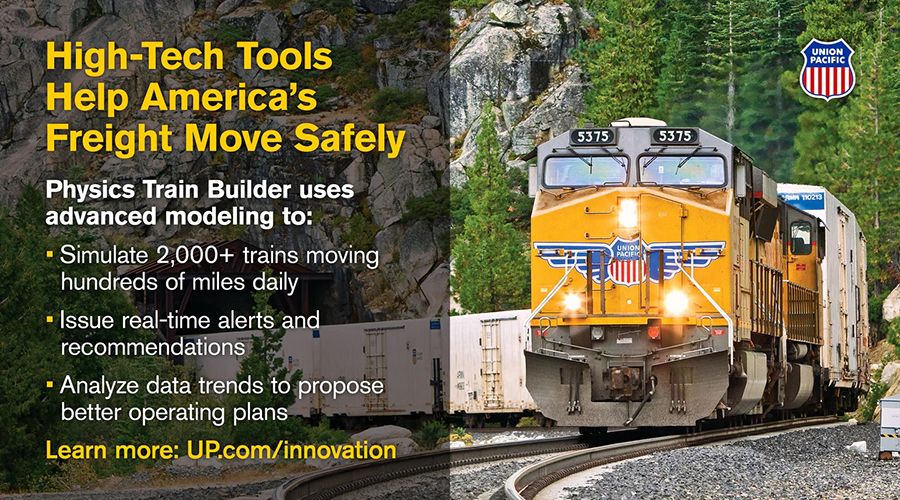 UP created a graphic to promote Physics Train Builder’s abilities and benefits. The tool can simulate more than 2,000 trains moving hundreds of miles in a given day.Union Pacific Railroad
Teams can work safer and smarter with PBT by using real-time modeling to adjust to changing business needs, traffic increases or route shifts, UP officials say. Locomotive engineer feedback can be paired with analytical insights to help ensure optimal train operations.
“PTB is extremely efficient; it takes only minutes to build and modify new scenarios,” Tysver said.
UP began using PBT in the second half of 2020. The Class I developed the software tool with its PS Technology Inc. subsidiary.
“From initial development through delivery of core functionality, PTB took approximately five years to complete and deploy to production. Since then, numerous minor changes and enhancements have been implemented, and we continually fine-tune and enhance this ... tool,” Tysver said.
Prior to employing PBT, UP used a vendor to help determine optimal train builds, but it typically took weeks to receive recommendations. Now, decisions are formulated and executed in house in a matter of minutes, meaning streamlined and faster processes and quicker corrective actions, UP officials say.
For example, root-cause analysis can be completed in about five minutes and predictive analysis can be finished in a day, boosting efficiency.
“In the past, if specific train builds needed to be addressed or modified, we would spend a week or a month creating and running simulations, or the proposed train would be run internally on a locomotive simulator with an engineer running the train,” Tysver said.
PTB initially was developed to run event recorder logs through locomotive simulators, helping to replay real-world events and better understand the in-train forces experienced during specific events, she said.
“Over time, the concept evolved into its current form, with the development of an internal train-handling algorithm to simulate how future trains would operate over their intended territory,” Tysver said.
Now, UP is continuously seeking ways to enhance and expand PTB’s functionality. Most recently, an automated dashboard was developed that generates event recorder logs based on engineer feedback.
That provides a more quantitative approach to analyzing the feedback, Tysver said.
“PBT is a great example of asking ourselves ‘what’s possible,’ and then developing a technology that enhances safety on the railroad,” she said.