AI's role in short-line operations a prominent topic at ASLRRA event
5/8/2026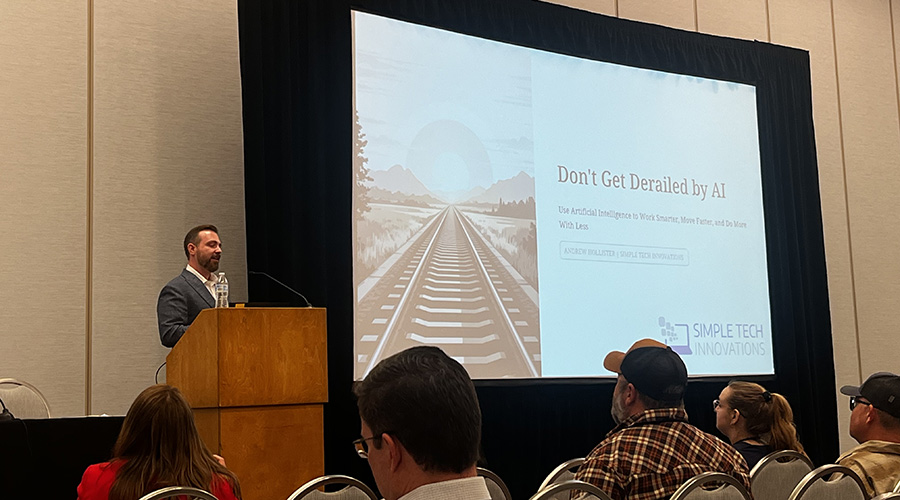
By Bridget Dean, Senior Associate Editor
Artificial intelligence (AI) and autonomous tech have been buzzing topics in the railroad industry for a number of years. And the use case for AI tools and systems in short-line operations is strong, according to a slate of presenters at the American Short Line and Regional Railroad Association’s annual conference and exhibition, which was held in Minneapolis on April 12-14.
Two breakout sessions covered the topic: One addressing AI for sustainability applications and the other reviewing how to incorporate AI into daily workflows at short lines. Speakers at both sessions highlighted how AI systems and tools can structure underutilized data to make information more easily accessible, improve workflows and make operations more efficient.
AI use cases for short lines Many AI tools in use today combine several types of AI systems, such as machine learning, deep learning, natural language processing, computer vision and generative AI — a well-known type of AI system used for programs such as ChatGPT and other “chat bot” or image generating systems, said Jason Smeak, vice president of global supply chain, logistics and industrial development at AECOM, who hosted the AI for sustainability session.
Railroads are already using AI systems for predictive maintenance, emissions measurement, energy management, regulatory compliance, environmental resilience, hazardous materials response and more, Smeak shared in a short introductory presentation. The session then pivoted to a slate of three panelists, who each presented their companies’ AI service offerings and demonstrated use cases for AI in short-line operations.
Dustin Bullard, CEO of Positive Train Control Services LLC, showcased one of his company’s products, the Locomotive Intuitive Support Assistant, or LISA4. The LISA platform is designed to reduce locomotive downtime by helping technicians troubleshoot failures, Bullard said.
The platform organizes technical knowledge from locomotive schematics, analyzes symptoms of failure, narrows down possible failure points and guides technicians toward the best next steps to find the root cause. LISA can reduce wasted time, unnecessary material usage and labor from trial-and-error approaches to maintenance, Bullard stressed.
“LISA models locomotive electrical systems and can predict how faults behave in real-world conditions,” he said, adding that the platform is not meant to replace expert technicians, but to make information accessible when no experts are available.
The second panelist, Simon Davidoff, an advisor with Beacon, shared how the company’s AI Traffic Management Center-React (TMC-React) platform has recently been implemented into the Georgia Department of Transportation’s incident response dispatch system. The TMC-React system, like LISA, helps people get the information they need quickly, without relying on outside support or needing to dig through hundreds of paper files or digital folders.
TMC-React ingests users’ internal data — including SOPs, contacts and construction documents — to create a searchable, chat-enabled database. Since every answer on the platform links back to source documents, users can trust the answers, Davidoff said. Although the system was built for state departments of transportation, the core technology could be implemented in short-line operations, he added.
 Dan Devoe from RailState (shown at lectern) was one of three panelists in the “AI for Sustainability” breakout session.Bridget Dean
Third panelist Dan Devoe, the director of marketing at RailState, pitched the company’s track-side imaging system as a tool for short lines to independently verify car movement, commodity trends and cargo interchanges — without relying on self-reporting from partner railroads.
RailState’s proprietary sensors are installed outside of railroad rights of way around the United States. They continuously gather the identifying information on rail cars and containers, speeds of trains and hazmat placard information, Devoe said.
That information is automatically uploaded to RailState’s Cloud, where computer vision and agentic AI systems categorize the data to derive train volumes, commodity flows, congestion points and other big-picture datasets. Users can access that data online within 30 minutes of a train being scanned, Devoe said. For short lines, that means timestamped verification of cargo flow without relying on data from multiple partners and railroads.
The three panelists’ AI system use cases are distinct, but each presentation hit on the same key point: Railroads frequently use data to drive decisions, and AI systems can make gathering and structuring that data much more efficient, leading to more sustainable operations.
Getting started with AI
The second AI session covered a range of use cases across short lines, with presentations from Simpletech Innovations, OmniTRAX Inc., Alaska Railroad Corp., and Wi-Tronix.
For example, Wi-Tronix's Violet platform enables short-line operators to “see, hear, feel and experience” what is occurring inside and outside the locomotive cab from miles away, said Lisa Matta, the company’s chief innovation officer. The system can detect phone usage in cabs, identify trespassing hot spots, verify radio calls and monitor operational data such as fuel and braking movements, added Ritu Chawla, Wi-Tronix's director for AI platform development.
OmniTRAX, too, uses AI technology on locomotives to compile data, said Leah Twombly, director enterprise services for the rail and real estate holding company, and AI has proven to be useful in the office for administrative work, added Beth Fleischer, who leads IT for Alaska Railroad. The short line had no AI policies until Fleischer learned there were employees using AI tools for work purposes with no guidelines, which is a security concern.
“If you think people aren’t using AI in your office, you’re wrong,” Fleischer said. “Learn what they’re doing and make sure they’re doing it right.”
Overall, there are many use cases for AI systems in the short-line industry, but for those new to the technology, there can be a steep learning curve. Andrew Hollister, CEO of SimpleTech, left session attendees with advice for getting started. Below are a few takeaways:
- Different AI tools work better for different tasks. Go beyond ChatGPT to find tools that are more versed in what you need. For coding, try Claude. For research, try NotebookLM.
- Your company might have AI policies in place already — know what they are before you begin using AI tools for work.
- If you aren’t paying for the product, you are the product. Large language models such as ChatGPT are trained on mass amounts of data, including any content you upload into it. If possible, subscribe to the AI tool of your choice and turn off data sharing and model training. Otherwise, private company information shared with the AI tool risks being regurgitated to the public.
- If AI tools aren’t working well for you, try using the paid version and learning better prompt structures.
- AI tools aren’t perfect, and important information should always be verified.