MxV Rail's international partnerships aim to advance rail research at home and abroad
1/22/2026
By Bridget Dean, Associate Editor
As a subsidiary of the Association of American Railroads, MxV Rail conducts rail research and testing to improve the safety, reliability and efficiency of domestic and global rail networks.
To that end, the organization in November 2025 signed two separate memorandums of understanding (MOUs) with rail research institutions in South Korea and India to share industry knowledge and conduct joint research.
MxV Rail inked agreements with Korea Railroad Research Institute (KRRI) and the Centre for Heavy Haul Rail Research and Development (CHHRR&D). Like MxV Rail, both the KRRI and CHHRR&D are government-funded rail research entities in South Korea and India, respectively.
The MOUs were signed while representatives from KRRI and CHHRR&D were in the United States for a rail research conference held Nov. 17-21, 2025, hosted by MxV Rail in Colorado Springs, Colorado. MxV Rail hosted the conference as part of its role on the boards of directors for the International Heavy Haul Association and the World Congress on Railway Research, combining both associations’ research conferences into one Rail Research Week.
The agreements had been in the works for months, says MxV Rail President and CEO Kari Gonzales. The organizations worked together to identify opportunities for collaboration and knowledge sharing that would benefit both partners. Gonzales plans to visit with leaders from both KRRI and CHHRR&D this year to schedule and further plan joint research.
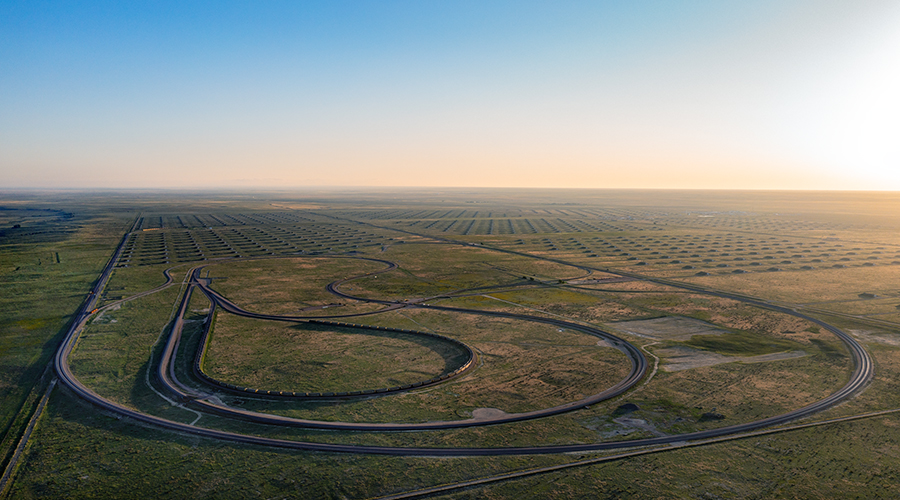 The Facility for Accelerated Service Testing (FAST®) Loop is a highlight of MxV Rail’s testing assets. It is located in MxV Rail’s PuebloPlex testing site in Colorado.MxV Rail
Collaboration with international research groups is a priority for MxV Rail, Gonzales says. It enables MxV Rail to exchange research results and share technology developments with other countries, which can speed up the process of implementing new findings for both parties, she adds.
Sharing testing capabilities and expertise
Among other things, the MOU with KRRI enables KRRI to test technology at MxV Rail’s PuebloPlex research and testing facilities in Pueblo, Colorado. One of MxV Rail’s testing assets, a 2.8-mile loop of track known as the Facility for Accelerated Service Testing (FAST®) Loop, is used to test technology, track elements and train components in a real-world operational environment. It allows for data collection in “rigorous and repeatable conditions,” says Gonzales.
In return, MxV Rail researchers will learn how KRRI’s evolving technology is used and how it performs. MxV Rail then can implement that technology into its own research and testing on behalf of the U.S. railroad industry. Despite the differences in track infrastructure and operating systems among railroads in partnering countries, research done in the United States can be adapted through simulations and modeling to suit the other countries’ needs, Gonzales says.
“Where we see similarities is in the underlying principles of safety, reliability, efficiency. Those are all universal,” she says. “We all have ballast, we all have ties and we all have fastening systems. ... At the component level, the basic engineering for rail is very similar.”
 MxV Rail President and CEO Kari GonzalesMxV Rail
The MOU with KRRI also established framework for future short-term personnel exchanges, in which a MxV Rail researcher would visit South Korea to get hands-on experience working with KRRI researchers, and vice versa. MxV Rail has conducted personnel exchanges through past MOUs; the experience builds stronger working relationships between the organizations and deepens participants’ understanding of other rail operating systems, Gonzales says.
Meanwhile, India’s advancements in machine vision inspection is an example of a country leveraging existing technology from its partners, says Gonzales, who visited India last year to meet with CHHRR&D members. The visit helped lead to the MOU. One of India’s goals is to have higher operational efficiency on the government-owned Dedicated Freight Corridors.
Because the North American market has been using machine vision inspection technology for more than a decade, the MOU enables CHHRR&D to leverage MxV Rail’s experience. MxV Rail will help with back-end testing to ensure India’s technology is ready for revenue service, Gonzales says.
MxV Rail will leverage these partnerships to help ensure the U.S. rail industry keeps up with technology advancements in other parts of the world. Adopting technology quickly and effectively ensures the United States and its research don’t just keep pace with evolving technology. but set standards in the global rail industry, says Gonzales.
“We’re not always looking just to advance our own capabilities,” she adds. “It’s really about how we’re contributing to the global rail ecosystem, because when that ecosystem is working well, it’s good for everybody.”