CSX applies autonomous technology to safety, efficiency projects
9/30/2025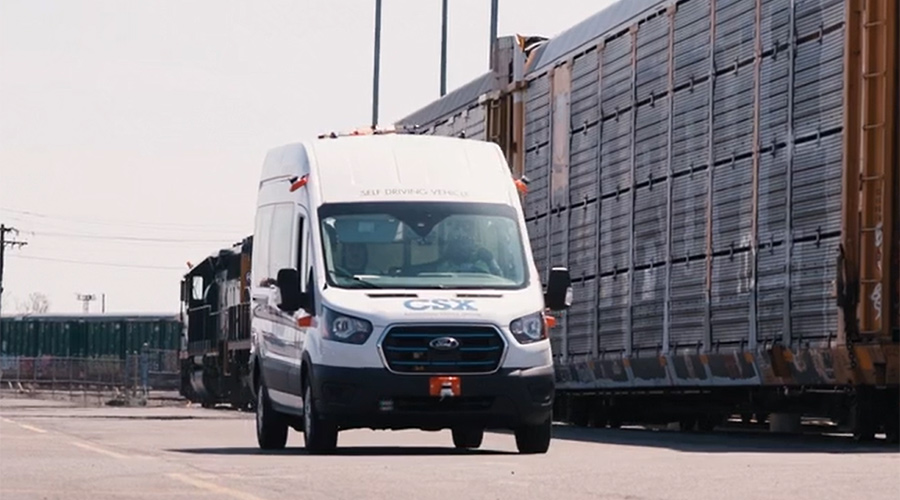
By Julie Sneider, Senior Editor
CSX subsidiary Total Distribution Services Inc. (TDSI) in June rolled out an autonomous electric van as part of a pilot project at the railroad’s auto terminal in Selkirk, New York. It’s among the latest examples of the Class I’s use of autonomous technology to improve operational efficiency and safety.
Since introducing shuttles in its auto terminals a few years ago, CSX and TDSI officials recently launched a pilot project at Selkirk involving COAST Autonomous. An AI, robotics and autonomous technology company, COAST provides the technology installed on the Ford E-Transit van.
 “The innovation team has done some amazing things this year.” — Bill Jacobs, CSX assistant vice president of innovation. CSX
Using a smartwatch, the unloading crew’s foreman at the Selkirk terminal pushes a button to call the autonomous van to pick up crew members and transport them to the location where automobiles are unloaded from autoracks, the specialized, multilevel rail cars that transport cars, small trucks and SUVs to the terminal. After the seven to nine members complete their work, the van returns to pick them up and transport them back.
The watch sends GPS coordinates to the van every 10 seconds, which the autonomous vehicle follows to operate to and from intended destinations within the terminal. Automating the shuttle service increases human productivity by allowing the crew members to focus on unloading the automobiles from the rail cars, CSX/TDSI officials say.
Since the shuttle is electric, it boosts CSX’s sustainability goals by eliminating a gas-powered vehicle.
“Our autonomous Ford E-Transit Van is transforming operations at the Selkirk yard by providing a safer, more reliable way to transport unloaders, while optimizing workflows and reducing environmental impact,” COAST President David Hickey said in a press release.
[subhed] A possibility for branching out
If the pilot project at Selkirk is successful, such technology might be deployed in other yards and terminals, says Bill Jacobs, CSX’s assistant vice president of innovation. The pilot will be evaluated based on safety and efficiency metrics.
The autonomous shuttle is part CSX/TDSI’s “Smart Autonomous Terminals” initiative, a broader effort to deploy technology to improve safety and efficiency. For example, CSX for several years has used autonomous gate technology to improve security, reliability and fluidity at terminals and speed up processing for truck drivers who arrive at a gate.
Jacobs is part of CSX’s dedicated team that studies and evaluates how autonomous technology, AI or other innovations can be applied to improve safety and efficiency across the organization.
The team solicits innovative ideas from employees across the company. Everyone has an opportunity to submit an idea for something that could be improved, Jacobs says.
“We have a significant portfolio of cutting-edge tools that we're developing for CSX and the automation space,” he says. “We're evaluating this technology that we're using at TDSI, [but] we do a lot of crew-hauling in our yards, as well. Could we use similar technology to improve the efficiency in our hump yards for instance? We think we can, so we have projects in place for that.”
[subhed] More innovations in the mix
Another example: CSX is deploying autonomous drones to inspect rail yards. The drones conduct inspections when rail traffic is moving through the yard, which removes the risk that a human inspector could be struck by moving equipment.
Yet another innovation — one that Jacobs says he’s most proud of — resulted in the development of a mobile collision safety system that’s now being installed on maintenance-of-way equipment. The system uses GPS, radar, lidar and cameras to enhance protection around heavy equipment; the system can determine within a “red zone” of risk if a person or object is in the way of moving equipment. If so, the system signals the vehicle or equipment to stop and avoid a collision.
“That’s the uniqueness of it over existing solutions, which simply sound an alarm,” says Jacobs. “And if you’ve ever been around maintenance-of-way equipment, it’s extremely loud and the people who are focused on doing their job might not hear the alarm.”
About 200 of the systems will be installed on equipment this year. Eventually, the systems will be installed on the entire MOW fleet, Jacobs says.
It’s the type of mobile safety system that the National Transportation Safety Board recently called for following its investigation of an August 2023 accident in Massachusetts in which a maintenance machine struck and killed a contracted rail roadway worker. Investigators found that the machine operator had no safety devices beyond a wide-angle mirror to look for hazards, according to the NTSB.
While CSX was not involved in the accident, it's the kind of tragic situation that the railroad hopes its mobile collision safety system will prevent in the future. The system is anticipated to be a game-changer for safety, according to CSX.
"The innovation team has done some amazing things this year,” says Jacobs. “But that one example really stands out to me because it makes things more efficient as well as creating a safer environment for everybody involved.”