G&W, Parallel Systems begin second round of autonomous vehicle tests
9/29/2025
By Jeff Stagl, Managing Editor
One down and six more to go. Genesee & Wyoming Inc. and Parallel Systems Inc. recently completed the first phase of testing of an autonomous battery-electric rail vehicle in Georgia and just launched the second phase.
Testing of the individually powered, self-navigating vehicles — which are designed to move containers to support short-haul and point-to-point rail movements — will involve a total of seven phases.
In August 2023, G&W’s Georgia Central Railway and Heart of Georgia Railroad petitioned the Federal Railroad Administration (FRA) to test Parallel System’s vehicle and associated computer and telemetry system. The goal: to demonstrate the technology in a field setting via protocols that ensure testing is performed in a safe and controlled manner.
In April 2025, the FRA granted 22 waivers to the short lines to move forward with seven test stages involving a prototype developed by Parallel Systems. The federal approval included about two dozen conditions that G&W, the short lines and Parallel Systems must comply with during the test program.
The prototype flat car is designed to carry one container about 500 miles on a single battery charge at speeds up to 25 mph and on grades as steep as 3% (a slope that rises or falls 3 feet). The vehicle features onboard cameras, sensors and software.
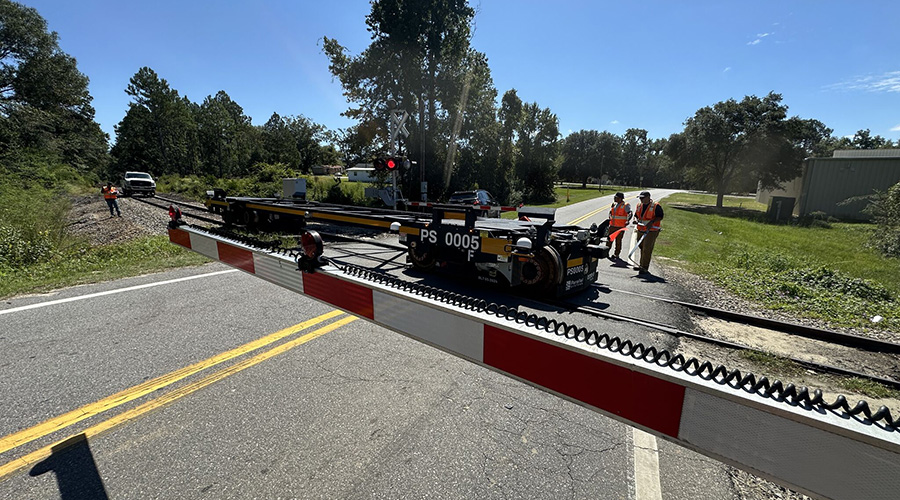 The prototype autonomous flat car is designed to carry one container about 500 miles on a single battery charge at speeds up to 25 mph and on grades as steep as 3% (a slope that rises or falls 3 feet). Parallel Systems Inc.
 Phase 1 testing — which lasted just less than a month — was performed on a two-mile section of track operated by the Heart of Georgia Railroad. The vehicle was operated over a total of 90 miles and passed all safety milestones, Parallel Systems officials said in a social media post.
“Tests were also performed for speed, automatic compliance with track warrant limits, slow order bulletins, concurrent warrant limits and Form A slow order bulletins,” they said. “In addition, the system’s communications links and monitors were verified to ensure proper connectivity and safety.”
The next phase of testing can begin because the federal government has green-lighted the results registered so far, said G&W spokesman Tom Ciuba in an email.
“The FRA needs to approve the start of each successive phase after a thorough review of the previous phase's results,” he said.
Phase 2 tests will be conducted on a 30-mile section of the Heart of Georgia’s track from Vidalia to just east of Helena, Georgia. The test region includes 43 grade crossings that will be protected by flaggers.
“Testing for Phase 2 is expected to last through the rest of September,” said Ciuba.
During this phase, G&W and Parallel Systems plan to evaluate system performance across different terrains, vegetation and weather conditions.
“Our specific test activities include speed and position accuracy, stopping distance, audible warnings for grade crossings and activation of grade crossing warning devices,” Parallel Systems officials said.
By the time testing reaches phases 6 and 7, the autonomous vehicle will operate over a 160-mile section of track operated both by the Heart of Georgia and Georgia Central railroads.
For Parallel Systems, the ultimate goal is to get railroads to adopt its autonomous rail vehicle as a way to augment trains. Up to 50 of the vehicles can be platooned to more efficiently use available rail network capacity, and the vehicle’s software can be integrated seamlessly with existing yard and mainline train-control systems, according to Parallel Systems.
The vehicle can boost railroads’ role in shorter-route transportation and help decongest the nation’s busiest highways, reduce shipping costs and lower emissions, Parallel Systems officials said.
The company plans to continue collaborating with G&W to initiate the commercial deployment of the vehicle. Parallel Systems anticipates launching initial commercial operations by 2026, pending test results and federal approval.