NS adds a wheel-detection system to its safety-enhancing technologies arsenal
2/17/2026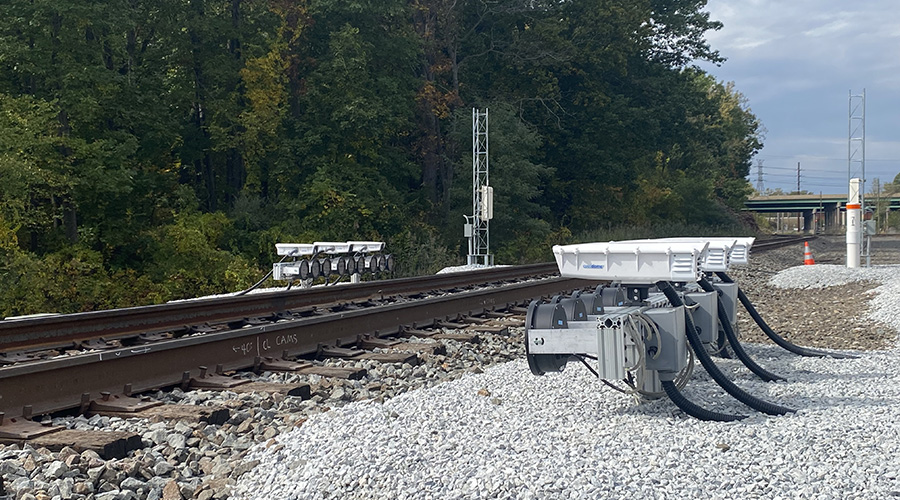
By Jeff Stagl, Managing Editor
For Norfolk Southern Railway, 2025 stands out as its best year in more than a decade for a low accident rate. The Class I’s Federal Railroad Administration-reportable train accident rate — or total number of reportable accidents per million train miles — fell to 2.19 last year versus 3.19 in 2024, 4.04 in 2023 and 4.50 in 2022.
In addition, NS’ FRA personal injury index in 2025 declined to 1.00 compared with 1.18 in 2024 and 1.09 in 2023. The index calculates the number of reportable injuries/illnesses per 200,000 hours worked in a given year.
NS is making safety improvement strides by employing more technologies. For example, the railroad now is leveraging digital twin technology designed to strengthen operational performance by creating continuously updated virtual replicas of locomotives and track infrastructure powered by real-time data. The technology integrates Internet of Things sensors, historical performance trends, artificial intelligence (AI) and predictive analytics to help simulate freight flows and yard activity, anticipate bottlenecks, improve scheduling and enhance network fluidity.
NS also recently began employing an Automated Track Geometry Measurement System that uses locomotives to continuously scan and evaluate track conditions in real time. The system operates autonomously and under load to perform inspections while trains are in motion, helping to increase inspection frequency without adding extra equipment or disrupting operations.
The Class I now is digitally inspecting 78% of its traffic with digital train inspection (DTI) and automated track inspection systems.
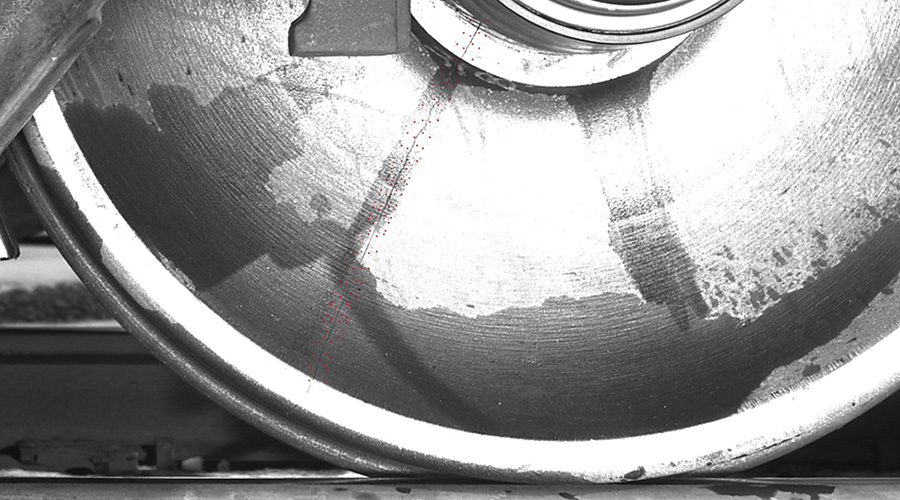 Shown: The initial system launched in Burns Harbor pinpointed a critical casting flaw on a wheel set that was supplied by an external vendor.Norfolk Southern Railway
In keeping with its safety-driven technological pursuits, NS late last year implemented yet another promising innovation: a wheel integrity system. It combines AI with hands-on expertise to identify wheel defects before they become major issues.
The system features six synchronized cameras that can capture about 55 high-resolution images per wheel at train speeds up to 70 mph. AI algorithms analyze images to identify subtle defects that are difficult for the human eye to identify consistently, according to NS.
Wheel defects are among the most serious mechanical defects in the rail industry. The system will enable workers to address wheel maintenance needs promptly while enhancing safety, reducing service disruptions and protecting long-term asset performance, said NS spokesman Chad Previch in an email.
NS is the first railroad to deploy a vision-based system designed to identify cracks in wheels before the break, according to the Class I. The system’s AI algorithms were developed by NS’ in-house data science/AI team, said Previch.
“Collaboration across multiple teams, including operations and digital & technology, brought the technology to life,” he said. “The Georgia Tech Research Institute assisted in the image capture trigger timing and processing.”
 NS is the first railroad to deploy a vision-based system designed to identify cracks in wheels before they break, according to the Class I.Norfolk Southern Railway
Design work on the wheel integrity system began in February 2025 and NS deployed the first one Nov. 24 in Burns Harbor, Indiana, near Chicago. The initial system enables the railroad to inspect cars entering and leaving its network in a busy area.
“We began testing the system a few months before it launched in November. We wanted to make sure the new system was weather-ready and that the cameras were best positioned to capture all angles of a train car’s wheels,” said Previch. “It was imperative that the system would catch cracks before they break.”
And it already has. Soon after it was deployed, the system in Burns Harbor pinpointed a critical casting flaw on a wheel set supplied by an external vendor. The cracked wheel was confirmed by NS teams and the associated car was removed from service.
“Coupled with our relentless root-cause investigation, the technology initiated an industry recall and the confirmation of seven confirmed defects across North America,” NS officials say.
The wheel integrity system so far has built on the success of NS’ DTI portals that over the past year have identified and removed from service over 50 wheels with various issues. Unlike the portals, which scan entire trains, the wheel integrity system zeroes in on wheels to capture ultra-high-resolution images from critical angles to identify cracks.
NS expects to install more wheel integrity systems around its network in 2026.
“The Burns Harbor wheel integrity system has been very successful, so we plan to roll out several more this year,” said Previch. “We are finalizing those plans.”