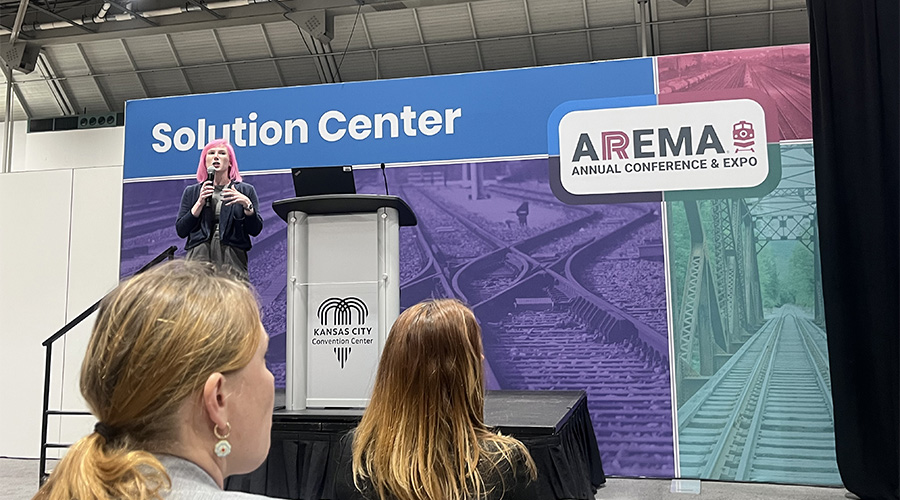
Gonzales provides updates on MxV Rail's progress in advancing rail
7/25/2025
By Julie Sneider, Senior Editor
MxV Rail President and CEO Kari Gonzales was hopeful that her organization — the rail industry’s research, testing and training center — would conduct as many as 30 experiments in its first season at its new multicampus facility in Pueblo, Colorado.
But in reality, MxV Rail researchers and staff produced as many as 50 experiments that ultimately could lead to innovations that will improve rail operations and safety.
A subsidiary of the Association of American Railroads (AAR) and formerly known as the Technology Training Center, MxV Rail relocated to its newly built multicampus facilities in late fall 2022. The center’s team consists of over 250 rail experts, including a support team of professionals that support more than 110 mechanical, civil, industrial and electrical engineers and metallurgists that lead MxV Rail’s scientific research.
“We really are the cornerstone research and innovation in the industry, and we are recognized as the people who are providing an extensive look at impactful research,” Gonzales said during an interview with RailPrime to provide an update on the center’s latest progress.
While MxV Rail experts pursue cutting-edge research and technology breakthroughs, they also focus on work that will help advance the fundamentals of rail technology, Gonzales says.
A look at weld performance
A key example is MxV Rail’s recent weld performance study, where scientists investigated the reason for a significant number of weld failures in the rail used to build the center’s Facility for Accelerated Service Testing (FAST) Loop. Designed and built in 2023, the 2.8-mile track is used to test freight-rail equipment, components and systems.
After the loop opened for experiments and various test runs in 2024, dozens of weld failures were detected in the rail. Even more weld failures were detected during the loop’s second season of operation this year.
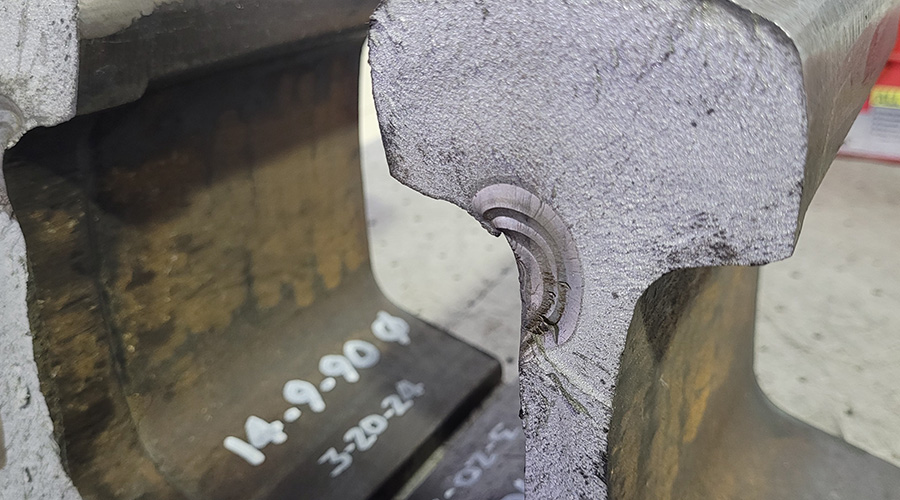 MxV Rail experts found that more careful grinding practices can help prevent weld failures. MxV Rail
After reviewing a considerable amount of data compiled during both seasons of the FAST Loop’s operation, MxV scientists found that a lack of post-weld grinding to remove stress risers was a major reason for failures in electric flash butt welds, while thermite weld failures were mostly due to the lack of enough heat used during the thermite process.
“What we found is that the pre- and post-grinding is essential to longevity of the electric flash butt welds,” Gonzales explains.
Since identification stamping on rail causes stress risers, MxV Rail now recommends that crews take care to grind those stress risers out before starting the welding process; then after the weld, examine that same running surface to make sure there are no additional points of stress.
“These are simple fixes to a problem, which we love because we can put this very important information in the hands of the people in the field and they can make a make a difference today,” Gonzales says.
The weld performance study is an example of how data collected during MxV Rail’s research and other experiments conducted at the site can be used to help the rail industry quickly address real-world problems.
“Our work here is where innovation becomes reality. We’re testing, validating and getting [rail technology] ready for deployment, which also spurs innovation in the industry,” she says, noting that a lot of that innovation exploration is directed by the railroads.
Weld failures have been around for a long time. But when examined in a different way, “some of these old issues are turning into new solutions that will reduce disruptions in the rail network, ultimately helping us get to that zero-derailment future that everyone is striving for,” Gonzales adds.
Another innovation MxV Rail experts worked on over the past year is a project that applied artificial intelligence and edge computing to ultrasonic testing (UT). The goal was to improve the real-time speed and accuracy of internal flaw detection in rail, wheels, axles and other components.
“[Reliability and speed] were the two key things that we were really trying to solve in developing this new AI application for the UT scan,” says Gonzales. “So, what this project has essentially done is take a bigger swath of data using a very robust computing system to be able to make better decisions faster.”
Expanded training for first responders
In another development over the past year, MxV Rail has expanded its training at the Security and Emergency Response Training Center (SERTC) in Pueblo, which provides full-scale training in surface transportation emergency preparedness and response. A division of MxV Rail, the center has trained over 75,000 first-responder professionals since 1985.
Last year, MxV Rail successfully implemented and piloted a program that covers interaction with incidents involving vehicles that operate on alternative fuels or electric batteries. In working with the National Domestic Preparedness Consortium and the Federal Emergency Management Agency, the MxV Rail team identified nationwide gap in training for such events and the impacts they could have on local communities, Gonzales says.
 The Security and Emergency Response Training Center (SERTC) in Pueblo, Colorado, recently expanded its first-responder training to include incidents involving alternative fuels, crude oil and batteries. MxV Rail, SERTC
As a result, SERTC expanded its flammable liquids emergency response education to include the Alternative Fuels and Flammable Incident Response and Management course, designed to prepare responders for all types of flammable commodity emergencies, from crude to batteries, according to a course description.
“So, in the event there’s a tank car incident involving hazardous materials, this addresses how the [local] first responders are going to safely approach it, evaluate it and mitigate the impacts of that incident,” Gonzales explains.
Looking ahead, MxV Rail’s research, testing, programming and training will continue to be directed by the rail industry’s needs, Gonzales says. At any given time, there are 16 different high-level projects going on at MxV Rail’s campuses, with a lot of sub-projects underway beyond those.
“If you look at the railroads’ investments and investment strategies, they're not just focused on today. They're looking for long-term solutions,” Gonzales says. “Through some of this consistent strategic, private investment — not only in the physical pieces of the railroad but also in the technology space — we're able to modernize the overall infrastructure, which is going to strengthen supply-chain resilience.”
On the horizon, Gonzales sees MxV Rail leveraging existing investments in today’s technology — such as in UT scanning — in ways that help railroaders make better decisions to improve safety, reliability and efficiency. That includes creating technological tools to help individual railroaders improve their decision-making, performance and safety.
One big question that remains is how quickly some of these inventions can get into the hands of railroaders when government regulations often lag the industry’s new-tech developments. By the time regulators greenlight a new way of doing things — such as track inspections — the rapid pace of technology may have moved on to something new.
For example, the AAR has a waiver application before the Federal Railroad Administration to allow railroads to supplement in-person track inspection with automated track inspection technology. According to the industry, more flaws can be detected faster and more accurately using ATI than human inspectors alone.
Gonzales acknowledges the conundrum.
“Certainly, there is a desire for swifter implementation, particularly when we have the data to support safe deployment of these technologies,” she says. “Part of the problem is that people don't always understand the community impact when you're implementing these new technology drivers and that, ultimately, [the technology] is going to be better for the community.”
Railroads aren’t in a position to apply new technology without it being thoroughly tested — and that’s where MxV Rail comes in.
“We understand what the challenges are, and 99% of the time those are going to be mitigated before [the new technology] ever gets deployed in a revenue service environment,” Gonzales says.