Baltimore port eyes volume growth from expanded grain, intermodal capacity
10/1/2026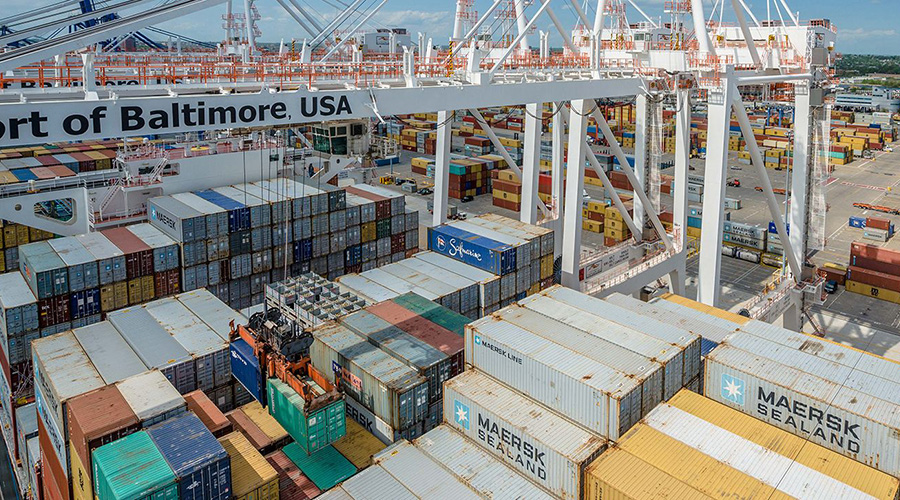
By Jeff Stagl, Managing Editor
In 2025, the Port of Baltimore handled 50 million tons of cargo, the second-highest annual total in its history, which stretches all the way back to 1706. The volume exceeded 2024’s 45.9 million tons and trailed only the record of 52.3 million tons set in 2023.
The port last year handled a lot of autos, farm and construction machinery, forest products, breakbulk freight, coal, aluminum, gypsum, salt and sugar. A high number of containers — in fact, a record number — stacked up on its docks, too.
The port registered 1,113,309 20-foot equivalent units (TEUs) at its Seagirt Marine Terminal, breaking the previous annual container record set in 2023 by more than 5,000.
With 2026 now in its final quarter, port leaders expect to set an even higher container-volume mark this year because of the expansion and modernization of CSX’s nearby Howard Street Tunnel, a multiyear project that was completed in June. Plus, an expansion of the intermodal container transfer facility (ICTF) at the Seagirt Marine Terminal — which is set to reach the construction stage this month — bodes well for future container-volume growth.
On top of that, the port’s annual grain volume is pegged to head upwards because of a grain transloading facility that opened in September. The facility is designed to make it easier for Maryland farmers to export their soybeans, corn, wheat and other grains to Europe, Asia and South America.
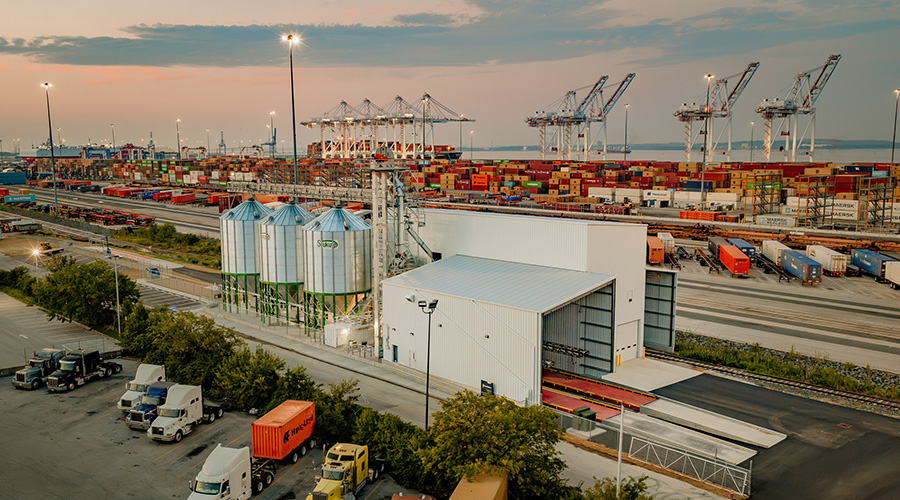 Opened in September, a new grain transload facility features three grain silos with a combined storage capacity of 60,000 bushels. The facility is served by the Canton Railroad, which interchanges with CSX and NS.GroffJulius Design Build
Located 150 miles farther inland than any other East Coast port and open since 1990, the Seagirt Marine Terminal is operated by Ports America Chesapeake under a 50-year public-private partnership agreement signed in 2010 with the Maryland Port Administration.
The ICTF is a 68-acre on-dock rail facility served by CSX that features four loading tracks, four storage tracks and one run-around track. It’s designed to handle up to 150,000 lifts annually.
Under a $42 million project, track will be realigned and other work will be performed at the ICTF to better accommodate double-stack container traffic coming through the Howard Street Tunnel, says Ports America Chesapeake President and CEO Mark Schmidt.
“Before, the ICTF handled mostly domestic intermodal traffic with CSX. Now, we will bolt on international boxes there,” he says.
The project calls for constructing five new working tracks totaling about 23,290 track feet and establishing infrastructure to support new electrified rubber-tired gantry cranes. It's designed to support increased cargo demand at the terminal; upgrade the ICTF’s aging rail infrastructure to achieve a higher level of safety; promote energy efficiency with electric rather than diesel equipment; and reduce emissions by trimming the number of trucks on roads.
The project will triple the ICTF’s annual lift capacity, from 60,000 or 70,000 to 160,000 or more lifts, Schmidt says. Construction is expected to begin in October and take about 18 months to complete.
“We could not have done this project if CSX hadn’t expanded the Howard Street Tunnel for double-stack trains,” says Schmidt.
Through a more than $500 million project, CSX modernized and raised the ceiling clearance in the 130-year-old tunnel, and completed double-stack clearance adjustments at 22 points between Baltimore and Philadelphia.
Meanwhile, the new grain transloading facility is accepting loads from various farms and transferring the grain products into silos. The grain then is loaded into containers, which are placed on ships.
The facility features three grain silos with a combined storage capacity of 60,000 bushels and can load more than 200 containers per week. It handles such export products as soybeans, corn and wheat. The facility eliminated the previous need to load containers offsite, helping to streamline export connections to Europe, Asia and South America.
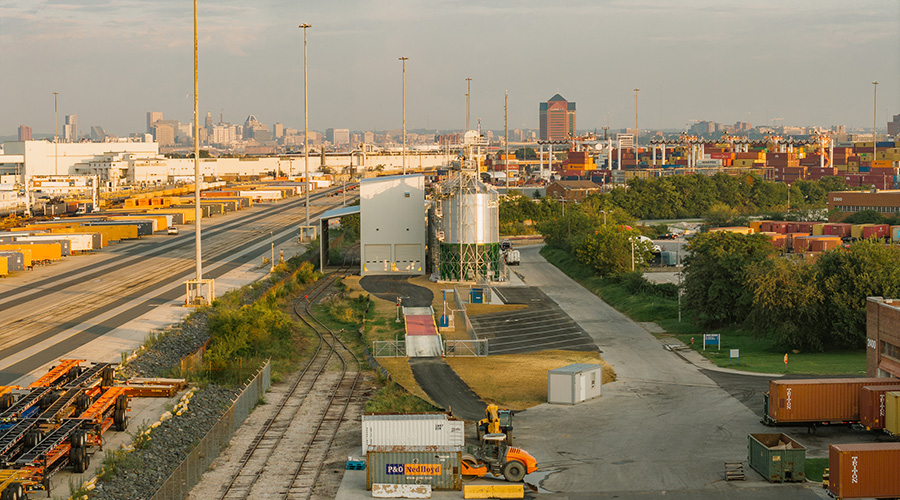 The grain transload facility handles such export products as soybeans, corn and wheat.GroffJulius Design Build
The transload facility is served by the Canton Railroad Co., which interchanges with CSX and Norfolk Southern Railway.
“With the short line, we can be agnostic with how cars come in, either by CSX or NS,” says Schmidt.
However, grain now primarily is trucked to the facility. Shipments by rail will start in October or November, says Schmidt.
“At first, rail movements will be intermittent based on demand by local farms. We will build up rail over time,” he says. “Over the long term in one to two years, rail traffic will pick up.”
Discussions about establishing a grain transloading facility began about seven years ago.
“We were import-heavy with grain at the port,” says Schmidt.
The port and Ports America Chesapeake partnered with others to develop the project and increase grain exports. Plans for the facility firmed up about two years ago, Schmidt says. After that, the project didn’t hit many snags through completion.
“It was pretty seamless getting everything lined up and built,” says Schmidt.