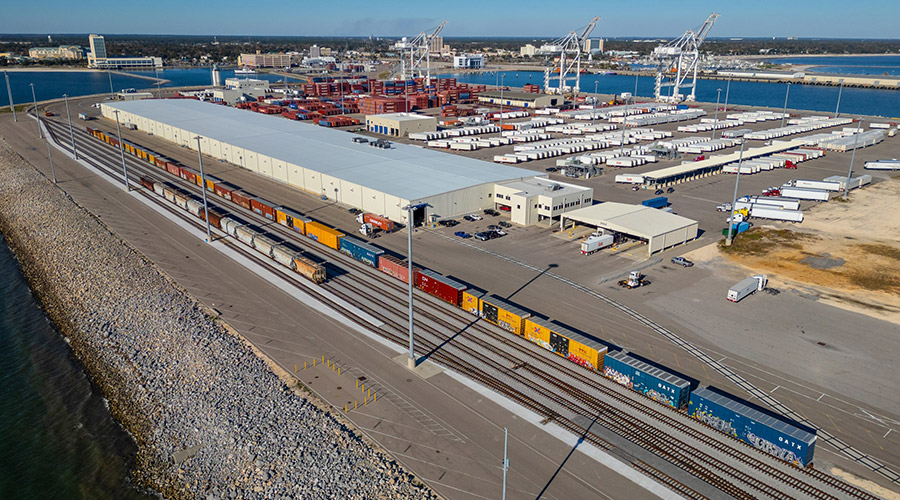
Alameda Corridor cranks up revenue as LA ports pump up volume
10/22/2026
By Jeff Stagl, Managing Editor
Since it opened in 2002, the Alameda Corridor has been a vital freight-rail conduit for intermodal traffic moving from the major ports in Los Angeles and Long Beach, California, to large consumer markets throughout the nation.
The 20-mile, grade-separated line connects the ports to the transcontinental rail network near downtown L.A. Mostly located in a below-grade trench under Alameda Street, the corridor eliminated more than 200 grade crossings in the area to reduce roadway delays and improve safety. The corridor was developed and is managed by the Alameda Corridor Transportation Authority (ACTA), a joint powers authority formed by the cities of LA and Long Beach.
BNSF Railway and Union Pacific Railroad heavily use the corridor, which accommodates about 32 trains carrying 16,800 containers each day. Dispatching and local services are supported by the Alameda Belt Line.
For much of 2026, the corridor has generated a healthy amount of revenue. The impetus for that is the ports, which are handling record container volumes. For example, both ports in September set new monthly volume highs.
On a record pace with revenue
Following a record $134 million and $139 million in annual revenue logged in 2024 and 2025, respectively, ACTA is on pace to surpass those marks in 2026. Through August, the authority already had registered $98.5 million in revenue this year, including a record $13.7 million in July and $13.6 million in August.
ACTA tracks the corridor’s performance by revenue instead of volume because volume includes mixed loads, empties and non-container traffic. The authority collects operating revenue to service general bond obligations totaling more than $2 billion.
The record-setting revenue performance is more evidence of strong freight and intermodal activity thus far in 2026, particularly at the nation’s busiest port complex, authority officials say.
“This growth reflects the strengths of the ports, the efficiency of rail transportation, strategic port capacity planning and capital investments, including the Alameda Corridor, and the resilience of the global economy,” ACTA officials said in an email.
 Each day, the corridor averages about 32 trains carrying 16,800 containers. Trains travel up to 40 mph through the corridor, reducing port-to-rail yard transit times from several hours to about 45 minutes.Alameda Corridor Transportation Authority
Both ports have reached 20 million 20-foot equivalent units the past several years, and both expect to hit that mark again in 2026, says ACTA CEO Michael Leue.
“The ports are performing well, which bodes well for the corridor,” he says.
From the bad times to the good
But the current revenue-growth trajectory hasn’t been that long running. Leue joined the authority as CEO in March 2020, when the pandemic began to create a global economic and health crisis. ACTA’s revenue had just gone through a growth period after supply chain and economic woes hampered performance for several years beginning in 2009. Then COVID drove down revenue for a few years.
“It was so tumultuous. Changes in the logistics industry and shipping put ports off their game a bit, but the last three years have been strong years at the ports,” says Leue.
He relied more heavily on his 35 years of leadership and rail industry experience in railroad engineering, maintenance and operations, planning and environmental quality to help turn things around. Leue’s technical experience includes leading engineering designs for 15 intermodal facilities, including terminals featuring wide-span gantry cranes at the ports of LA and Long Beach, and for BNSF and UP. His mainline rail design experience includes new construction and maintenance projects for ACTA, BNSF, UP, Metrolink, the Orange County Transportation Authority and San Diego Association of Governments.
ACTA oversees the corridor’s operations, maintenance, safety, security and financial management, and works with public- and private-sector partners to strengthen freight mobility.
 A below-ground, mid-corridor trench is 10 miles long, 33 feet deep and 50 feet wide. It features three tracks that enable trains to bypass surface streets.Alameda Corridor Transportation Authority
The corridor’s infrastructure is in good shape and the authority aims to keep it in a state of good repair, says Leue. For example, rail and infrastructure is inspected twice a week.
“We look for signs of wear and then rely on grinding or cleaning or replacement as a fix,” he says, adding that a focus on accounting and infrastructure maintenance is key for the corridor.
The corridor was designed to accommodate the ports’ volume growth for a long time.
“We looked out 50 years when we built the trench. There isn’t really an opportunity to go back and change it, so we made sure it was practicable,” says Leue.
ACTA officials believe the potential is significant for an increasing reliance on rail — particularly to move international containers — as the logistics and shipping industries seek more efficient freight solutions. The ports expect to double volume over the next 20-plus years.
So, it’ll take a continuing joint effort among the ports, railroads and other partners to ensure the corridor can handle that growth, says Leue.
“We have always had good coordination with the railroads and good, productive relationships with all the partners,” he says. “The railroads are more engaged with us as volumes grow.”