New depot reinforces Port of Little Rock Railroad's central role in port operations
7/10/2026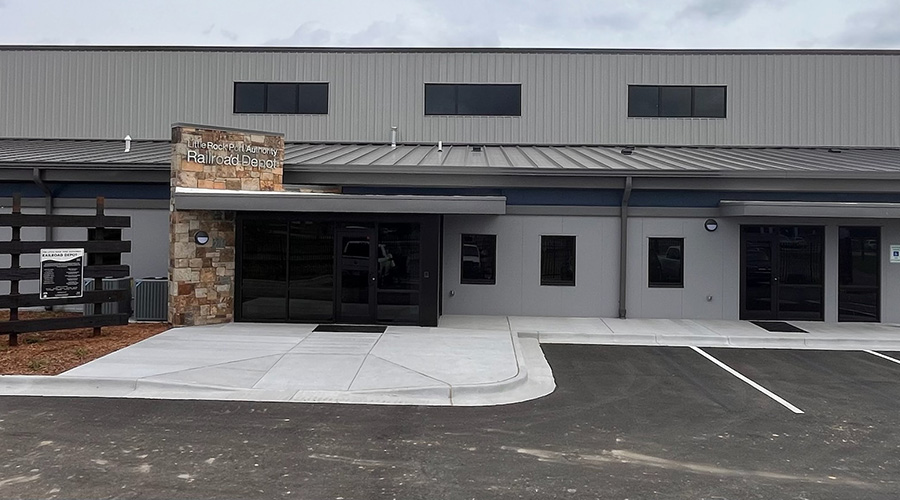
By Bridget Dean, Senior Associate Editor
The June 3 grand opening of a rail depot at the Port of Little Rock, Arkansas, marked the completion of a project that had been in the works for more than a decade. Designed to improve working conditions for rail employees, the facility positions the city-owned port for more business opportunities.
With three docks on the New Orleans River, access to Interstates 40 and 30, and dual rail service from Union Pacific Railroad and BNSF Railway, the inland port offers prime connectivity and optionality for shippers. The port authority operates the Port of Little Rock Railroad (LRRR) and a 500-acre industrial park with 53 tenants and shovel-ready greenfield space.
“The railroad at the port truly is the heart of our business,” says Little Rock Port Authority (LRPA) Executive Director Bryan Day. “People locate here because of the efficiencies and the success of the railroad.”
When Day joined LRPA in 2014, the railroad’s crew — then five, now nine — was operating out of a bare-bones metal shed. It didn’t have storage space for the port’s locomotives, crew facilities or any meeting spaces.
For the port to best serve its customers and support its rail crew, Day recognized it was time for a better rail facility. The authority purchased a mobile office building for the rail crew to work out of in the short term while it reviewed financing options for a permanent replacement. Rail infrastructure is expensive; it would take a long time to save enough revenue to self-fund the project, Day says.
Instead, the LRPA submitted an application in 2021 for a federal Consolidated Rail Infrastructure and Safety Improvements (CRISI) grant. Although a fiscal-year 2021 CRISI grant of up to $5.6 million for construction of a new depot and related track extensions was awarded in 2022, construction on the depot didn’t start until 2025.
The construction industry was still facing supply chain disruptions and labor shortages as a result of the COVID-19 pandemic, and material costs had increased in the time since the port authority had written the original grant application. Meanwhile, federal grant funding comes with regulatory hurdles to clear, Day says.
For example, the authority needed to meet Buy American Act standards for material procurement and ensure contractors were operating in accordance with the Davis-Bacon and Related Acts, which require contractors and subcontractors performing work under certain federally funded or assisted contracts to meet specific wage requirements.
“[The challenge] is the administrative paperwork. It’s the length of time it takes to implement some of the requirements,” Day says.
There’s also the matter of environmental and archaeological testing that must be completed before groundbreaking, which can further prolong project work.
Not that Day’s complaining: Federal funding is necessary for large-scale projects like the new rail depot, he says. LRPA has received over $50 million in competitive grant funding over the last seven years for different infrastructure projects, including roadways, traffic signals, rail improvements, the new rail depot and a new river dock.
When pursuing the grant funding, the port also relied on the support of its industrial park community of businesses, who all benefit from the new rail depot, Day says. The port authority held meetings with its rail users and park tenants to ask for support letters to the granting agency, project feedback and design input.
Now, LRRR offers a large multipurpose rail facility. It features indoor storage for all three of the railroad’s locomotives, an engine servicing space and a workroom for tool storage, a dedicated training room, and bunk, bathroom and shower facilities for the rail crew. A meeting room enables the port authority to host shippers, rail partner representatives and prospective customers.
There’s room to grow, too; about 600 to 700 square feet of interior space is set aside for future needs. Land around the building could support an expansion, if needed.
The new depot is already improving the safety, efficiency and effectiveness of rail operations, as well as making the port’s industrial park a more competitive spot for businesses to set up shop.
“The port is growing; our rail business is growing,” says Day. “It’s really just something we’re able to hang our hat on and feel good about, because rail is so important to what we do.”