BNSF opens Flight Operations Center to boost drone performance
12/5/2025
By Julie Sneider, Senior Editor
Technology advancements over the past decade have resulted in drones becoming a more effective tool for railroads to use across their entire network. As a result, BNSF Railway recently opened its new Flight Operations Center, where pilots can launch, operate and keep track of beyond-the-line-of-sight (BVLOS) drone flights.
Opened about three months ago in Fort Worth, Texas, the state-of-the-art center enables pilots to remain in a controlled environment while remotely flying drones to conduct tasks anywhere on the BNSF network. BNSF uses drones capable of autonomous and semi-autonomous flights.
The Flight Operations Center is the latest development in BNSF’s now 10-year-old drone operations program. There, BNSF has about 30 drones that are set up to be piloted remotely. Network-wide, BNSF maintains a fleet of about 200 drones that are operated by BNSF-employed pilots.
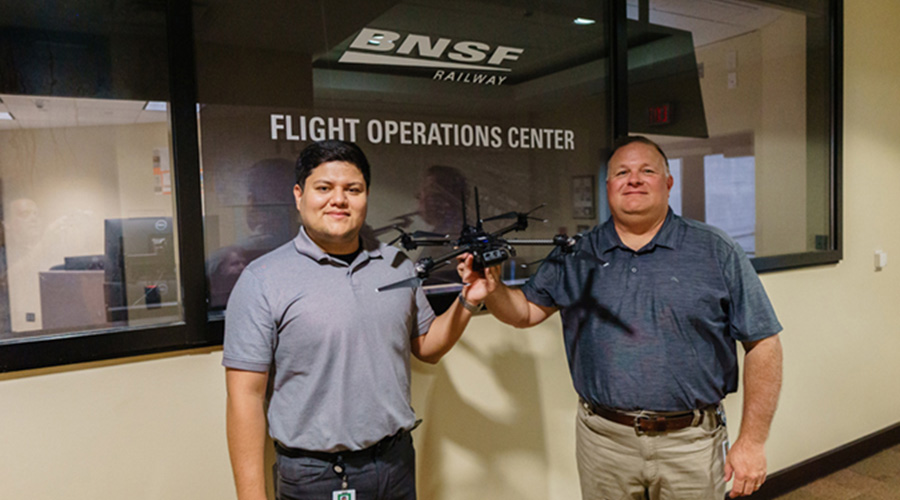 BNSF Technology Services Manager Michael Ibanez (left) and Technology Services Director John Martin (right).BNSF Railway
BNSF first began using drones in 2015 in New Mexico, says Technology Services Manager Michael Ibanez, who oversees BNSF drone operations.
“We performed the first commercial BVLOS flights in New Mexico because we believed we could utilize the drones to find defects in track,” he says. “We then extended our operation through New Mexico, Arizona and Montana because we were also testing how this technology could perform in snowy conditions, in the cold and in other weather conditions.”
But after achieving limited success, the BNSF team determined the technology wasn’t yet ready for drone use in track inspection.
“Early on, flying a drone was a chore,” says BNSF Technology Services Director John Martin. “You had to set up the drone and perform inspections and maintenance after almost every flight. And it was a struggle where the drone wouldn’t necessarily act the way we thought it would. We worked with the manufacturers to address all sorts of problems.”
But by 2019, flying a drone became significantly easier, which enabled BNSF to expand their use across the company so that people who weren’t strictly drone-operating pilots could use the technology for specified purposes.
Now, most BNSF departments have some level of drone usage, Ibanez says. Engineering uses them for bridge inspections; telecommunications use them for tower inspections; and environmental uses them to create maps around track to monitor encroachment. Drones also are used in vegetation management to ensure trees and shrubs aren’t growing on or over the right of way.
Once the drones became more reliable and easier to use, the next step was the launch of drone-in-a-box technology, in which an autonomous drone is charged, deployed from and returned to its docking station.
In 2022-23, BNSF began exploring drone-in-box technology to conduct inventory checks in intermodal yards. Starting with the railroad’s Alliance Yard near Fort Worth, the drone was programmed on a schedule to automatically lift off, inventory all the containers in the yard and update the railroad’s inventory databases.
Still, the drones are not fully automated remotely due to Federal Aviation Administration (FAA) regulations. That’s where the pilots come in: They initiate the mission and monitor the drone’s activity, but don’t actively control it as it flies the mission. If something goes amiss in the air space, the pilot can take steps to mitigate the problem, according to Ibanez.
Using the drones remotely to monitor inventory in the Alliance Yard was working, so in 2023 the effort was expanded to the Hobart Yard in Los Angeles, BNSF’s busiest intermodal yard.
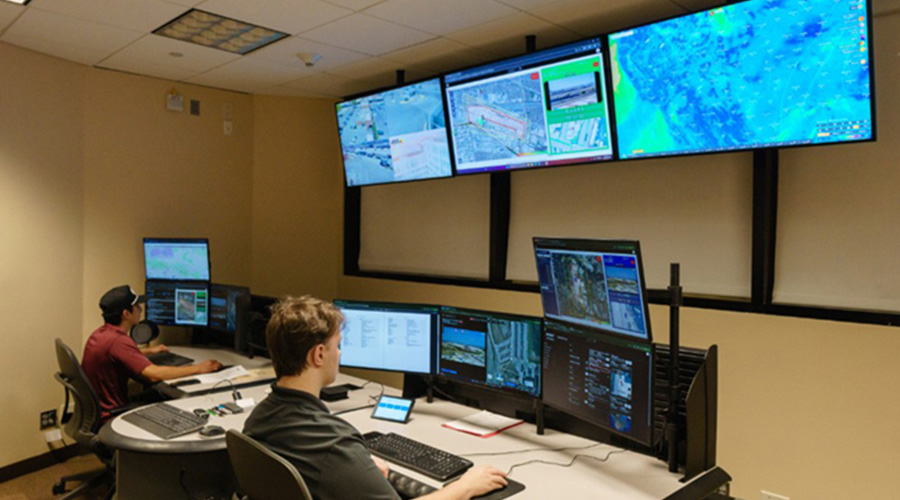 A view inside the BNSF Flight Operations Center.BNSF Railway
Increasingly, drones are collecting all types of data about intermodal yard operations, such as monitoring when containers arrive, where they’re located and when they depart.
Additionally, BNSF uses its own patented technology in the intermodal yards so the railroad knows where each customer’s container is at all times, according to Martin. The technology has helped reduce dwell time in the terminals.
The expanded use of autonomous and remotely operated drones prompted the need for the Flight Operations Center, says Martin.
The FAA requires BVLOS drone pilots to operate from a quiet space with controlled access in order to avoid distractions. Inside the center, everything is designed to ensure safe drone operations. Only authorized personnel may enter, and strict rules govern critical moments during flight such as takeoff and landing. During those periods, pilots are not allowed to eat, drink or talk so that they can focus their full attention on the aircraft, according to a Nov. 6 BNSF “Rail Talk” article.
The opportunities for drone usage will continue to increase, Martin says.
“More of our intermodal hubs be equipped with drones in the future,” he says. “And that’s some of what our Flight Operations Center was also preparing us for: that we have the proper facility and work environment to support expansion of those capabilities system-wide.”
Additionally, the FAA has proposed a rule that would allow expansion of remote drone operations, which could mean bigger drones that can cover more territory, Ibanez says.
“As this new FAA regulation becomes law and manufacturers start working on new drones that fall under that regulation, we will be evaluating the new technology to see how we can use drones in [ways] that we’re not using them today,” he says.