Speakers touch on hot intermodal topics at IANA expo
9/23/2026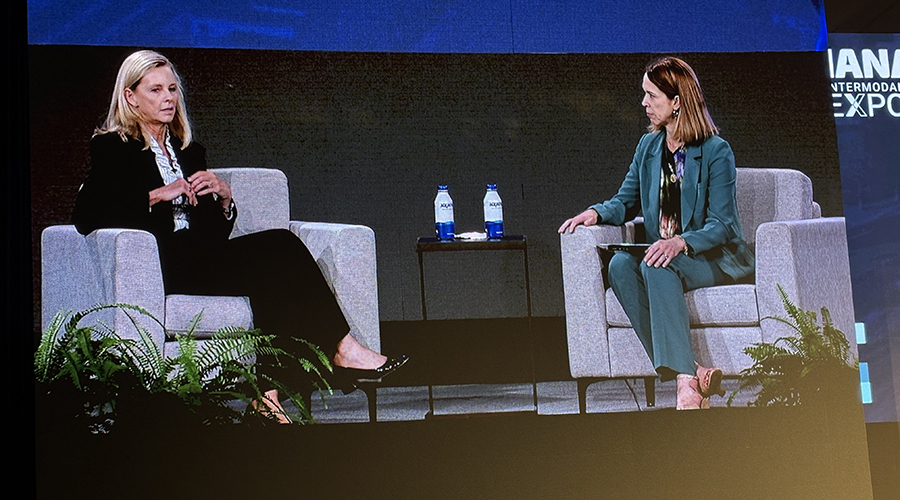
By Jeff Stagl, Managing Editor
At the Intermodal Association of North America’s (IANA) annual expo in Long Beach, California, held Sept. 14-16, there was a lot of intriguing commentary shared by various keynoters, presenters and panelists.
Intermodal volume is in a significant growth period despite a number of headwinds and the timing was right for the event to focus on the sector. The expo featured three keynote speakers (including Union Pacific Railroad CEO Jim Vena) and nearly 20 presentations or panels.
Following are paraphrased comments shared by a number of the speakers.
BNSF Railway President and CEO Katie Farmer (keynoter): Some shippers are making a decision on intermodal for the first time. We need to get shippers to redesign their supply chains to focus on intermodal. It’s incumbent on us to create a value proposition, to keep the stickiness of intermodal. The top two reasons why shippers won’t use intermodal is a lack of responsiveness by railroads and rates. Every conversation with shippers starts with service resilience and reliability. We’ve got to show up with resilience and reliability every time.
Intermodal is in our DNA, and our planned Barstow International Gateway (BIG) facility in southern California is considered the next phase of BNSF’s intermodal franchise. BNSF wants to be a carrier of choice, and BIG is the next step in that. BIG will feature a rail yard, intermodal facility and many warehouses for transloading freight from international containers to domestic containers. Freight can come from the East Coast to the BIG, where blocks of cars are built. There is a high level of excitement about BIG among beneficial cargo owners. We think the BIG can open by 2029.
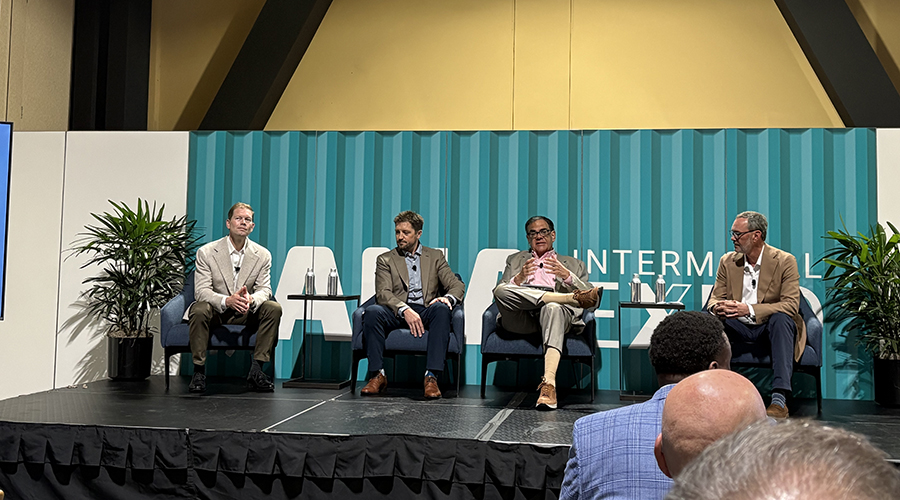 A panel discussion titled “Strengthening the Port-Rail Connection” was held Sept. 15 in one of three theaters stationed in the exhibit hall at the Long Beach Convention Center. From left: Northwest Seaport Alliance COO Jeff Bellerud; UP AVP of Intermodal Sales Ryan Steinbach; Tri-Cities Intermodal founder and CEO Ted Prince (the moderator); and NS VP of Intermodal and Automotive Marketing Shawn Tureman. Jeff Stagl
As for the possibility of BNSF merging with CSX or another large railroad if the Union Pacific Railroad-Norfolk Southern merger comes to fruition (a question posed by an audience member)? BNSF would rather spend $4 billion on the BIG facility instead of $85 billion on a merger transaction. It isn’t exactly clear what a merger solves.
IANA President and CEO Anne Reinke (speaker/moderator): We have found that the top three things customers want from intermodal is reliability, resilience and optionality. Intermodal is in a great time period right now. The question is: Are we ready? And do we have the capacity? Intermodal volume was strong last year and volume so far this year is slightly ahead of last year.
Union Pacific Railroad Assistant Vice President of Intermodal Sales Ryan Steinbach (panelist): On-dock rail is the most efficient and productive asset at a terminal. But poor rail-car dwell times can kill that efficiency and productivity. Customers do not want to hold onto their car inventory. On a day-to-day basis, it’s vital ports, railroads and other intermodal partners do what they say they are going to do. They need to stay in alignment and keep each other accountable. We want to grow our pie. Our new terminal in Phoenix keeps growing. We’re trying harder to meet customers where they are. In terms of length of haul, it isn’t only moves of 750 miles or more that work best for intermodal. UP is interested in moves going 250 or 300 miles, as well. The peak season for intermodal likely will carry over into the Chinese New Year holiday early next year.
Norfolk Southern Railway Vice President of Intermodal and Automotive Marketing Shawn Tureman (panelist): Not every port terminal is open 24/7. It’s important how ports, railroads and drayage partners collaborate in those off periods to keep freight flowing. Traffic needs to be balanced. We need to tap more short-haul opportunities with ports. We can make 200- to 300-mile moves work through collaboration. Inland ports present opportunities, such as in the Gulf area in Alabama, Georgia and Louisiana. For example, in partnership with the Georgia Ports Authority, NS is the exclusive rail provider for an inland port in Gainesville, Georgia. It serves as a “heat map” of demand.
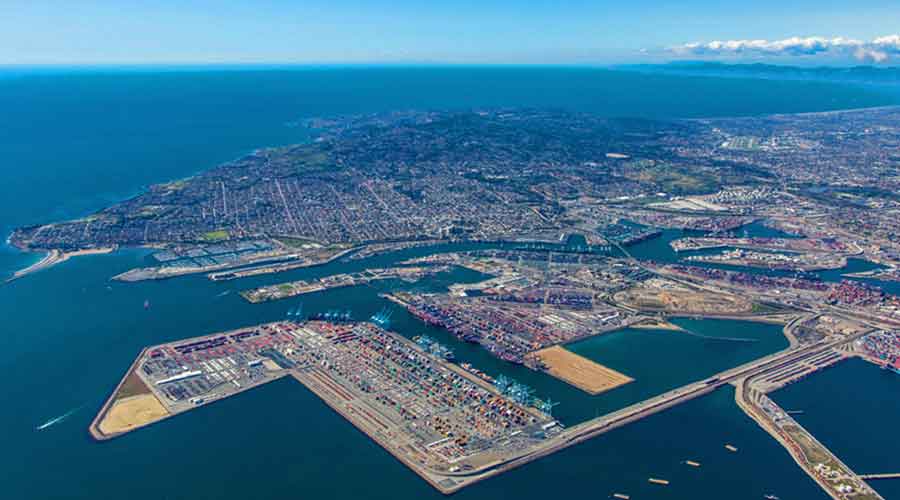
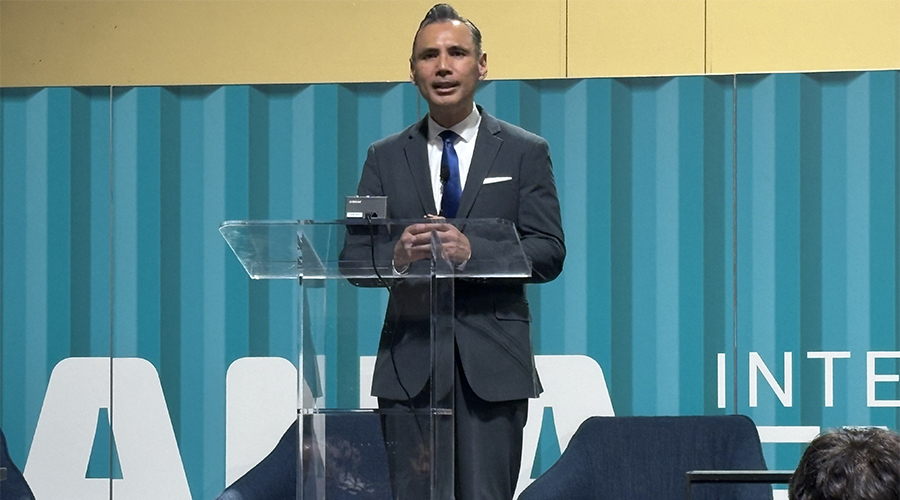 Another session held Sept. 15 in an exhibit hall theater featured Port of Long Beach CEO Noel Hacegaba, who reviewed a new plan that calls for doubling the port’s annual volume by 2050.Jeff Stagl
Northwest Seaport Alliance Chief Operating Officer Jeff Bellerud (panelist): At our port in Seattle, we are averaging a two-day dwell for containers. At some of our facilities, we see no dwell with rail. It comes down to terminal infrastructure and getting the most out of all partners. Investment isn’t always needed, such as adding more on-dock rail. Inland ports can be a play for more growth. For us, it’s more important to be a gateway to growth. We work collaboratively with UP, Tri-Cities Intermodal and other partners. We are seeing freight moving into North Dakota, Idaho and other states, and into more areas in Washington.
Port of Long Beach CEO Noel Hacegaba (speaker): The 115-year-old port recently determined it was time to push the reset button on its overriding mission and create the port of the future. So, we developed a “Path to 2050” plan that calls for doubling annual volume to 20 million 20-foot equivalent units (TEUs) by 2050. We need to “future-proof” the port if we want to be around another 100-plus years. The port plans to invest $3.3 billion over the next 10 years. The Path to 2050 plan includes the $1.8 billion Pier B on-dock rail support facility that’s designed to move containers from ships to trains in less than 24 hours, improve connectivity with inland destinations and triple on-dock rail volume to 4.7 million TEUS. The facility is on track for completion in 2032. Speed to market is important to our success, so speed to rail is key. It now takes four days to move containers from ships to trains and at Pier B, that will drop to 24 hours, shaving off three days. We are also working with the U.S. Maritime Administration to study the use of nuclear power in maritime operations. We are years away from harnessing this power and we want to make sure it’s deployed in a safe fashion.
IANA Director of Economics Andrew Sibold (panelist): Intermodal growth has been predicated on consumer spending and the artificial intelligence boom. It’s been more brittle growth overall. There has been an uptick in manufacturing and cheap natural gas prices, but credit is more scarce. The intermodal industry will always be cyclical. In terms of market share, intermodal still only holds a 5% share. It’s not measurable yet in a significant way.
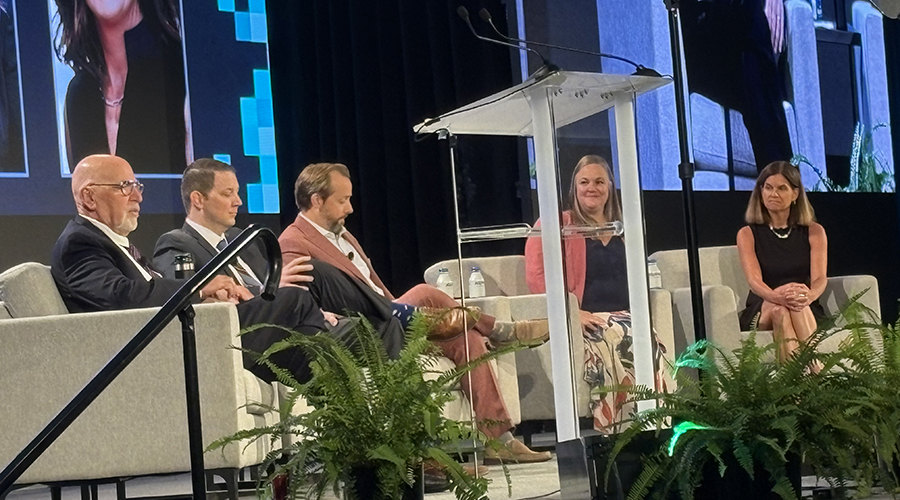 An “inside intermodal” panel presentation during the general session on Sept. 16 included (from left) Gross Transportation Consulting founder Larry Gross (the moderator); IANA Director of Economics Andrew Sibold; ACT Research VP and Senior Analyst Tim Denoyer; Squall Strategies LLC founder and Principal Lauren Beagen; and InTek Freight & Logistics President Shelli Austin.Jeff Stagl
ACT Research Vice President and Senior Analyst Tim Denoyer (panelist): The U.S. economic outlook looks strong for 2027, while the intermodal volume outlook calls for continued growth. The level of consumer spending is decent, but not exactly wonderful, but the housing market is struggling. Intermodal capacity continues to be constrained, with low chassis production. On the trucking side, a truck driver shortage that took hold in February continues, in part because the nation’s immigration policies are leading to some drivers being forced out of the United States. High diesel prices and other costs are helping to shift some freight to intermodal, as long as railroads keep up service reliability.
Squall Strategies LLC Principal and Founder Lauren Beagen (panelist): We are seeing unprecedented disruptions in the maritime industry, including congestion at the Panama and Suez canals, and the Strait of Hormuz. Worldwide, there are seven choke points for ships. There are geopolitics in play in the supply chain that weren’t always there. But freight still has to move. Ocean carriers are coping — adaptability is the name of the game. The sustainability of demand is the biggest risk depending how long the disruptions last.
InTek Freight & Logistics President Shelli Austin (panelist): There is a more positive atmosphere surrounding intermodal marketing companies (IMCs) than last year. Beneficial cargo owners are relying on IMCs to provide transportation solutions. Drayage partners are a lynchpin. Intermodal service doesn’t just hinge on what railroads do but on what all modes do. If drayage partners don’t get help, then overall service won’t win. Some railroad ramps are a “hot mess.” Truck drivers have told me they sometimes have to wait for five or six hours in those terminals. In some areas, diesel prices are extremely high, In some points in the Southeast, diesel costs $10 per gallon.