For CPKC, water hazard monitoring system enhances infrastructure resilience
5/6/2026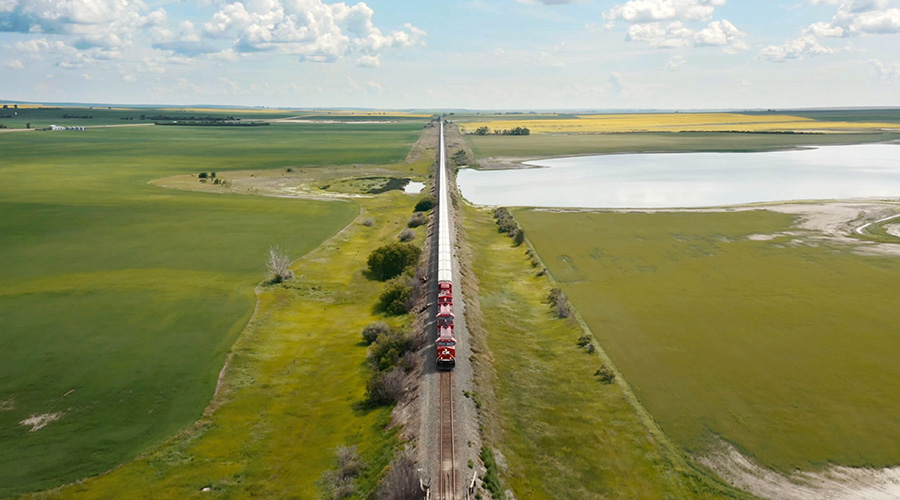
By Jeff Stagl, Managing Editor
Operating trains in Canada is always challenging given the extreme weather and imposing terrain. When floods, rapidly melting snow, heavy rains and other factors cause track washouts, operations can be even more daunting.
That’s why CPKC has sought to identify potential track washouts before they happen by employing a Waterbody Hazard Monitoring System (WHMS). Using artificial intelligence (AI), satellite data, synthetic aperture radar (SAR) and multispectral imagery, the system is designed to detect water-related hazards along CPKC’s network and issue alerts on potential washouts.
WHMS was developed several years ago by consulting and engineering services firm Tetra Tech and the railroad’s geotechnical engineering team. It scans more than 1.2 million waterbodies along more than 12,600 miles of track across 75,500 square miles and generates satellite images, providing near real-time visibility across the network.
AI then analyzes the images against pre-determined business rules and sends automated alerts for potential water-related hazards, such as high water/flooding, beaver dams and an increasing proximity of water to tracks that could impact operations or cause an accident if a train crew isn’t aware of a washout. WHMS processes data within four hours of information capture and analyzes more than 3,000 satellite images weekly.
The system has helped transition the Class I’s water-hazard management from a reactive process to a proactive and predictive risk management approach, which enhances infrastructure resilience sets a new standard for smart infrastructure, CPKC officials say.
WHMS operates without any physical equipment and, as the AI continues to monitor the network, the system gets smarter as it learns from real-life feedback, says CPKC Vice President of Engineering Tom Bourgonje.
 CPKC recently created a video on the Waterbody Hazard Monitoring System, which scans more than 1.2 million waterbodies along more than 12,600 miles of track.CPKC
The idea: to identify potential hazards, inspect the area under an alert and then prioritize work to address the problem before operational issues develop.
"We don't want a train to find a washout,” says Bourgonje.
A 45-year rail industry veteran who retired from CN in 2020 and joined Canadian Pacific in 2022, Bourgonje began researching SAR and other technologies soon after coming to CP. SAR is designed to “see through” clouds and rain, and operate during the day or night.
The Class I operates through many heavily wooded areas and near many waterbodies, but did not have sufficient severe weather protocols, Bourgonje says.
“I realized they had an issue,” he says.
In mid-2022, Bourgonje asked upper management for permission to start developing a water hazard monitoring system and then helped contract Tetra Tech. Programming WHMS began in early 2023.
From mid-2023 through the end of that year, the system was piloted along a 2,500-mile test site mostly in northern Ontario, but also in portions of British Columbia and New York.
Once WHMS was ready to turn on throughout the CP network, something unexpected happened.
“We had 10,000 alerts. We kept refining the system to get realistic alerts and not so many fake positives. We learned from the fakes,” says Bourgonje.
CPKC continues to learn how to best manage the system’s data.
“We want to separate the useless data and good data,” says Bourgonje.
Currently, WHMS is employed along CP’s legacy network and the Haverty Subdivision between Meridian, Mississippi, and Myrtlewood, Alabama. By June 1, CPKC expects the system to cover 20,000 miles of track after additional programming work is completed.
So far, WHMS has paid off by helping to avoid operational issues and train accidents. In 2025, which was a dry year, the system issued 50 urgent alerts, 16 of which turned out to be potential washouts after inspections of the identified areas, Bourgonje says.
As of April 2026, WHMS already had issued over 500 alerts, including more than 50 urgent alerts, mostly because of the amount of snow that continues to melt, he says. The system helped the railroad identify two sites to closely monitor and remove two other sites from service due to water hazards.
WHMS is yet another valuable technology the Class I has adopted of late that helps boost safety and efficiency, as well as meets other company goals, says Bourgonje.
“At CPKC, we see the value of emerging technologies,” he says.