CPKC's new AEI technology targets fewer accidents, more efficiencies
9/23/2025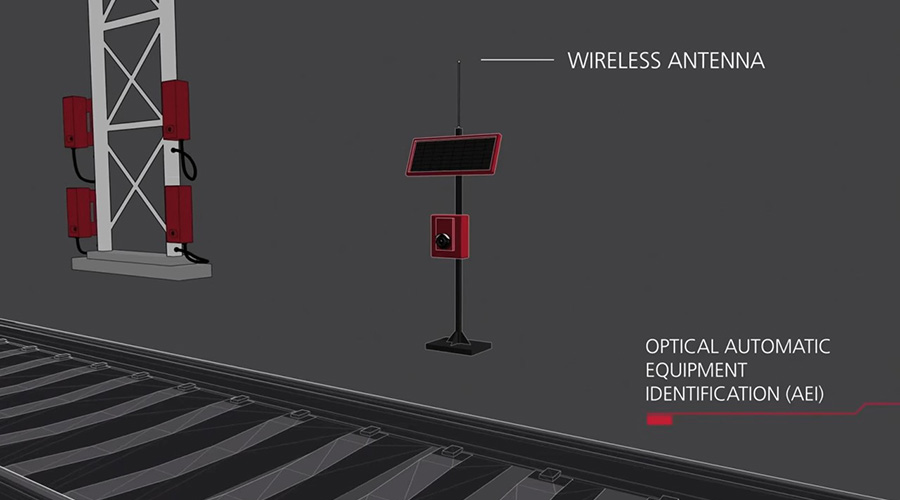
By Jeff Stagl, Managing Editor
Like other Class Is, Canadian Pacific Kansas City is trying to push the technological envelope to adopt more innovations that can bolster safety, boost productivity and increase efficiencies.
A team of CPKC engineers recently developed something that targets all three: Optical AEI technology.
Automatic equipment identification (AEI) is an electronic recognition system that’s been widely used in the North American rail industry for decades. The system features passive tags mounted on each side of rail cars and trackside readers, and uses radio frequency identification (RFID) technology to identify railroad equipment while a train is en route. RFID uses radio waves to identify objects from a distance via wireless tags.
Optical AEI incorporates optical imaging, artificial intelligence (AI) and thermal technology to analyze rail cars and components in real time as trains pass a stationary device. The technology is designed to provide more accurate car description data and earlier detection of various rolling stock and equipment defects.
Optical AEI technology features lidar to capture the presence of a train; visible and infrared spectrum cameras to collect images of rail cars and containers on passing trains; and real-time AI to identify and mark the equipment number of cars and containers. All collected data is integrated into cloud storage.
 Visible and infrared spectrum cameras installed in an Optical AEI device collect images of rail cars to help identify potential component defects. Canadian Pacific Kansas City
RFID technology has been used for 30 years and AEI readers are expensive to install, says CPKC Assistant Vice President of Operations Technology Kyle Mulligan. So, the Class I spent 12 months developing Optical AEI technology, which is incorporated in a metal box that’s installed on a post 15 feet from a track, along with a solar panel and a wireless antenna.
“We can challenge ourselves to develop something at fraction of cost. Optical AEI costs a fraction of an AEI reader,” says Mulligan. “It has cameras and an RFID chip in it.”
The development of Optical AEI stemmed from a derailment that occurred in mid-2024 near Minneapolis/St. Paul. The new technology could improve defect detection and help prevent accidents, says Mulligan.
The team of engineers developed an Optical AEI prototype in just eight weeks that could be tested and analyzed, says CPKC Assistant VP of Business Intelligence Shailesh Yerrem, who played a role in the technology’s development.
Optical AEI is a flexible and scalable technological solution, CPKC officials say. There are potential opportunities to deploy the technology in yards, terminals or customer’s facilities to gain efficiencies or improve safety, says Yerrem.
“We are looking at data capture and making [Optical AEI] portable,” he says. “It’s all about better wayside detection, and making it cheaper and easier to deploy technologies that can reduce risk and help us gain efficiencies.”
So far, CPKC has installed eight Optical AEI devices in Alberta and Missouri, where business needs are changing, says Mulligan. Two more are expected to be installed by year’s end.
Next year, the development team hopes to obtain funding to ruggedize the Optical AEI device to resist extreme hot and cold temperatures.
“By the end of 2026, we expect to have a rugged product that we can scale up,” says Mulligan. “We want to build solid platforms and push technological boundaries, and do it in an efficient fashion.”