CPKC's Hucker: Rail can offer myriad career opportunities under one roof
7/21/2026
By Julie Sneider
In 2001, Elizabeth Hucker landed on a railroad career the same way many past generations did: She followed a family member into the business.
Her father drove trains for Canadian Pacific and her grandfather worked on the mechanical side of the rail yard. Despite what she knew of their jobs while growing up in central and western Canada, Hucker hadn’t thought about rail as a career path for herself.
After graduating from the University of Ottawa with a degree in marketing, Hucker struggled to pick a field to pursue. If she wanted to stay in Ottawa, a city she still calls home, her career choices in the early 2000s appeared limited to working for the Canadian government or the booming high-tech sector, she says.
“I actually started my schooling in management information systems, which lended itself to the tech industry, but I found very quickly that wasn’t what I wanted to do,” Hucker says.
Her preference was a field that involved working with people and keeping up with current events and economic trends.
As she struggled to find the right fit, her dad posed the question: Had she thought about a job in rail?
Bio Stats
Name: Elizabeth Hucker
Age: 48
Employment: Vice president of sales and marketing, bulk, for Canadian Pacific Kansas City.
Education: Honors Bachelor of Commerce in Marketing, University of Ottawa.
Personal history: Born in Thunder Bay, Ontario; grew up in central and western Canada; calls Ottawa home but has lived in Calgary for the past 25 years.
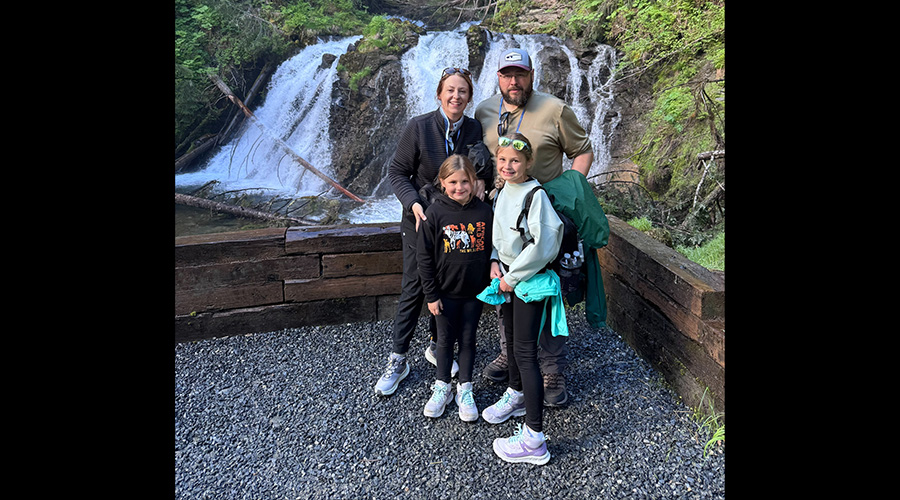
Family: Husband Kevin Hrysak, managing director of corporate heritage, CPKC; two daughters, ages 11 and 13.
Hobbies: Traveling with family to North American destinations that “create memories,” including a recent vacation on a lake in British Columbia; running and competing in marathons; reading fiction and nonfiction, with book choices based on recommendations from friends and colleagues.
“And I hadn’t,” she recalls. “But at the time, there happened to be a posting for an open position at Canadian Pacific Railway in what was then called the ‘growth markets team,’ which was very commodities based and involved small to medium sized customers.”
Communicating with customers and staying apprised of commodity economics seemed to fit her job-search criteria. A month-and-a-half after her job interview, Hucker packed her bags for a cross-country move to CP’s home base in Calgary to start her career. Twenty-five years later, she remains with the company.
Although it’s not unusual for a railroader to enter the field after a prompt from a family member, the career path that Hucker subsequently followed at what is now Canadian Pacific Kansas City (CPKC) over the past two-and-a-half decades has resulted in opportunities and experiences she says she couldn’t have imagined back in 2001. After rising through the ranks, she now serves as vice president of marketing and sales, bulk. She oversees a team of nearly 30 people located in CPKC offices in Canada, the United States and Mexico.
That she’s served her entire career so far at one company — without getting bored or feeling stagnant — is against the tide of most careers nowadays, where people move from one employer to another to pursue new opportunities and experiences, she notes.
Hucker’s story demonstrates that the rail industry can offer young professionals a lifetime of diverse opportunities under the roof of one company — if that’s what they want, Hucker believes.
“I’ve had the absolute honor and privilege to see so many different pieces of this business; to talk to so many different companies across Canada and the United States,” she says. “And I’ve been consistently challenged — not just in learning about different commodities, but also how to navigate different markets and create opportunities that drive the economy forward.”
A front-seat view of the economy
At CPKC, Hucker and her team are responsible for the grain, coal, potash, sulphur and other commodities that typically move in unit trains. The team conducts direct customer interactions — such as internal advocacy for customers on service and contract negotiations — as well as develop strategies that drive growth in the commodities segment.
“Rail is one of the early indicators for what’s going on in the economy, and I have been very lucky in my career to touch a variety of different commodities,” says Hucker. “I started in logs, poles and railway ties — which was a small commodity group but interesting, nonetheless. Railroad ties drive the investments that rail companies are making across North America in infrastructure in order to continue to maintain safe railway operations.”
From there, her focus on commodities evolved to cover lumber (an indication of how the North American home-building industry is doing), then energy, chemicals and plastics (the building blocks of the economy), and finally to bulk.
Hucker’s leadership and achievements led to her selection earlier this year as a Progressive Railroading Woman of Influence in Rail. Mentorship, as a mentee and as a mentor, has been a key component in her leadership development and growth at CPKC, she says.
As Hucker rose to positions of increasing responsibility, she relied on the guidance of Brent Dornian, who served as the Class I’s general manager of marketing and sales in energy, chemicals and plastics. Dornian encouraged her to test out new ideas and helped her refine and “lean in” on some of her intuitive leadership skills, Hucker says.
Now, Hucker returns the favor by serving as a mentor in CPKC’s formal mentorship program.
“I try to impart the experiences and wisdom that I’ve learned to them so that they can be successful in whatever their career paths may look like,” she says.
She’s also open to providing suggestions for managing work demands with life at home.
“I don’t know that being balanced in life, whether you’re in rail or any other industry, truly exists,” Hucker says, adding that she’s fortunate to have a supportive spouse who understands the demands of working in the rail business. Her husband Kevin Hrysak also works for CPKC; the couple has two young daughters.
Her primary advice for achieving work-life balance? Be intentional with your time. For example, when she’s home with the girls and her husband, she aims to be present.
“I try to create the opportunity where they know that I’m focused just on them and that work can wait for a certain period of time,” Hucker says.
She also makes herself as available as possible for important events in the children’s lives, from gymnastic competitions to school talent shows.
“There are always so many distractions, so much competition for your time,” Hucker says. “So, I find trying to be intentional in the moments that I have has helped me not only connect [with family] at home or the team that I lead at CPKC, it really helps me stay focused.”
Leadership philosophy? Serve others
Hucker’s leadership philosophy boils down to “leading in service of others,” she says. That means never asking anyone on her team to do something that she wouldn’t do herself. She also believes that how one leads another person depends on what motivates that person. So, Hucker seeks to learn and understand those differences so that she can build the trust of her team.
“Trust is critical in coaching and being able to provide feedback, be it constructive or positive,” she says.
As she looks ahead, Hucker plans to continue tapping into the knowledge the incoming generation of railroaders has about new technology, especially when it comes to artificial intelligence. Many enter the industry well-versed in tools such as ChatGPT, Claude and Perplexity; they want to know how the company plans to use AI to impact their work today and shape it tomorrow.
In multigenerational organizations, being open to what young recruits have to offer is key to preparing for, and adapting to, the future of rail, Hucker believes. While she may have decades of experience dealing with business cycles, she knows that doesn’t mean those cycles will forever turn in the same direction.
“Asking questions and not assuming that [business] is going to happen the same way again helps us evolve, and find new solutions to opportunities and challenges,” she says. “Being open to what might be the new art of the possible helps you see something different.”
Julie Sneider, who retired April 1 as senior editor of Progressive Railroading, is a Wisconsin-based freelance writer.