Systems thinking: RDC's Ida Posner bridges the worlds of rail and environmental philanthropy
8/11/2026
By Hazel Wheaton, Associate Editor
Ida Posner is a planner by nature, but a career in rail was not initially part of her plan.
Railroad Development Corp.’s (RDC) chief operating officer started her career first with a company working on renewable energy in Kenya, then with an environmental nonprofit in San Francisco. That she eventually found herself in the rail industry speaks to her flexibility and her willingness to embrace new directions. That she did so while increasing her activities in the environmental world speaks to her distinct ability to find unexpected connections — and when they can’t be found, to forge them.
As one of three children of RDC Chairman Henry Posner III, Ida was always aware of her father’s work. RDC, which Henry co-founded with Robert Pietrandrea in 1987, is an investment and management company focused on rail in emerging markets.
Ida grew up amid the constant thrum of the business. Family trips (or "adventures," as she calls them) were to destinations where the RDC was doing business at the time — Guatemala, Peru, Malawi, Estonia — and Iowa, where the RDC had revitalized the Iowa Interstate Railroad.
"We'd go to the office," Ida recalls. "[But] growing up, 'the office' was my grandfather and my father. I was more like the kid showing up to eat the snacks in the kitchen."
Now, as RDC’s COO, Ida occupies her grandfather's old office, and 'the office' is her father and her.
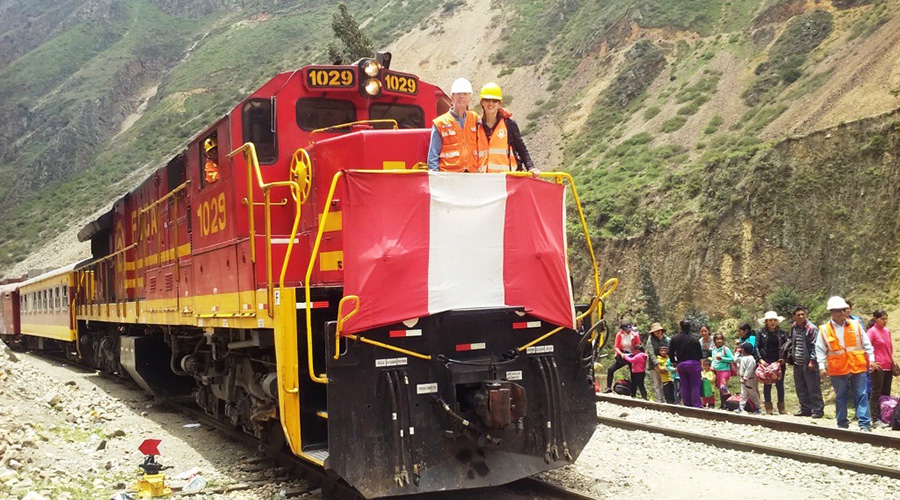 Henry and Ida Posner in Peru, atop a Ferrocarril Central Andino locomotive.Ferrocarril Central Andino
Perhaps it’s not so much of a stretch that a mind geared toward environmentalism, which sees the earth as an infinitely intertwined system of cause and effect, might be equally at home in the intricate layers and connections of rail — which Ida describes as “the ultimate network industry.”
At RDC, Ida sees her role as being the connective tissue — between people, between issues, between causes and results, between problems and solutions. With one foot in business and the other in philanthropy, she sees connections others might not.
“She’s a systems thinker,” says Jesse Fink, an emeritus board member of ReFED, a nonprofit dedicated to eliminating food waste, with which Ida is heavily involved. “A lot of people say, well, here’s my philanthropy and here’s my family business ... and they check one of their roles and experience at the door when they do the other. Where she has these two worlds and she’s using one to help understand and benefit the other, and the other way around.”
The environmental piece
The two worlds of philanthropy and business — or, more accurately, the separate strains of idealism and pragmatism that led Ida into each of those worlds — were apparent in her academic pursuits.
Ida, like Henry, attended Princeton University and studied civil engineering. But where he'd zeroed in on transportation, she studied civil and environmental engineering with a focus on renewable energy and African studies. Following graduation, she launched her career in 2012 as a Princeton in Africa fellow, at a company working on renewable energy in Kenya.
After extending her initial one-year fellowship to 18 months, she moved to San Francisco in 2014 to work for the Pisces Foundation, an environmental nonprofit. The policy work she did there fell into two categories that would figure prominently in her future: transportation, specifically diesel and truck emissions, and food waste.
"Learning that we waste 40% of the food we produce, as a country and globally, and that it all goes to landfills, is deeply frustrating and solvable," she says.
The issue became a personal cause.
Fink, who’d gained prominence as one of the founders of Priceline, first met Ida when he approached Pisces seeking funding for his new organization, ReFED. Hers was one of the faces across the boardroom table when he made his pitch.
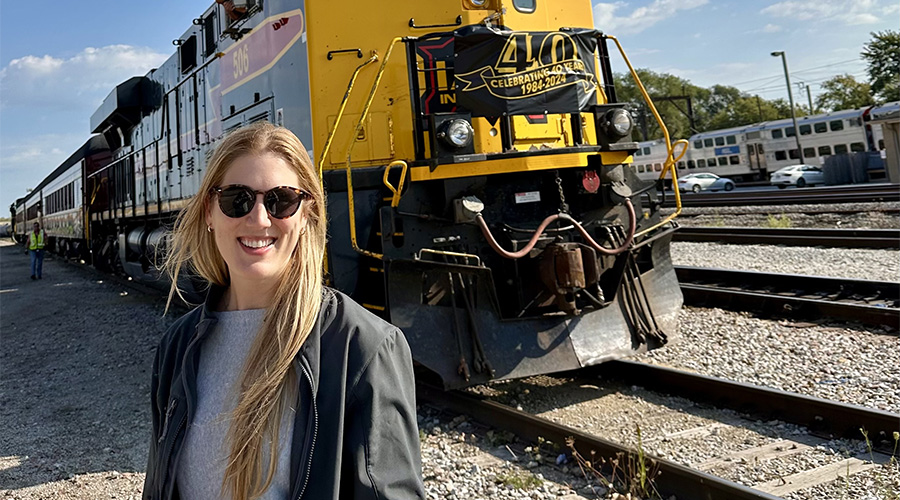 Ida Posner with an Iowa Interstate locomotive, celebrating the railroad’s 40th anniversary.Amy Thornton
"It was early days in the movement," says Fink. "So the idea of a philanthropic organization funding food waste — it just didn't make sense."
But Ida and her colleagues got it, and ReFed got its funding.
The rail piece
For all the satisfaction Ida found through her work at Pisces, she found herself looking for something more. Whether through restlessness, nostalgia or an unexamined interest in what her father was up to, in 2016 Ida proposed a trip to visit an RDC partner, like the ones the family had taken when she was a child.
There were some appealing options for travel. RDC currently partners with a British light-rail business, a Peruvian mining railroad, a company producing passenger and rolling stock in Germany, a freight and logistics company in Belgium, and a joint venture to develop and manage French feeder lines.
Henry chose Peru's Ferrocarril Central Andino, which climbs 305 miles from the port of Callao to an elevation of over 15,000 feet into the Andes. RDC owns a stake in the railroad and operates it under a concession from the Peruvian government.
"You're the environmental engineer," Henry told her. "Let's go to Peru in the rainy season and see what happens.'"
What happened was that heavy rainfall washed out the tracks behind them and Ida got to witness the railway workers' efficiency in repairing the route.
"That railroad is spectacular," Ida says. "It's the second highest by elevation in the world, it's cut through the mountain and there's zigzags, there are tunnels, there are bridges, and every year it gets wiped out by El Nino, and then they put it back together."
Within three days, the crew had the line open. Despite it being a freight line, the railroad was helping to move people through the area while the highway was still unpassable. The experience left a lasting impression.
"With my engineering brain on, it [was] just amazing, technically, what they were doing. ... Just that moment was important in seeing what a railroad can actually do, what it means for the country, for the economy, for the people.”
The experience made her realize that she wanted to be more than a visitor on a tour; she wanted to be involved with RDC in a professional capacity.
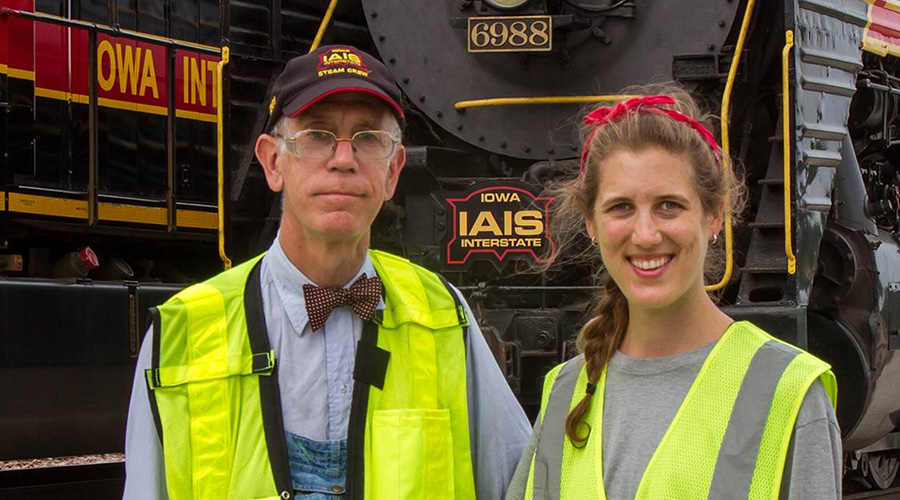 Henry and Ida PosnerRailroad Development Corp.
Rather than a sudden change, her renewed interest in the railroad was a way to reconcile the things about her work in San Francisco that satisfied her and the things that she found frustrating — or bewildering.
On the one hand, rail was a good fit for someone well-versed in the data of emissions in transportation. She proudly points to the 75% decrease in emissions that comes with the conversion of a truckload of freight to rail.
On the other, it also appealed to her pragmatic, solutions-driven nature.
“What I’ve always loved about the rail industry is that it’s so tangible,” she says. “I was coming from San Francisco, where so many of my friends worked in tech. And they were building apps or doing all this stuff that was really cool but ... what is it? It’s not real.”
And Henry's reaction to Ida wanting to join RDC?
"Pure happiness," he says.
Learning the rails
Henry and Ida then sat down with RDC's co-founder and then-president, Bob Pietrandrea, to figure out where Ida could get started in railway service. Ida officially joined RDC in 2017 as a project manager, and set out to learn all she could.
"I quickly realized I knew nothing. I describe the first five years as more of an apprenticeship.”
She hit the road, visiting all of RDC’s different partners, asking endless questions and listening to the experts on the ground.
"I've always been lucky that we are a team that goes out and does things and talks to people, and so I spent time with all our portfolio companies and being at the operations."
That way of learning the territory was perfectly suited to Ida, who prefers a face-to-face meeting to a Zoom call, but the direct dealing with partners was less about luck than the intentional structure of RDC.
"[One thing] that distinguishes us from all of our peers is that our business model is not based on control, it's not based on even necessarily direct synergies, but rather local partnerships," says Henry. "One could argue that Ida is the third generation of the cultural DNA of my father’s business philosophy, which is you always want to have partners. Most railroad companies do not operate that way.”
The diversity of RDC's individual partnerships — heavy haul freight railroading in North America, passenger trains in Germany, mining routes in Peru, manufacturing in the UK — meant there was a lot to learn. Henry wasn't worried. With Ida's endless curiosity and engaging personality, he knew that she'd ask the right questions, and that their partners would be willing to give the answers.
"She got to know the people, and picked up the jargon and I believe that she is now equally respected and equally known as I am. And that took her only nine years. Part of that is ... you can't help but want to work with her."
Henry’s pride and pleasure at Ida’s choice and her determination to earn her place is clear. In 2025, upon being inducted into the Short Line Railroad Industry Hall of Fame, he called her decision to follow him into the industry his “first lifetime achievement award.”
As her role would eventually come to include all aspects of the business, from policy to operations, finance to human resources, Ida went back to school to fill in the gaps in her formal business education; in 2020, she received her MBA from Columbia University. The same year, she was named VP, strategic planning at RDC. In 2025, she was appointed chief operating officer.
Connecting the pieces
Working full time at RDC didn’t mean leaving her environmental roles behind her. She also added her voice to the Posner family's philanthropic foundation, adding a robust grant program dedicated to food waste issues to their stable of philanthropic causes. She also joined the board of ReFed, and added that organization to the list of causes the Posner foundation funds.
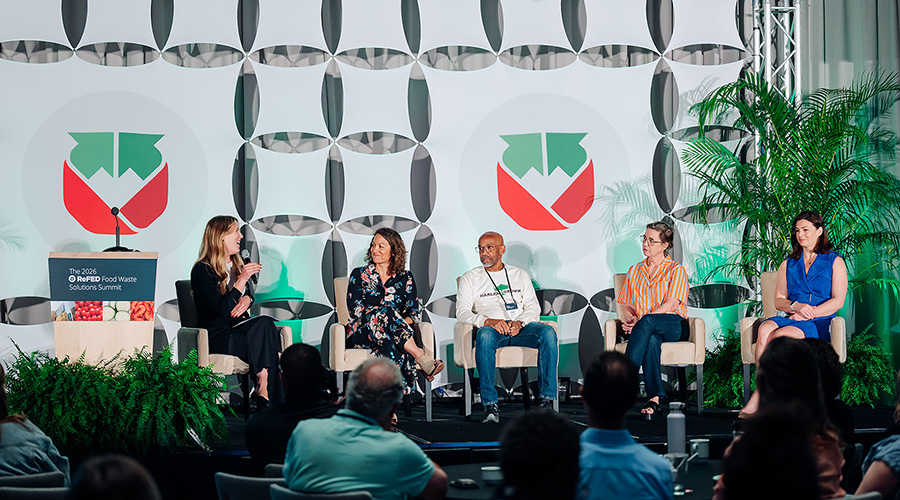 Ida Posner (left) hosting a panel discussion at the 2026 ReFED Food Waste Solutions Summit.ReFED
Combining the two roles, as a businesswoman and a philanthropist, led her to create a third path as well.
“I’d been working on the nonprofit side, but I’m also a capitalist, and I believe in market-based solutions,” she says. “What would it look like to start building out an investment vertical on food waste?”
The result was Hawthorne Food Ventures, of which Ida is the founder and managing partner. Hawthorne invests in food and agriculture startups that address the issues of food loss and waste, incorporating the whole chain from on-farm food loss to supply chain efficiency to landfill diversion.
“It’s given me a lens to think about,” she says. “You know venture capital and railroads haven’t always sat in the same room together. So, it’s nice to have kind of a foot in both of those and try to be helpful where I can.”
Fink praises her ability to make connections, to address problems that arise with solutions that may come from the world of philanthropy, may come from pure business, or may be an amalgam of both.
“Most people have a hammer, and they use a hammer. But when Ida looks at a problem, she’s got a whole toolkit,” he says. “She identifies where the problems are, where the solutions are, and then she's trying to see how she can use her various resources. She's all in."
With one foot in philanthropy and the other in business, Ida has an instinctive adapt/reuse/recycle mindset. Ideas that didn't pan out can be broken down, and parts used in a new way, whether it's using reclaimed and refurbished London tube cars from a failed experiment in the UK for a fledgling pop-up metro program in the United States, or questioning a big revenue source. Ida admits to spending a great deal of time thinking about, well, garbage.
"Trains move a lot of trash," she says, "It’s actually good business for the railroads, but does it really make sense that we’re moving trash from New York to Ohio? How do we design a better waste-management system and what opportunity could there be for rail for like, compost operations or other more circular solutions that still require transportation?"
Looking ahead
With Ida on board, RDC’s long-term succession plan is in place, although Henry has no plans to retire: The two have settled into a comfortable shared leadership dynamic. A multigenerational family company has the luxury of thinking in decades, rather than quarterly returns, and yet an increasingly fast-paced, chaotic environment exerts pressure to think about the short term. Another balance for Ida to find.
"This is still a work in progress — a thought in progress," she says. "The whole narrative right now is that the industry has to grow. We have to grow, we’re losing market share to trucks, we gotta fight there. What’s interesting is, we’re talking about carload growth. How many carloads are we moving? We don't talk as much about growth mindset, about how we’re growing and changing as organizations.”
The diversity of RDC's holdings fosters creative and innovative thinking, which may be crucial in an industry that is steeped in legacy and can be reluctant to change, Ida says.
"We really do have a broad scope of the rail industry. It does allow us to think really expansively about the art of the possible ... what can we learn from other geographies, from other businesses.”
She sees progress coming through more risk-taking, more creative thinking, a greater exploration of technology, and a willingness to learn from different sectors and industries.
On the technology front, Ida joined the board of RailPulse in 2022 and now serves as its vice chair. The North American initiative aims to put telematics devices onto rail cars and collect data on location, load and safety indicators in a centralized platform. That neutral, accurate dataset would prime the rail industry to take advantage of AI advances, since AI's outcomes are wholly dependent on the quality of the data it ingests.
She'd also like the industry to have a higher public profile. Barring interruptions of the supply chain, such as the COVID pandemic, most people don't think much about how things get where.
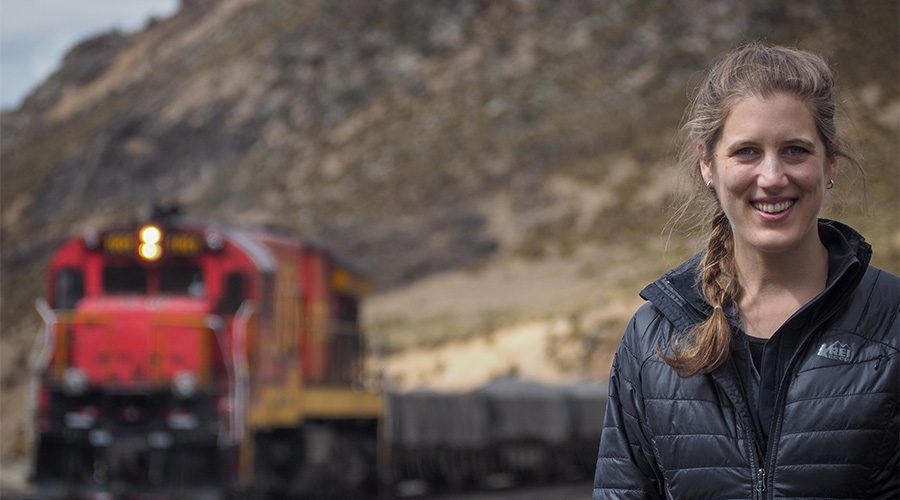 Ida Posner visiting the Ferrocarril Central Andino in Peru in 2019.Luke Zakzek
"If we're doing our jobs right, you're not hearing about us," she says. "Because we're just moving stuff in the background, we're not blocking your crossings."
So, no news is good news, but a low profile makes it harder to attract and retain the next generation of professional talent, one of the biggest challenges the industry faces. Ida says, “There’s no visibility into the fact that you can be a data scientist and work for a railroad, you can work in marketing ... and also the operations jobs are really cool, too.”
On its face, the rail industry is simple, Ida says: "Our job is to move things, as safely and as efficiently as possible." In execution, however, that simple, concrete task spins off into endless complexity of systems and networks.
For a systems thinker, there's plenty to keep her fascinated.
"People don’t really think about trains as much,” she says. “But we think about them all the time.”