ASLRRA's Baker addresses key short-line issues at annual gathering
4/21/2026
By Jeff Stagl, Managing Editor
As president of the American Short Line and Regional Railroad Association (ASLRRA), Chuck Baker each year provides a “state of the industry” presentation at the organization’s annual conference and exhibition.
It was no different on April 14 at the Minneapolis Convention Center. Baker walked to the lectern during a general session at the ASLRRA’s major 2026 event and shared information on a broad range of topics that are of high interest to regionals and short lines.
But first, Baker mentioned the conference had drawn 200 exhibitors and attracted about 1,700 attendees, the second- or third-highest attendance figure in the association’s more than century-long history.
The first topic he addressed highly interests small railroads: the federal Consolidated Rail Infrastructure and Safety Improvements (CRISI) grant program. The program has been transformational for ASLRRA members, hundreds of rail industry suppliers and thousands of shippers.
Baker said he expected the Federal Railroad Administration (FRA) to release a notice of funding opportunity (NOFO) for the next round of CRISI grants “any day now.” (Editor’s note: The FRA issued the NOFO on April 20, with applications due June 22.)
The NOFO combines advanced appropriations in fiscal years 2025 and 2026 with discretionary appropriations for each year, providing a total of $2.04 billion. Short-line projects traditionally have performed well in the CRISI application pool and the ASLRRA expects that to be the case in this current round.
“The grants are necessary for short-line railroads. We are charged with preserving low-density lines,” Baker said. “There is no better bang for the public buck [than these grants].”
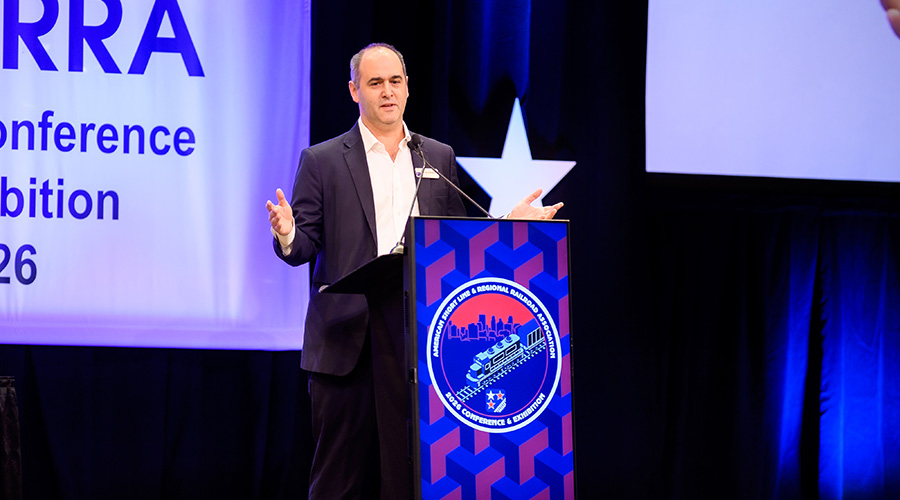 When it comes to short lines obtaining federal CRISI grants to help fund their projects, “there is no better bang for the public buck,” Baker said.American Short Line and Regional Railroad Association
But after 2026, there is mounting concern that there will be fewer dollars available through the CRISI grant program going forward, he said. Legislation in Congress aims to provide an adequate or near-equal amount of funding compared with prior fiscal years.
In addition, the ASLRRA is seeking its own CRISI grant to help fund short-line courses, safety training and other efforts, Baker said.
Some other issues the association and small roads will be monitoring — since they are impacted by proposed regulatory or legislative measures — are crew size, truck size/weight and locomotive inspection requirements.
A bigger legislative concern is the Section 45G short-line tax credit. Since it was enacted in 2005, the tax credit has been a valuable federal incentive for Class II and III railroads to help cover qualified track maintenance expenditures.
But Section 45G needs to be modernized to reflect today’s short-line needs and mounting inflation, Baker said.
Legislation introduced last year in both the House and Senate aims to update the credit to reflect current economic realities. The bill would increase the annual cap from $3,500 to $6,100 per mile; index the tax credit to inflation for future years; and expand eligibility to include track owned or leased by regionals and short lines as of Jan. 1, 2024, rather than a current 2015 cutoff.
“There are 160 co-sponsors in the House and 41 senators who support this legislation,” Baker said.
Toward the end of his presentation, Baker also touched on the proposed Union Pacific Railroad-Norfolk Southern Railway merger. The ASLRRA neither supports nor opposes the merger, he said.
However, there are implications to short lines since the single-line transcontinental railroad UP and NS seek to form would operate trains needing fewer stops and making less interchanges.
“We plan to engage on it,” Baker said.
He wrapped up his talk by mentioning future dates that are of high importance and interest to ASLRRA members and short-line industry constituents.
The association will hold a super regional meeting in fall merging all four regions — the Central, Eastern, Pacific and Southern — into one conference instead of each holding a separate event. That super meeting will be held Oct. 5-7 in St. Louis.
In addition, the ASLRRA will hold its next annual meeting and exhibition March 14-16, 2027, in New Orleans and the next Railroad Day on Capitol Hill on May 19, 2027, in Washington, D.C.