AREMA presenters spotlight solutions for MOW, infrastructure and funding challenges
9/29/2026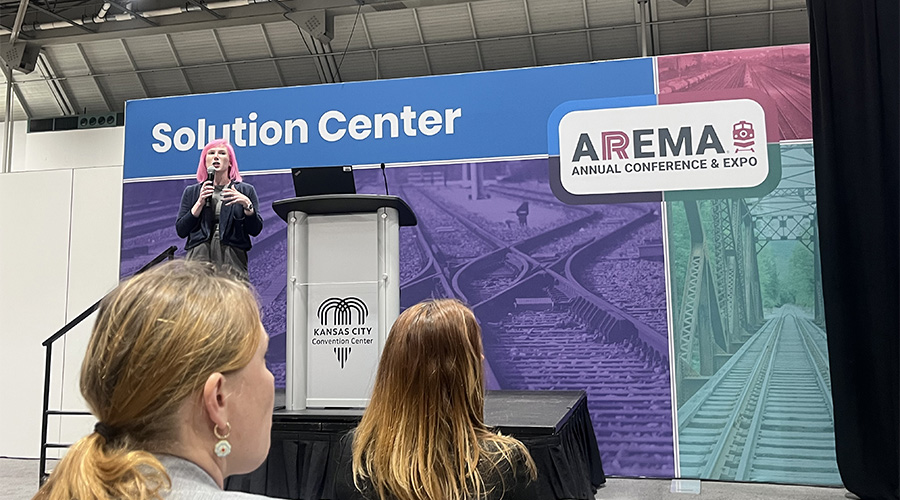
By Bridget Dean, Senior Associate Editor
Attendees of this year's American Railway Engineering and Maintenance-of-Way Association (AREMA) annual conference and expo had the opportunity to attend a variety of presentations.
Held in Kansas City, Missouri, from Sept. 13-16, the event featured an exhibit hall, technical presentations, two general sessions, AREMA committee meetings, networking opportunities and student resources.
On the exhibit hall floor, a dedicated “solutions center” stage featured five 15- to 30-minute presentations about new rail-specific software and products, maintenance-of-way advances and data analysis for federal grant applications. Below is a summary of the later three presentations, one of which was held Sept. 14 and the others on Sept. 15. The Sept. 14 presentations were summarized in a previous RailPrime article.
Mapping solutions for maintenance
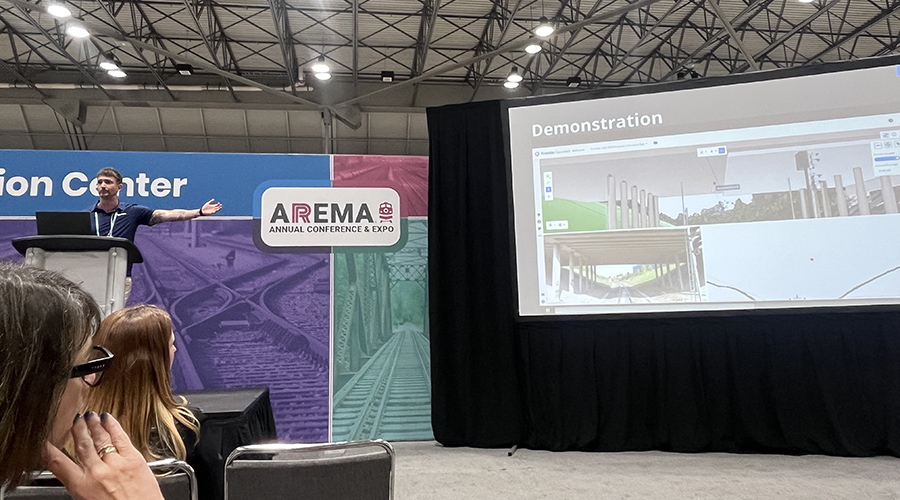
Esri, the company behind the major mapping and geographical tool ArcGIS, presented two ways railroads use its platform. As rail is inherently a land-based industry, there are many use cases for ArcGIS across both freight and transit, said Leah Newman, senior account manager on Esri's infrastructure team. She spoke alongside Jim Barry and Kevin Ruggiero, two solution engineers at Esri.
The first use case aims to make finding land ownership and zoning records, work permits and utility information easier. For maintenance crews, having the correct property information is critical — working on land that isn’t on the right-of-way or was not cleared for work by local authorities can result in fines, Ruggiero said. ArcGIS holds property information and records on its cloud-based platform, giving crews the ability to pull documents and maps while in the field from their mobile work devices.
The second example presented was a map-based MOW flagging solution. Barry shared how one of the company’s customers, a transit agency, uses ArcGIS to create and assign maintenance-of-way tasks while keeping the operating side of the agency aware of active and planned service outages.
Supervisors pre-flag track segments for maintenance. Crews receive these marked segments as assignments on their ArcGIS-enabled field tablets. Once on site, crews mark the pre-flagged segments as being out of service. ArcGIS updates its map and dashboards in real time to show supervisors and operators that work has started and the area is out of service. Once assignments are completed, crews update the map to display the areas as being in service again, said Barry.
A key advantage of the solution is its built-in documentation process: Users enter maintenance information right into ArcGIS with custom data entry forms. This creates a shared database of maintenance history, eliminating inaccuracies that can result from the use of different documentation and data entry procedures, Barry added.
A new way to extend the life of wood ties
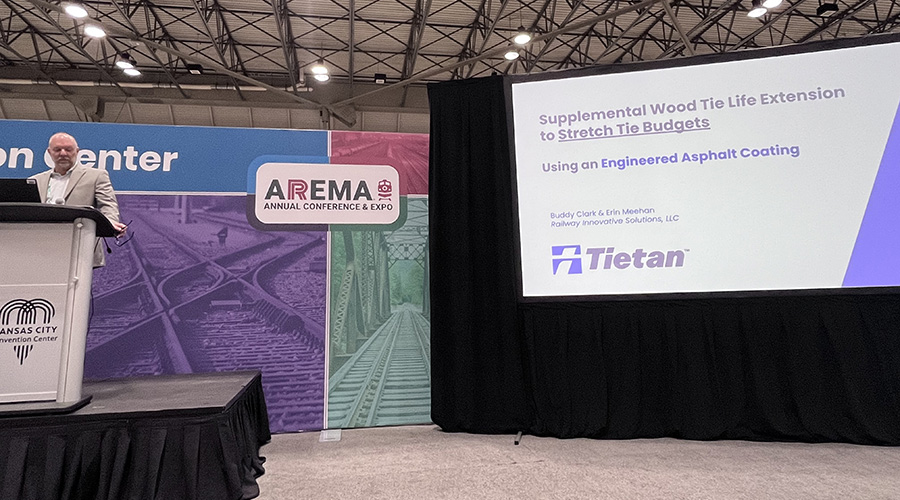 Erin Meehan, Tietan's business development manager, shared the company's research and development process for its asphalt-based wood tie coating.Bridget Dean
Wood tie replacement can be costly and time consuming, so extending the lifespan of ties is critical for railroads, said Tietan Business Development Manager Erin Meehan. The primary cause of tie degradation is moisture cycling — water repeatedly seeping into ties and evaporating. Newer ties, while still treated with chemicals to preserve the wood, have shorter lifespans than ties of prior decades due to heightened regulations on chemicals and the use of new growth wood.
Over the last three years, Tietan has developed a flexible, polymer-modified asphalt coating as a supplement to standard preservation treatments. When applied to the top of ties, it reduces moisture fluctuations and delays cracks from growing, Meehan said. The coating is impermeable, yet flexible enough to move with ties and stretch when they inevitably do develop cracks.
The company uses a combination of field testing and lab testing, including a recently unveiled weathering chamber that mimics harsh conditions in a condensed timeframe. However, the first test was as simple as applying the coating to half of a timber beam and leaving it outside for over two years.
Norfolk Southern Railway recently had Tietan’s solution applied to ties on a bridge deck in Tennessee. The Class I raised concerns about the coating being slippery when wet, so Tietan applied a layer of pebbles on top of the asphalt. It added grip and an extra layer of fire resistance against sparks from rail grinding operations, Meehan said.
Critically, the coating delivers a financial return for railroads, he said. Tietan originally developed the coating for bridge timbers, which are also expensive to replace, and anticipates it can extend their life by 40%. The company plans to launch a tool on its website that will allow railroads to calculate their estimated return on investment, he added.
Improved grant applications
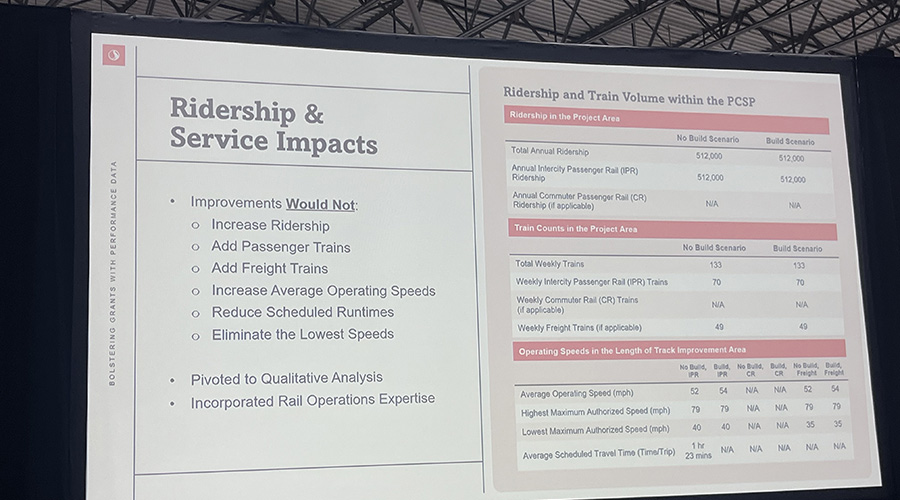 Rather than aiming for increased ridership as a result of the project, NCDOT's grant application focused on how the capacity upgrades would improve service reliability for existing customers.Bridget Dean
The third and final Solutions Center presentation was from Charles Hoppesch, a consultant at Santec who worked with the North Carolina Department of Transportation (NCDOT) to put together an application for the Federal Railroad Administration’s National Railroad Partnership Program.
NCDOT sought funding for its Piedmont Corridor Safety Program, which calls for eliminating nine grade crossings with the construction of four new highway bridges. The program will also add nearly 6 miles of second track to the corridor, which is owned by NS, and other infrastructure improvements in Guilford, Durham and Wake counties between Raleigh and Charlotte.
Upon an initial review of the region’s rail network, Hoppesch said it was clear NCDOT’s program would improve grade crossing safety and service reliability for Amtrak’s Carolinian and Piedmont routes. However, he's found it can be hard to secure federal funding for projects that won’t lead to increased passenger service, Hoppesch said.
Since NCDOT's Piedmont Corridor project did not call for adding more daily Amtrak trains along the corridor, the grant application instead focused on how the project would improve Amtrak’s on-time-performance (OTP) rates. The federal government requires Amtrak to meet an OTP threshold, otherwise the FRA has to investigate the host railroad to determine the cause of the delays. Hoppesch conducted a qualitative analysis of the publicly available OTP data for the two Amtrak routes and pinpointed where on the routes delays began to form. Sure enough, they were where NCDOT proposed making the capacity improvements, Hoppesch said.
NCDOT included this information in the grant application to show how capacity projects can remove delays and improve passenger service without adding more trains. In August, NCDOT announced it was awarded nearly $300 million for the projects. Building railroad infrastructure is expensive, so showing the need for capacity improvements is critical, Hoppesch concluded.