Webcast panel weighs the latest issues surrounding UP-NS merger
5/20/2026
By Jeff Stagl, Managing Editor
Will the Surface Transportation Board (STB) accept the amended Union Pacific Railroad-Norfolk Southern Railway merger application by May 30? Will the proposed merger ultimately pass regulatory muster? What are the broader underpinnings and concerns about UP-NS at the moment?
Those questions and more were addressed on May 15 by a four-member panel during a RailTrends® webcast titled, “Inside the Revised UP–NS Merger Application: A Virtual Salon.”
The panelists were:
Tony Hatch, an independent transportation analyst, Progressive Railroading columnist, and RailTrends co-founder and program consultant;
Farrukh Bezar, an operating partner-transportation and logistics with Littlejohn & Co.;
Roger Nober, a professional lecturer in law and affiliated scholar with George Washington University’s Regulatory Studies Center, and a former STB chairman and BNSF Railway chief legal officer; and
David Woodruff, a principal at WashingtonGPS and former assistant vice president of U.S. public and government affairs for CN.
In terms of the application, which the panelists referred to as “Application 2.0,” the consensus was the STB will accept it this time around. If it’s rejected again — as was the case in January, when the board found the first application incomplete — UP and NS would lose a lot of momentum for their combination, said Hatch.
“They would lose confidence if it gets rejected again,” he said.
If need be, UP and NS could refile an application a third time, but they would be facing unfavorable past precedent, Bezar believes.
“I’m unaware of an application getting turned down twice for any major railroad merger in the past,” he said.
As for the merger’s prospects of making it to the finish line, the panelists agreed the transaction’s best chance is to get approved by the STB with concessions. There is a lesser chance that UP-NS is just approved as is, is rejected or is held up by a prolonged delay.
Following are some of the other intriguing comments made by each panelist during their presentations.
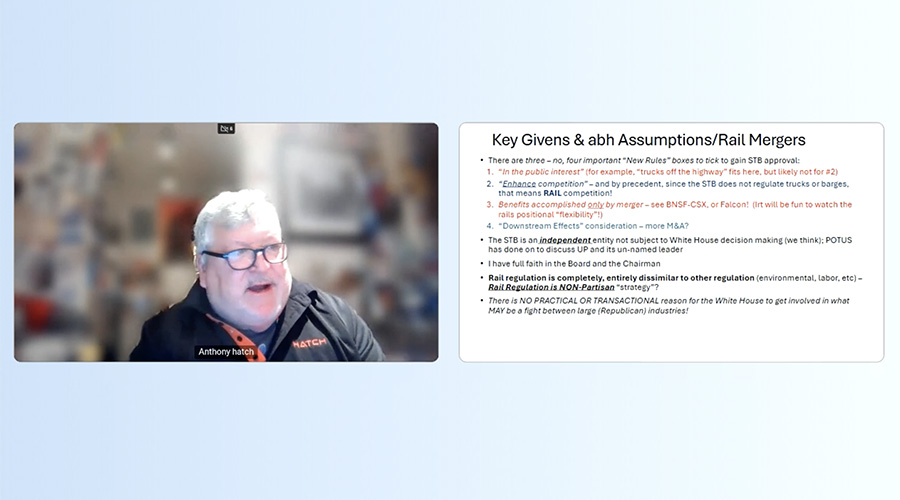 “There is no practical or transactional reason for the White House to get involved” in the merger, said independent transportation industry analyst Tony Hatch.Progressive Railroading/RailTrends
Tony Hatch
The key question the STB will need to answer about UP-NS is: Will it enhance competition? It depends on whose definition of enhanced competition is correct, he said.
But it is up to the STB to make the call on the merger. Hatch has faith in the board and in STB Chairman Patrick Fuchs, he said. No other portions of the federal government need to weigh in.
“There is no practical or transactional reason for the White House to get involved,” Hatch said.
Eliminating single-line issues is the “holy grail” of rail and the merger promises to do that. Yet, the transaction will be under heavy scrutiny by a host of interested parties to determine if it measures up.
“There is the risk of death by 1,000 cuts. All communities want something and it all adds up,” said Hatch. “Are the benefits of the merger worth the risks? We don’t know yet.”
Once the STB actually analyzes the transaction, it will take longer than anyone thinks. Hatch estimates a decision wouldn’t be made until fall 2027.
“It’s the biggest deal ever,” he said.
Hatch also mentioned he had just attended the 2026 Rails to the Future conference at Michigan State University, which was held May 11-13 in Troy, Michigan. Former BNSF Railway CEO Matt Rose and former NS CEO Wick Moorman spoke at the event and addressed UP-NS.
“Moorman said he was against mergers before and he’s against them now,” said Hatch.
Rose said a merger should only happen if shippers demand it.
“And they will demand it if railroads run out of capacity,” said Hatch.
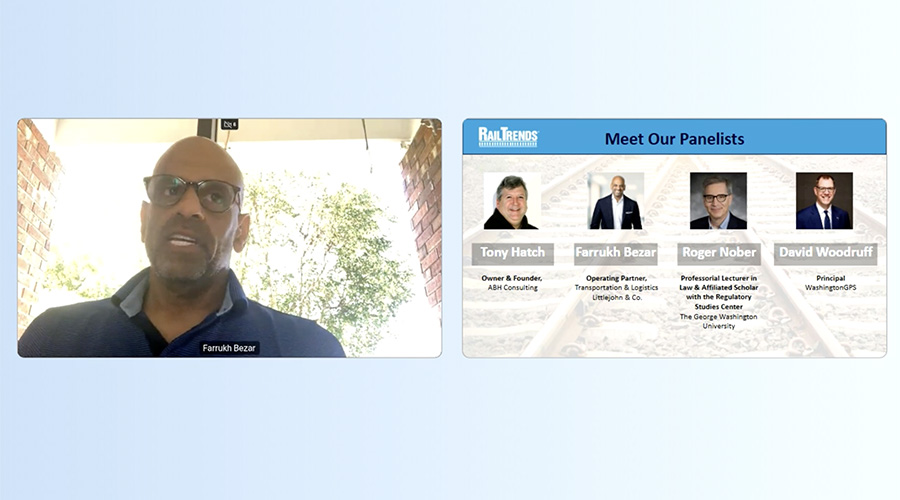 It would be irresponsible of UP and NS to have worked on the second application for nearly four months and then have it rejected again, said Littlejohn & Co.’s Farrukh Bezar.Progressive Railroading/RailTrends
Farrukh Bezar
Bezar began by referring to the merger as “the most impactful and interesting thing happening in the industry.”
UP’s approach to the regulatory aspect of it so far is akin to a prize fighter feeling out their opponent, he said. UP and NS provided the most minimal information possible in their first application to the STB, and that didn’t work, and now it remains to be seen if that approach works in “round 2.”
“It would be irresponsible of them to work on the second application for nearly four months and then have it rejected,” said Bezar.
Some of the uncertainties now are whether the merchandise traffic-building opportunity is larger than what UP and NS believe. Also, Bezar wonders if their estimate about market share is spot on, what concessions will be proposed and, ultimately, if the rail industry is facing the possibility of one major rail merger or two (if BNSF and CSX decide to combine).
From an industrial logic standpoint, a transcontinental merger makes a lot of sense, Bezar said. But he’s skeptical if forming a transcontinental railroad is the only way to foster growth.
“With this merger, the value creation is considerable. But it’s really driven by UP. They want to do something impactful,” Bezar said. “Part of it is performance theater, setting up for what happens down the road.”
What competing Class Is are doing in terms of their efforts to drum up opposition to the merger isn’t really just trying to share their opposing views and draw the like-minded, he believes.
“It’s more about riling up other constituents,” Bezar said.
But UP’s and NS’ competitors will definitely factor into the STB’s decision, he believes.
“BNSF is key to what happens, to if the deal is approved,” he said.
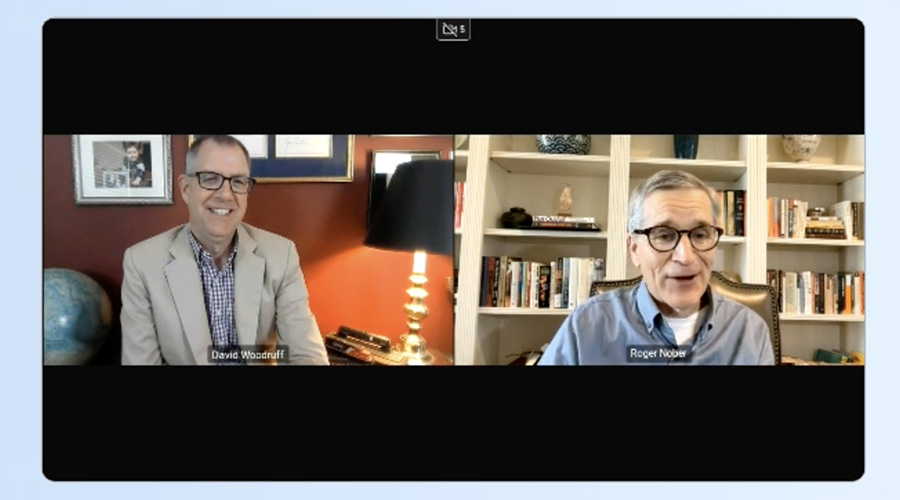 Former STB Chairman Roger Nober (at right) and former CN AVP David Woodruff posed questions to each other during a joint presentation.Progressive Railroading/RailTrends
Roger Nober
The STB has flexibility when it comes to reviewing a merger application. While it typically is a nine- to 12-month process for a formal review, the board can “stop the clock in some cases” to seek more data or information, said Nober.
In addition, the STB can provide parties with limited resources more time to share their thoughts or concerns about a merger, he said.
Overall, the board needs to ensure its review is thorough and complete, which can be a big challenge with UP-NS.
“This is a complicated merger, and there’s a lot in it,” said Nober.
The STB will need to balance fairness on one hand and timeliness on the other, he believes.
“They need to make sure it’s a fair process,” said Nober, who noted he currently is consulting for BNSF.
As for the question if UP-NS will enhance competition, that’s a stark choice for the STB, he believes.
“The regulations are not definitive. It can be seen as rail to rail, but that’s not absolute,” said Nober. “The common understanding is that it’s mostly rail to rail.”
The STB could prevent the merger if one of the railroads proposing to combine was in financial trouble or had shaky finances.
“But that’s not the case here,” Nober said.
David Woodruff
The STB’s makeup is poised to change very soon, Woodruff stressed. Richard Kloster — the founder and president of Integrity Rail Partners Inc. — had reached the final step in becoming the board’s fourth member, he said. (Note: Kloster’s nomination was confirmed by the Senate on May 18.)
In addition, STB Commissioner Karen Hedlund has been nominated for a second five-year term on the board. She joined the board in January 2022.
“They’re not really that far off from getting all five members,” said Woodruff.
A Democrat, Hedlund was a bit of a surprise as a nominee given the Trump administration’s penchant for nominating Republicans, several panelists mentioned.
Meanwhile, how Class I competitors continue to react to the merger bears watching, Woodruff believes.
For example, CSX had been relatively quiet about UP-NS for quite some time, but recently set up a web page — called Staying on Track — that shares its position against the merger and offers resources to concerned shippers. The railroad has also hired a consultant to gain help with its anti-merger efforts, said Woodruff.


