CPKC gains more efficiency from more workable shop in Illinois
4/13/2026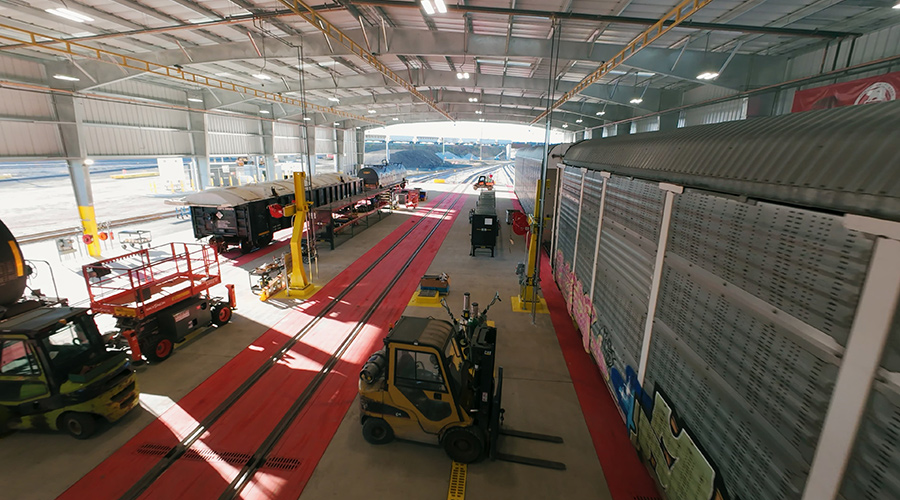
By Jeff Stagl, Managing Editor
CPKC is reaping the benefits of a new mechanical shop in Bensenville, Illinois, that was reconfigured and revamped late last year to help drive operational efficiency.
The shop at Bensenville Yard now enables workers to service multiple rail cars simultaneously in a more effective, accessible and safe environment. The facility helps reduce dwell time and keep freight moving fluidly across the network, CPKC officials say.
“The new Bensenville mechanical facility represents the latest phase in the comprehensive reconfiguration of Bensenville Yard,” said CPKC Vice President of Mechanical-Car Bradley Robertson in an email. “This endeavor required a full redesign of mechanical operations at Bensenville and the physical relocation of the facility from the south end to the north end of the yard.”
Design work for the new shop began in summer 2024 and CPKC launched construction in May 2025. The facility became fully operational just six months later on Nov. 1, 2025.
“The project was executed under an accelerated timeline, as it was imperative that the new facility be operational prior to the onset of winter,” said Robertson.
Because of the project’s scope and scale, CPKC employed multiple contractors to ensure completion within the specified timeline, he said. AECOM was responsible for the shop’s design and K-Five Construction was the primary heavy civil contractor responsible for coordinating with several subcontractors on various aspects of the project.
The project involved construction of a new 700-foot by 100-foot concrete working pad designated for rail-car repairs and a 300-foot by 100-foot shelter equipped with integrated utilities to support car maintenance activities.
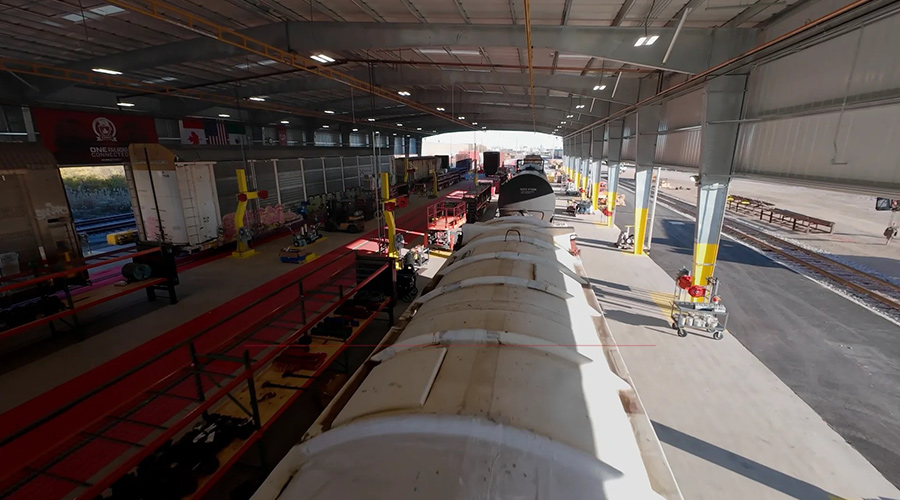 The new facility features a 300-foot by 100-foot shelter equipped with integrated utilities to support rail-car maintenance activities.CPKC
In addition, 14,000 feet of new track and 15 new turnouts were installed. Trackwork was performed by both CPKC teams and crews from Lewis Equipment Services.
“Notably, this project also included the installation of a high-speed drop table, enabling the mechanical team to replace a wheel set in under five minutes,” said Robertson.
Now, the new shop layout enables cars needing repairs to be spread out across more space, providing workers easier access to all points of each car while simplifying and better securing car tie-downs. Technicians now can approach each job — from brake work to wheel service to other maintenance tasks — with greater confidence and fewer constraints, said Robertson.
“The result? At least four hours cut from each car's dwell time, more cars serviced simultaneously and a safer environment that gives the carmen better access and more room for work,” he said.
Shop output has vastly improved due to the project, Robertson stressed. In the past, the repair track was averaging 10 to 15 cars released per day, with many cars sitting for days because of slower processing times. Now, the shop averages 20 to 25 cars repaired per day depending on how many are spotted, Robertson said.
With the inbound tracks built directly off the yard lead, train crews can bad order cars faster than the old repair track allowed. Cars have a direct path to the wheel pit and then down to the repair track, eliminating all extra switch moves.
“Prior to the new repair track, the average daily bad-order count was averaging 40, and the new daily bad-order count averages 20,” Robertson said.
The new wheel pit improves both safety and speed of wheel changes by reducing the amount of equipment moves and the additional setup time of moving jacks and jack stands to change wheels or brake beams.
“Another part of the project was switching to a remote-control track mobile that allowed us to operate the wheel pit with less staff so employees can work heavy bad orders or assist in other parts of the operation,” said Robertson.
The entire repair track area was equipped with new electric over hydraulic jacks that can be used on any of the three repair tracks to jack cars and change cushion units, draft gears or any other work requiring cars to be jacked.
“Once the cars are repaired and the back-to-basics inspection is completed, the cars are shoved west to an easily accessible lead that allows for a quick efficient pull by the switching crew,” said Robertson. “Where on the old repair track cars would dwell and require all the extra moves, the new repair track allows us to get all cars that are spotted each day repaired and shoved out, removing unneeded delays and dwell.”


