UP-NS merger dissected at MARS event near Chicago
1/20/2026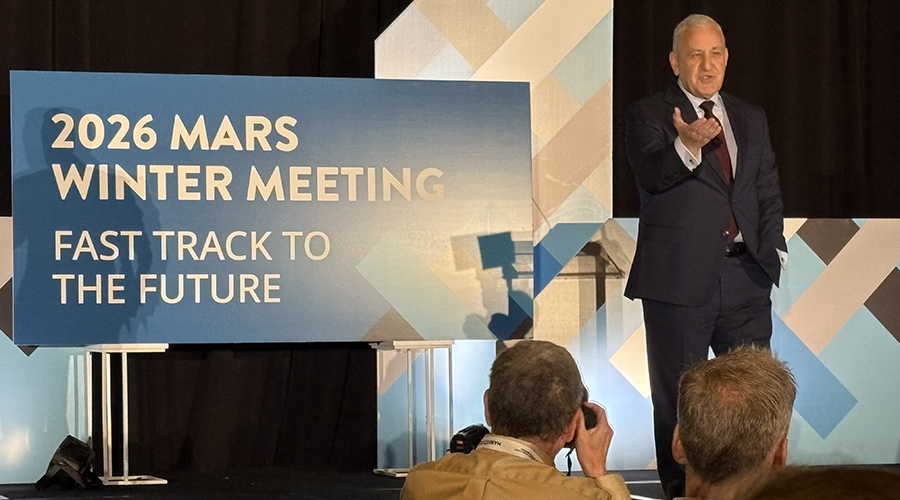
By Jeff Stagl, Managing Editor
Ever since Union Pacific Railroad and Norfolk Southern Railway announced their plan to merge almost six months ago, their attempt to create the first U.S. transcontinental railroad has been a very hot topic in the rail industry.
That was more than evident at the Midwest Association of Rail Shippers (MARS) winter meeting, which was held Jan. 14 and 15 in Schaumburg, Illinois (about 30 miles from Chicago). Three Class I CEOs — including UP’s Jim Vena — and one Class I CMO spent much of their presentations talking about the proposed merger.
And the timing of the MARS event was impeccable, given the Surface Transportation Board (STB) issued a key decision the day after the winter meeting ended that determined the merger application filed by UP and NS on Dec. 19 was incomplete.
CPKC’s Creel: Do no harm
CPKC President and CEO Keith Creel led off the meeting’s presentations the morning of Jan. 14 and quickly began to critique the merger. During a keynote that ran about a half hour longer than it’s allotted time, he set the tone for the event by telling the large audience they would “get a debate” about the UP-NS combination over the course of the two-day meeting and gain a better understanding of what’s at stake.
Creel and Vena aren’t enemies, Creel stressed, adding that they worked together at CN for 15 years.
“We have a unique set of views given the seats that we sit in,” Creel said.
From Creel’s viewpoint, perspective matters, he said. When Canadian Pacific and Kansas City Southern merged a few years ago, the two smallest Class Is combined to form what’s still the smallest Class I. The CPKC merger “didn’t tip the scales in size and risk,” Creel said.
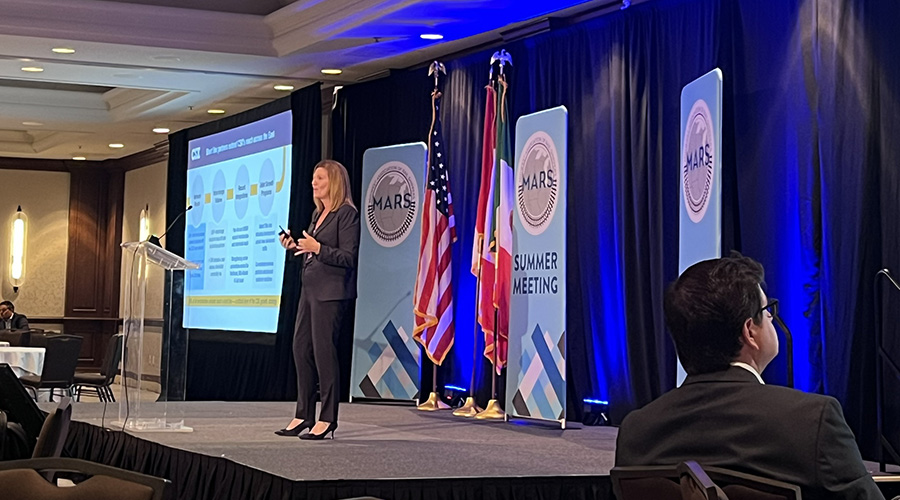
 BNSF Railway President and CEO Katie Farmer (at left) said history hasn’t been kind when it comes to Class I mergers. CHS Inc. Director of Rail Transportation Monica Freeman (right) posed questions to Farmer during the presentation. Jeff Stagl
 However, the mammoth UP-NS combination could harm shippers, he believes. The bar perhaps hasn’t been set high enough for that merger to be properly considered, Creel said.
He then referenced something he heard former CP board member and STB chair Linda Morgan — who died in 2015 — say. She had her own way of sizing something up, especially something big, by placing the pros and cons in separate boxes.
“The ‘benefits’ box must be fuller than the ‘harm’ box,” Creel said.
And for UP-NS, the harm box is much fuller, he believes. Since the merged entity would be unprecedented in scale and scope, and radically and permanently change the U.S. rail network, it poses extraordinary and far-reaching risks to shippers, rail employees and broader supply chains, Creel said. He encouraged the shippers in the audience to make their voices heard about UP-NS by sharing comments with the STB.
One point of contention for Creel is the estimate by UP and NS that the combined railroad could convert 2 million loads from truck to rail over time. That’s the equivalent of 14 additional 10,000-foot intermodal trains moving every day, Creel said. By contrast, CPKC moved 1.8 million container loads on its network in all of 2025.
“If you’re going to the public-interest test and you’re filling up that benefits box, are they real, or are they achievable?” Creel asked about the truck diversion goal. “Is it achieving or is it aspiration?”
He also questioned the merger’s proposed gateway pricing that would streamline rates for some shippers. Only about 20% of shippers would benefit from that program, Creel estimates.
“That means 80% either got the same or higher rate,” he said.
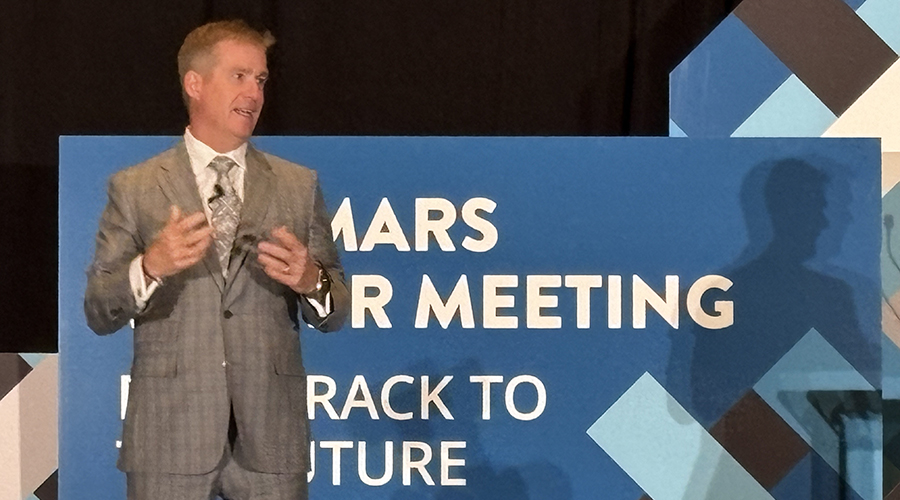 CPKC President and CEO Keith Creel had so much to say about the merger — such as how it would harm shippers — that he exceeded his slotted time by about a half hour.Jeff Stagl
 BNSF’s Farmer: Use history as a barometer
BNSF Railway President and CEO Katie Farmer made similar points and was equally critical of the merger. During her 34-year career in the rail industry, she’s “lived through three mergers and one failed merger.” And history largely has not been kind when it comes to Class I mergers, Farmer said.
“When we talk about any future mergers, [we need to] look back at history and say, ‘How does history inform what we think might happen in this consolidation?’” she said.
UP and NS are talking about 11% to 13% traffic growth in the first three years after the merger, but their volumes “have shrunk” over the past decade, Farmer said.
“So, the idea that they’re going to grow volume by double digits in three years, I think we have to at least question, is that an accurate premise?” she posited.
Less than 6% of all shippers have sent letters to UP and NS voicing support for the merger, Farmer said. The open gateway concept proposed by the “near monopoly” can be questioned as to whether it would work now, she said.
For example, BNSF has had a negative experience at the Laredo, Texas, international gateway post-CPKC merger.
“Prior to the CP-KCS merger, we handled 10,000 units a month over Laredo for our customers. Today, we don’t handle a single unit over Laredo,” Farmer said.
Saving a few hours by eliminating some interchanges might not be worth the risk of service issues on a scale the rail industry has not witnessed before if the merger comes to fruition, she said.
“My opinion isn’t important, but I’m gonna make sure that you all have the facts in front of you,” Farmer told the audience. “And I would encourage you that now is the time to make your voices heard.”
CN’s Drysdale: Keep shippers top of mind
Although she didn’t spend a lot time talking about the merger, CN Executive Vice President and Chief Commercial Officer Janet Drysdale did make some points about UP-NS toward the end of her address.
There are consequences for shippers, she said. CN doesn’t believe the merger would enhance competition or generate significant public benefits, Drysdale said.
“It would increase congestion on key corridors [and] increase the risk of more consolidation,” she said.
UP and NS must go beyond the remedies that were part of previous mergers that were analyzed under the old merger rules, Drysdale stressed. UP-NS should be measured more in the context of shippers.
“I would ask all shippers to get involved in the process. You can file a notice of intent to participate by Feb. 2,” Drysdale said.
She stressed that CN is not anti-merger as long as such a combination meets public interest requirements.
“We are pro competition,” Drysdale said.
UP’s Vena: All about the facts, not feelings
The true star of the MARS event — who drew hundreds to the ballroom as the first presenter on Jan. 15 — was UP CEO Jim Vena. And he didn’t disappoint.
Vena was engaging and highly entertaining. He shared some funny anecdotes, such as a phone call he received that morning from his 95-year-old father who wanted to know if he was working that day (“I said dad, I work every day. He thinks I don’t work because I have all these assistants,” Vena said.)
He also poked fun at Creel a number of times for running so far over his allotted time. Vena promised to finish his presentation on time (although he did exceed his time by just a few minutes).
Vena had a bit of a chip on his shoulder since the merger was so highly criticized at the MARS event. He said he didn’t care what people feel or think about the merger. It’s not about what anyone feels but what the facts are, Vena said.
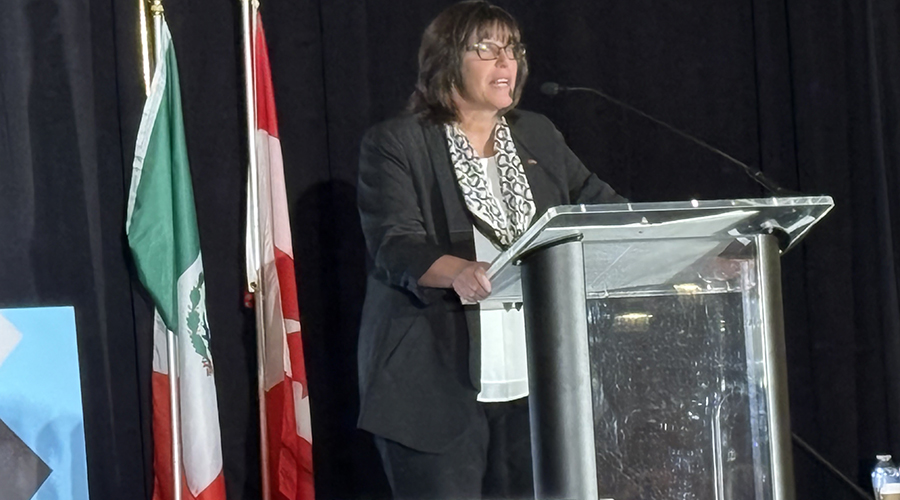 CN EVP and CMO Janet Drysdale said UP-NS poses a risk for more consolidation in the rail industry. Jeff Stagl
For example, UP is the safest Class I, and that’s not because that’s what he thinks but because that’s what the statistics show, Vena stressed. What he does think is that others should be keeping more of an eye on their issues.
“Let them worry more about their own business. What we’re doing is the right strategy. I like talking about facts, not fiction,” Vena said.
Every day already is a dogfight to win business from competitors, and BNSF is not an easy competitor to UP, he said.
“This is an opportunity to grow business and compete against trucks,” Vena said.
In terms of all the critiquing by UP’s Class I competitors, he posed a question to them: If you thought a competitor was doing something stupid, “wouldn’t you just shut up and let them do it?” he said.
“Because at the end of the day, they’re going to screw up and you’re going to have a better place in the marketplace and win more business,” Vena said.
Competing railroads are “up in arms” about UP-NS because it would be a new competitor that’s faster and moves freight more seamlessly, meaning other railroads will need to compete at a higher level, he said.
“So, the bottom line is you would only complain, and complain as hard as they are, without the true facts, especially if you thought that your competitors have something that’s going to give them an upper hand,” Vena said.
He also addressed criticisms about the high rates UP-NS would charge and how much of the market the transcontinental railroad would cover/control. UP-NS will set prices that reflect where the market is, Vena said. And it won’t control more than half of the market.
“We will have 38 to 40% of the railroad market in the U.S., at best,” Vena said.
As to if UP-NS might lead to other mergers, such as a BNSF-CSX combination, that would be more than fine to Vena.
“It would be good for customers. I’d be supportive of it,” he said.