Connecting passions: How an NS hazmat manager makes the most of his fire service background
8/25/2025
By Bridget Dean, Associate Editor
When a derailment or hazardous materials release occurs, local first responders rely on railroad professionals as subject matter experts and response coordinators. In Norfolk Southern Railway’s Gulf/Coastal Division, that professional is Elliott Austin, a 12-year fire service veteran.
As one of eight hazardous materials managers across the NS network, all overseen by a director of hazardous materials, Austin has the important role of ensuring railroad incidents are responded to properly. On any given day, he may be teaching NS’ Operation Awareness & Response (OAR) courses to firefighters, reviewing hazmat compliance procedures or coordinating the response to a derailment and hazmat release.
“I used to say in the fire department that every day is different. Every day is really different here,” he says.
With nearly two years under his belt in his current role, Austin has quickly picked up the knowledge needed to serve as point person during rail emergencies, helped significantly by his previous experience in fire service special operations. In order to gain that expertise, he completed numerous trainings over the course of his career, becoming a hazmat technician, a tank car specialist and a hazmat incident commander for railroad emergencies.
Railroad 101
How first responders react in the first minutes and hours when arriving on a scene can reverberate throughout the rest of the response, Austin says.
“[Derailments are] not like what most first responders are used to. It’s not just a house. It’s not just one patient. It can be something that affects a town, a region,” he adds. “That’s a once in a career incident for most first responders.”
Railroads must equip first responders with the tools necessary to respond to an incident until subject matter experts arrive on scene. In basic OAR courses, sometimes known as Railroad 101, Austin teaches them how to identify types of rail cars and hazardous materials — and, critically, how to get in touch with him. Annually, NS hazmat managers train 5,500 first responders in railroad safety.
Integration with the NS response team and any contractors involved in the process is crucial. Austin makes sure first responders are prepared to work with all members of the NS team who respond to an incident, from engineers and conductors to hazmat specialists and divisional leadership. Austin’s role onsite is to be a liaison between members of the NS team and the local response. Having a dedicated liaison makes the response run smoothly, he says.
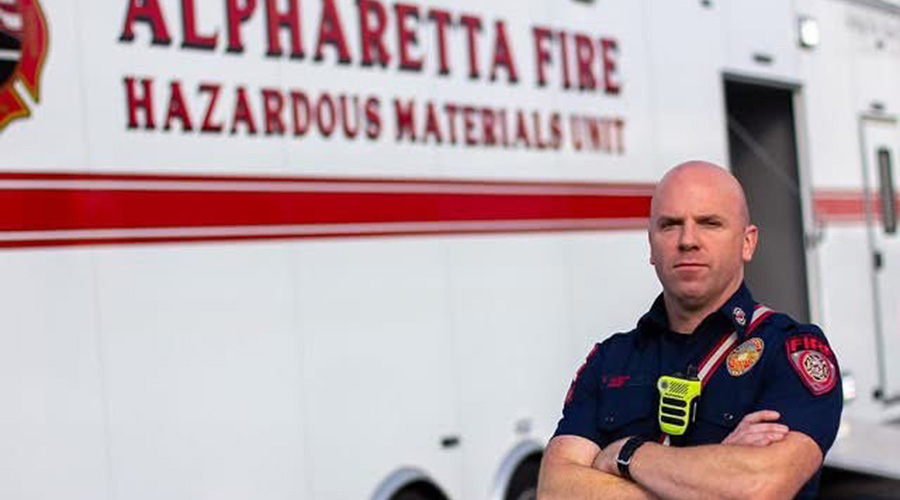 Before joining Norfolk Southern, Elliott Austin was in the fire service for 12 years, including in hazardous materials operations. Courtesy of Elliott Austin
Inspiring others
While not all the NS hazmat managers come from the fire service — others have backgrounds in railroading, military and government — Austin’s previous experience allows him to easily connect with first responders and share information effectively, as he understands how they operate and the challenges they face.
The most frequently asked question Austin gets when teaching is “how did you get this job?” The answer to that question is education, experience and lucky timing.
“It’s putting yourself in the right position. Taking the leadership classes, understanding that there’s not a lot of these positions in the country, let alone with Norfolk Southern,” Austin says.
He had already put in the work to be an expert on hazmat releases from the fire service side. Then it was just waiting for the job opening. When he saw the role of hazmat manager was open, he reached out to NS expressing his interest.
Austin’s practical experience with hazmat management was important to securing his NS role, but so was his character and leadership abilities. First responders should have a good sense of their own capability, not be afraid to ask for help, and be able to stay calm in emergencies, Austin says. Those qualities are valuable in the railroad industry, too, and that’s what he tells first responders who look to him as a guide to working in hazmat management or switching to the railroad industry.
During his time in both industries and in teaching classes to first responders, Austin has noticed a connection between people’s passion for working in the fire service and working in the railroad industry. Both industries are held in high regard and “ingrained in American society,” he says. He feels fortunate to have worked in both industries and hopes he can be an example to others with the same passions for fire service and railroading.
“If it weren’t for what I did in the fire service, I never would have had an opportunity to come work for NS,” he says. “I just hope that by putting this message out ... it encourages other people who have the same interest.”


