Vancouver port combines auto terminals to address mounting import demand
9/2/2025
By Jeff Stagl, Managing Editor
From two to one. That’s what the Vancouver Fraser Port Authority recently accomplished in a big way with the Port of Vancouver’s auto terminals in British Columbia.
Work completed in late July resulted in the consolidation of the Annacis Auto Terminal and Richmond Auto Terminal into a single facility, the now larger and more efficient Annacis Auto Terminal. The Annacis Auto Terminal Optimization Project began in 2022.
The terminal is located on Annacis Island, a narrow island governed by the city of Delta. It’s the largest auto terminal on Canada’s West Coast, says Arpen Rana, the port’s senior communications adviser.
The project involved expanding two rail yards to create 60 additional rail-car spots, constructing a new vehicle processing facility and installing electric vehicle charging stations. Now, the terminal’s annual auto import capacity has increased by 36%, from 352,000 vehicles to 480,000 vehicles.
The consolidation will enable the port to better serve Canada’s growing imported auto market, port authority officials say.
“The project also frees up valuable industrial land for other trade-enabling activities in the future,” says Rana.
The Annacis Auto Terminal primarily is served by Southern Railway of British Columbia, which is branded as SRY Rail Link. The 125-mile short line provides main switching and terminal rail services, and transports nearly all autos imported from Asia that arrive at the port.
SRY Rail Link interchanges directly with BNSF Railway Co., Canadian Pacific Kansas City and CN, and indirectly with Union Pacific railroad via cross-border connections. The short line’s network enables vehicles at the Annacis terminal to be efficiently transferred to the Class Is through interchanges in New Westminster, British Columbia, allowing for nationwide and international rail distribution, says Rana.
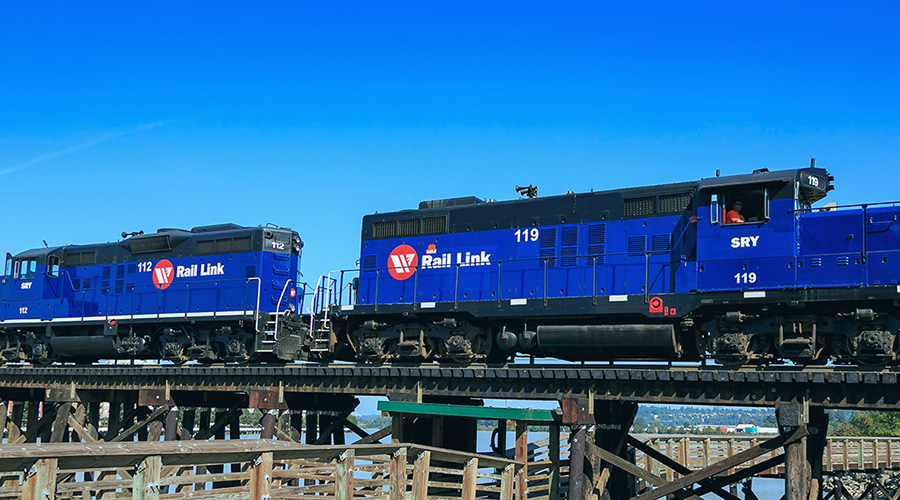 SRY Rail Link, which serves the Annacis Auto Terminal, interchanges directly with BNSF, CPKC and CN, and indirectly with UP via cross-border connections. The short line operates 125 miles of track. Southern Railway of British Columbia
Operated by Wallenius Wilhelmsen Solutions (WWS), the Annacis Auto Terminal serves more than a dozen of the world’s top auto manufacturers, including BMW, Honda, Hyundai, Kia, Mercedes, Mitsubishi, Nissan and Subaru. The project was funded by the Canadian, port authority and WWS, a global shipping and vehicle logistics service provider that manages the distribution of cars, trucks, and rolling and breakbulk equipment.
The terminal consolidation is one of more than three dozen infrastructure projects that are part of the Greater Vancouver Gateway 2030 strategy, an initiative aimed at enhancing the region's infrastructure and services to support trade and tourism growth.
Located on the southwest coast of British Columbia, the Port of Vancouver manages shoreline that extends across Burrard Inlet, Fraser River and Roberts Bank. It’s the fourth-largest port in North America as measured by tonnage and handles almost as much cargo as Canada’s next five largest ports combined.
Imported vehicles account for nearly all of the port’s auto volume, says Rana.
“There are only a small number of vehicles exported annually, ranging from 50 to 100 units,” she says.
Last year, Canadian auto sales rose 8% compared with 2023’s level due to strong sales momentum in 2024’s first half, steady production and inventory levels, easing interest rates and dealership incentives.
The Port of Vancouver in 2024 imported about 470,000 vehicles, up 3% year over year and an all-time volume record. Imports from the United States account for only about 3% of the port’s total auto volume, says Rana.
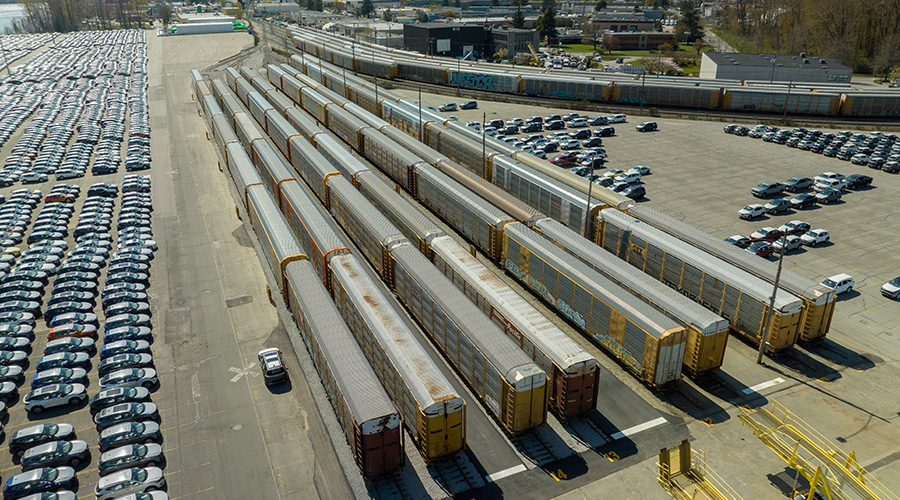 After setting an import record of 470,000 autos in 2024, the Port of Vancouver in first-half 2025 registered vehicle volume that was just 3% below that all-time pace.Vancouver Fraser Port Authority
The port’s auto volume remained strong in 2025’s first half, tracking just 3% below last year’s record pace.
“Similarly, Canadian auto demand showed resilience over the first half of the year, with sales rising 6% compared to 2024,” says Rana. “Looking ahead, we expect throughput to stay solid, though broader economic conditions could impact demand.”