CSX's REDI center has been getting railroaders job-ready for 20 years
10/31/2025
By Julie Sneider, Senior Editor
More than 100,000 people have undergone job and safety training at the CSX Railroad Education and Development Institute (REDI) since the center opened its doors in Atlanta 20 years ago.
Not only has the center offered instruction in safety, technical skills and leadership development to CSX employees over the years, it also has served the training needs of the Class I's customers and short-line railroad partners.
“For two decades, this [REDI] facility has been the place where our shared journeys begin,” said CSX Executive Vice President and Chief Administrative Officer Diana Sorfleet in a press release. “It's where we welcome new team members and is where we instill our values and our culture, so that when you leave here, you truly understand what it means to be a railroader.”
Sorfleet was among the CSX employees, alumni and public officials who gathered on campus on Oct. 21 to celebrate the center’s 20th anniversary. Everyone who has gone to work for the Class I since 2005 has passed through the REDI’s doors.
Jim Schwichtenberg first visited the REDI center in 2012 while working for another railroad that was considering opening an employee training center. Six years later, Schwichtenberg went to work for CSX, where the REDI center now falls under his responsibilities as vice president and chief safety officer.
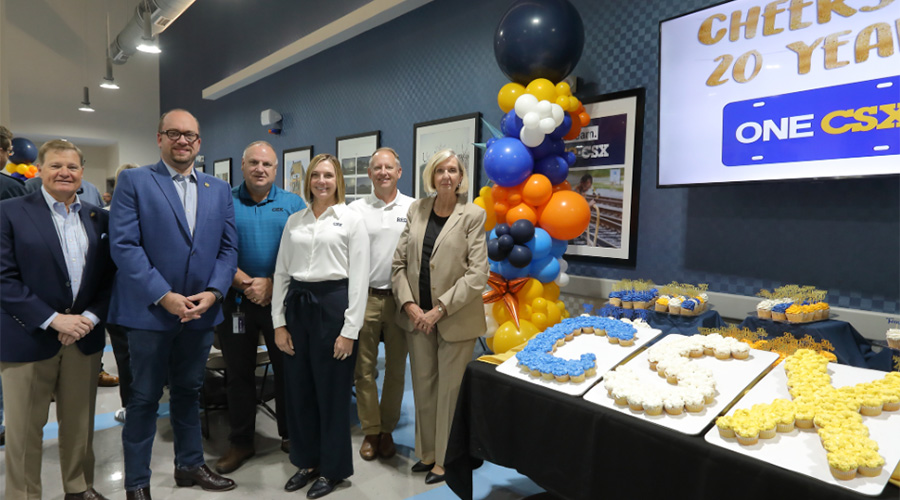 Shown left to right: Craig Camuso, CSX senior director of state relations; Dustin Hillis, Atlanta City Council member; Doug Ryhorchuk, CSX VP of transportation; Diana Sorfleet, CSX EVP and chief administrative officer; Jim Schwichtenberg, CSX VP and chief safety officer; and Margaret Downey, adjunct professor and former CSX GM of learning development and strategies.CSX
The center serves as the flagship for training at CSX, where employees may come through its doors and classrooms multiple times as they advance in their careers at the company, Schwictenberg says. New hires from all departments start their training there to learn entry-level and other basic skills, then depart for more intensive on-the-job or in-the-field training according to their individual job requirements.
REDI staff aim to prepare new employees and program participants for success in three core areas: safety, customer focus and engagement, according to CSX.
Over time, the center’s physical space has expanded from rooms in a former office building to a campus of three buildings with state-of-the-art infrastructure to support real-world learning. The engineering and mechanical building features 16 welding labs, 12 locomotive simulators and PTC and signaling labs; the transportation and management building houses classrooms for up to 80 trainees, a model rail room and an outdoor area for testing competencies; and the field facility replicates a crew-room environment plus outdoor training along rail track.
In just the past five years, the center has trained 6,347 conductors, 1,800 engineers and 825 new mechanical hires, CSX officials estimate. Additionally, 4,350 people have completed safety certification training and 720 have completed refresher courses.
 “As things change in the railroad environment, we'll invest back into the center and make sure that our railroaders are getting the latest and greatest when it comes to technology or changes in the workforce.” — Jim Schwichtenberg, shown at left with Doug Ryhorchuk (center) and John Barnette (right), director of transportation training.CSX
As employees advance in their careers, they may also return to the center for additional preparation as leaders in their departments, according to Schwichtenberg.
Although the REDI campus has expanded in 20 years, its mission has remained constant, he says.
“We’ve really wanted to be an industry leader in development for our employees [and] the benchmark for safety,” he adds. “The technical training and professional development have been everlasting.”
While the mission hasn’t changed, the equipment and tools that railroaders use on the job have changed, so “any opportunity that we get to enhance the center, that’s what we try to do,” Schwichtenberg says.
How future technological advancements — such as artificial intelligence — might affect the REDI’s training programs is “a little bit of an unknown,” he says.
“In the rail industry, a lot of the things we do are hands-on,” he says. “So, if you think of conductors or the men and women that do track construction, there needs to be a place where they can get that technical training in a controlled environment.”
The center will be ready to help railroaders adapt to whatever the future may bring to the job, he believes.
“As things change in the railroad environment, we'll invest back into the center and make sure that our railroaders are getting the latest and greatest when it comes to any technology or changes in the workforce,” he says.