BNSF needs to clear one more BIG hurdle for sprawling Barstow facility
10/8/2026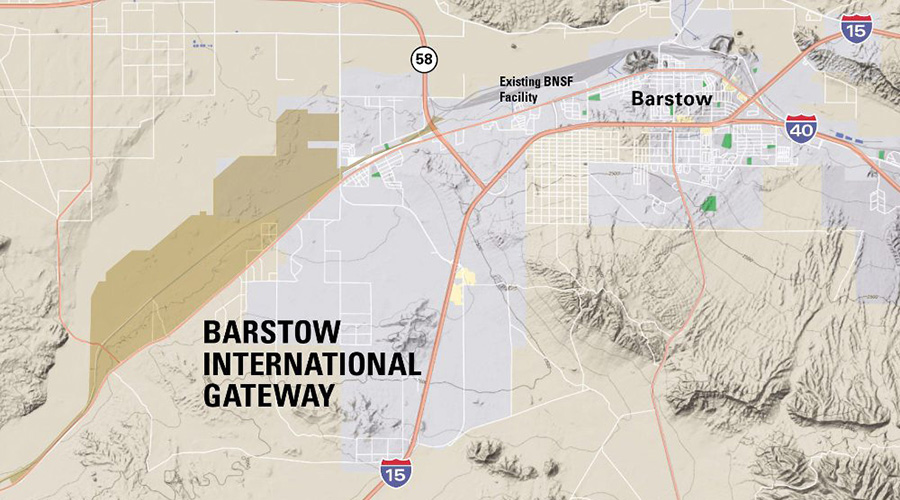
By Jeff Stagl, Managing Editor
After four years of preparation efforts and a series of hoop-jumping maneuvers, BNSF Railway is closer to starting construction on its more than $4 billion Barstow International Gateway (BIG) master-planned facility in southern California.
The aptly named BIG complex would cover about 4,500 acres on the west side of Barstow and feature a rail yard, intermodal facility and warehouses for transloading freight from international containers to domestic containers. BIG would accommodate containers that arrive at the ports in Los Angeles and Long Beach; BNSF would transport them through the Alameda Corridor on its mainline to Barstow.
But there’s one last hoop that BIG needs to clear before ground is broken: a lawsuit filed against the city of Barstow by a group of environmental advocacy groups. They are seeking to overturn the city’s recent project approval, claiming that decision was based on a faulty and inadequate analysis of the facility’s environmental impact.
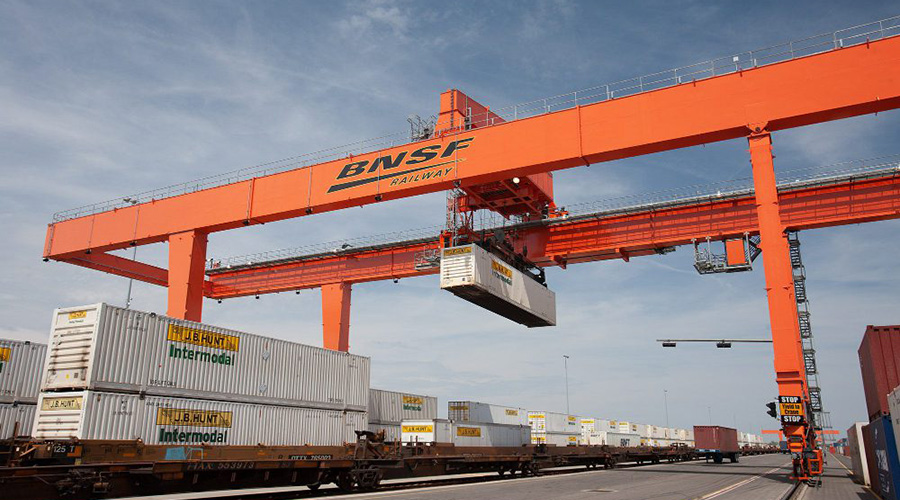 The BIG complex would accommodate containers that arrive at the two L.A.-area ports. BNSF would transport containers through the Alameda Corridor on its mainline to Barstow.BNSF Railway
The Sierra Club, East Yard Communities for Environmental Justice, Natural Resources Defense Council and Center for Biological Diversity officials argue the city didn’t adequately analyze the project’s effects on certain wildlife and plants in the Barstow area, and failed to thoroughly analyze the project’s energy, water, noise and cumulative impacts. For example, they claim that BIG would emit high levels of nitrogen oxide and increase greenhouse-gas emissions.
BNSF officials say BIG is a critical infrastructure investment that has garnered strong support at the local, regional and state levels, and the pending litigation challenge misrepresents the technologies the Class I plans to implement for the facility.
The railroad has committed to employing zero-emission equipment at the facility, such as electric rail-mounted gantry cranes, forklift and hostlers, and hybrid rubber-tired gantry cranes, they say. BNSF also plans to use electric plug-ins for refrigerated units and battery-electric switchers.
In addition, the facility would be powered by a 140-acre solar farm, rooftop solar panels on warehouses and solar canopies.
 Since the Class I seeks to be an intermodal carrier of choice, the BIG will serve as a crucial next step in that objective, BNSF leaders say.BNSF Railway
BNSF estimates that over its first 20 years of operation, the BIG complex will create about 5,400 new direct jobs, and generate $938 million in total earnings and $2.9 billion in total economic output for the area.
The project already has secured the necessary local approvals and an expedited court review process has been established, said BNSF General Director of Public Affairs Lena Kent in an email.
“We expect the matter to be heard this fall, and a decision to be issued this year,” she said. “In the meantime, BNSF continues advancing construction readiness activities and remains on track for a construction start at the end of 2026, subject to the court's decision.”
If construction does start by year’s end, BNSF officials anticipate that BIG could open in 2028 or 2029.
Deep in its DNA
Intermodal is in the Class I's DNA and the BIG would be the next phase of the railroad's intermodal franchise, said BNSF President and CEO Katie Farmer Sept. 13 at the Intermodal Association of North America's annual expo in Long Beach, California. Since BNSF wants to be a carrier of choice, BIG is the next step in that objective, she said, adding that there's a high level of excitement about the facility among beneficial cargo owners.
The Class I estimates the BIG facility would eliminate about 205 million truck miles traveled (TMT) in 2028. The TMT reductions then are projected to grow to 269 million by 2033 and 312 million by 2048.
BNSF recently partnered with supply chain solutions provider NFI to provide integrated access to transportation, warehousing, distribution and transload solutions within the BIG facility. Based out of Camden, New Jersey, NFI owns and operates over 70 million square feet of warehouse space and a fleet of 5,100 tractors and 13,000 trailers.
NFI's portfolio of logistics services will complement the capabilities available through BIG, helping shippers simplify operations and improve supply chain coordination, BNSF officials say.
BNSF and NFI plan to jointly support businesses seeking scalable solutions that integrate port drayage, transportation, warehousing and distribution into a single logistics ecosystem.
In addition, BNSF recently forged a partnership with Spearpoint Logistics regarding the BIG. Specializing in heavyweight loads, Spearpoint will establish operations at the Barstow facility to provide warehousing and transportation services.
The collaboration will provide customers with additional supply-chain options, including warehousing, distribution and brokerage services for freight moving through southern California from Asia and Mexico to various U.S. destinations, BNSF officials say.