Class I execs talk traffic growth, competition at MARS summer meeting
7/17/2026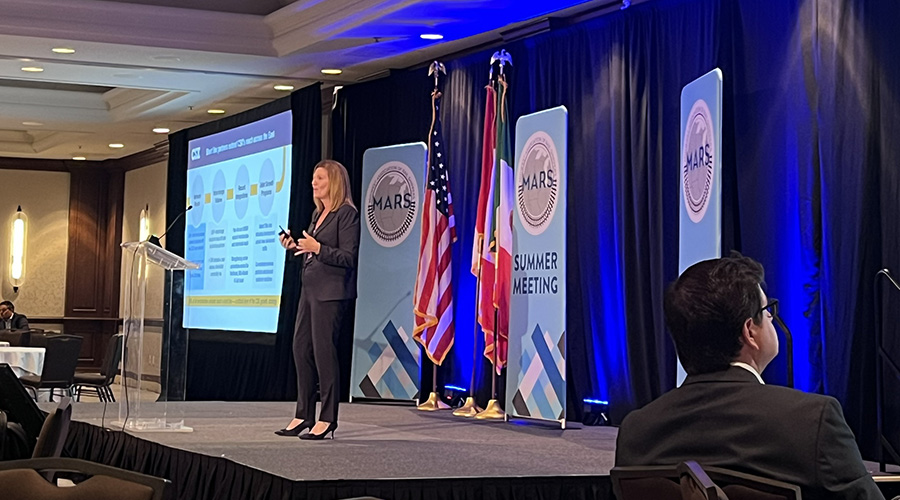
By Bridget Dean, Senior Associate Editor
On July 14, transportation professionals from the U.S. Midwest and Canada came to Lake Geneva, Wisconsin, to attend the annual Midwest Association of Rail Shippers (MARS) summer meeting.
They heard presenters discuss market trends, international trade disruptions, trucking rates and, of course, the proposed Union Pacific Railroad-Norfolk Southern Railway merger.
A reoccurring theme throughout the day was growth, as Class I presenters talked about how railroads are aiming to help shippers increase production and opportunities for railroads to expand their reach and capture more volume in the transportation market. Following are highlights from CSX and NS execs’ presentations.
CSX’s Kenney: Shippers are rethinking the global supply chain
CSX Senior Vice President and Chief Commercial Officer Maryclare Kenney was the morning keynote speaker; she provided updates on CSX’s market outlook, capital planning and growth strategy.
Rail traffic growth was slow in the first half of 2026 as macroeconomic conditions continued to challenge U.S. industrial production, although Kenney noted a slight traffic uptick in recent months as companies have been reinvesting in U.S. manufacturing, given the global trade uncertainty.
CSX also logged unexpected strength in intermodal traffic, she said. Trucking rates have risen, leading more intermodal shippers to opt for rail. The increase in data center construction has driven demand for metals, and volume has been strong in that sector, Kenney said. Data center usage is also leading to high energy demand and power utilities are struggling to keep up.
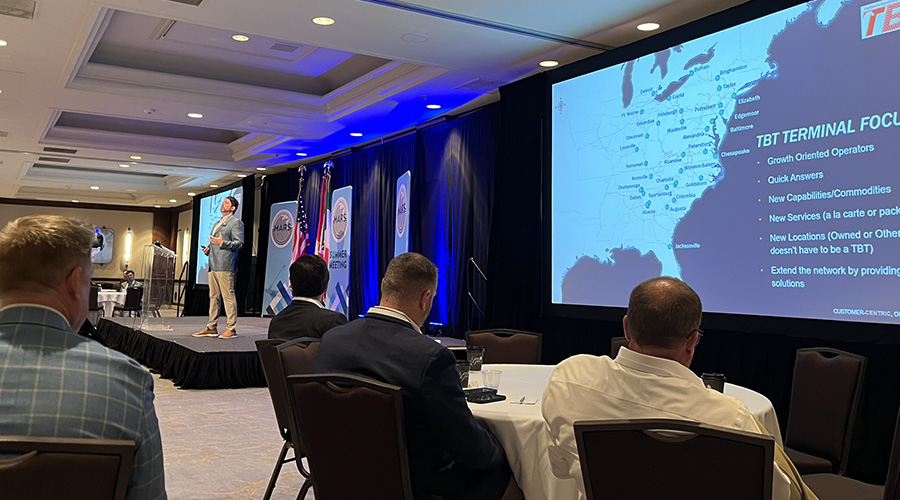 Stefan Loeb, NS VP of business development for first and final mile markets, shared how the Class I has pursued first- and last-mile traffic.Bridget Dean
Meanwhile, the Trump administration has supported an increase in coal-fired power plant usage, but many facilities have outdated infrastructure and are not operating at full capacity. Still, coal-by-rail traffic has been stable in 2026, with a mixture of domestic and export traffic.
“The U.S. is not done with coal,” she said.
Kenney also shared the capacity improvements and capital investments CSX has planned for this year, including switch upgrades, yard improvements and siding extensions. The Class I also is investing in growth through its dedicated site selection program and industrial development team.
“When you think about U.S. industrial development, CSX really sits in the prime part of it,” Kenney said, showing a heat map of recent industrial development activity across the railroad’s corridors in the southeast United States.
Partnerships are also key to CSX’s growth strategy as the railroad aims to leverage its relationships with short lines, fellow Class Is and terminal partners to create solutions for shippers that don’t have direct rail access.
“We have a pretty robust transloading operation called TRANSFLO. We have 46 locations today; it’s an area we continue to invest heavily in,” Kenney said, adding that TRANSFLO has opened three transloading terminals within the last year.
Demand forecasting, too, is crucial. Crew availability can be a challenge; finding and training qualified conductors and engineers takes time. CSX could use more lead time from shippers to ensure it has enough capacity to handle volume growth, she said.
In response to a meeting attendee’s question about the proposed UP-NS merger, Kenney reiterated CSX’s publicly stated opinion: The merger would cause an imbalance in rail competition by eliminating options for shippers, she said.
“We compete today; we want to keep competing,” Kenney said. “We want to stay in a landscape where we can provide competitive solutions.”
NS’ Loeb: Rail growth can’t be limited to revenue
An NS exec also had thoughts to share on the merger, business development strategies and what successful growth looks like.
Stefan Loeb, NS VP of business development for first and final mile markets, joined the Class I in 2023 to help strengthen relationships between NS and short lines. Prior to that, he was executive VP and chief commercial officer at Watco.
That dual perspective was clear in his speech, as he shared NS’ successes — and struggles — with increasing traffic.
Total U.S. rail volume year over year has been “flat at best” in 2026, despite other measures of economic success, he said. Growth cannot just be reported in revenue; it must be seen in capacity, too, Loeb added.
Railroads need to create solutions that outcompete trucking and current rail offerings. They also need to be easier to work with.
“The freight is out there. We have to earn the business,” Loeb added.
To do so, railroads need to look past their own networks. And that’s exactly what Loeb’s role entails. He helps expand NS’ reach beyond traditional long-haul routes by working with transload terminals, short lines, trucking companies and industrial development teams to create first and last mile solutions.
Among those solutions is a short-line interchange pilot program, now in its third year, that has led to increased freight volume each year.
NS has also partnered with transload terminal operators. In 2023, NS purchased equity in the Great Lakes Reload Terminal, which has seen major growth since then, Loeb said. NS in April also leased its Doraville, Georgia, rail corridor and transload terminal to Jaguar Transport. It was a first for NS in that it did not save the Class I money, but it increased overall volume. Jaguar can move more freight in a high-intensity switching operation than NS could, Loeb said. Class Is aren’t good at that particular operation, he added.
Loeb also made a brief pitch for the UP-NS merger. For shippers located in the center of the country, the number of required interchanges between carriers can make shipping via rail more expensive and time consuming than shipments by truck, he said. Eliminating those interchanges would solve that problem and lead to increased rail traffic overall, he believes.
“Not merging would leave freight on the table,” Loeb said.


