AREMA solution center highlights connected rail ecosystems, better flaw detection
9/21/2026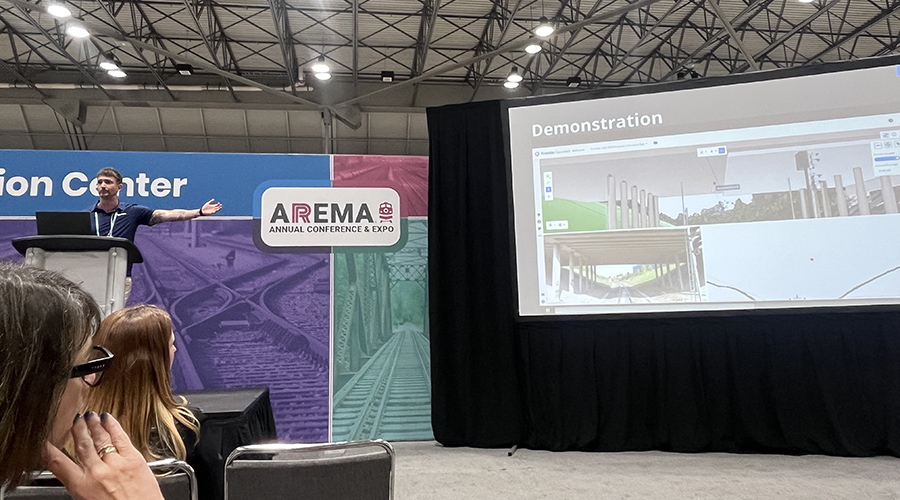
By Bridget Dean, Senior Associate Editor
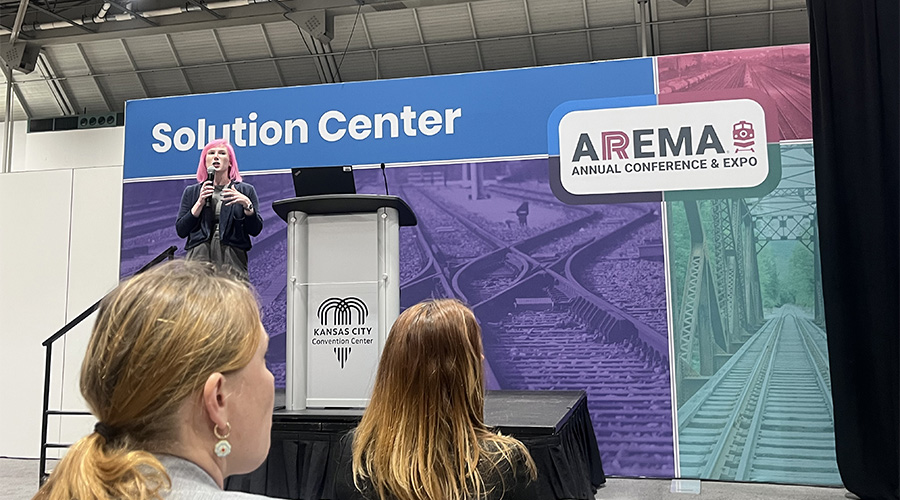
At this year’s American Railway Engineering and Maintenance-of-Way Association (AREMA) annual conference and expo, several presenters showcased how their companies are addressing some of the challenges associated with track maintenance.
Held in Kansas City, Missouri, Sept. 13-16, the conference featured an exhibit hall, dozens of technical presentations, two general sessions, AREMA committee meetings, networking opportunities and student resources.
On the exhibit hall floor, a dedicated “solutions center” stage featured five 15- to 30-minute presentations about maintenance-of-way (MOW) advances. Below is a summary of the first two presentations, which were held on Sept. 14; the remaining three will be summarized in a future RailPrime article.
Trimble: A single platform to connect entire MOW processes
Railroads often have separate teams, schedules and data management systems for different maintenance and construction activities, making it challenging for companies to keep track of each material’s lifecycle, said Trimble Inc. Rail Sales Specialist Thomas Williamson during the first solutions center presentation.
“[Railroads are] an incredibly complex ecosystem,” he said. “You have [workers] doing monitoring, tunneling, inspections, maintenance, earthworks and tamping. All this information gets sent back to all these individual offices and pushed back to different control centers.”
The company’s TrimbleConnect platform was created to help connect entire MOW processes by keeping data management practices consistent between the field and the office and between different MOW teams. The cloud-based platform provides teams with a synchronized online workspace.
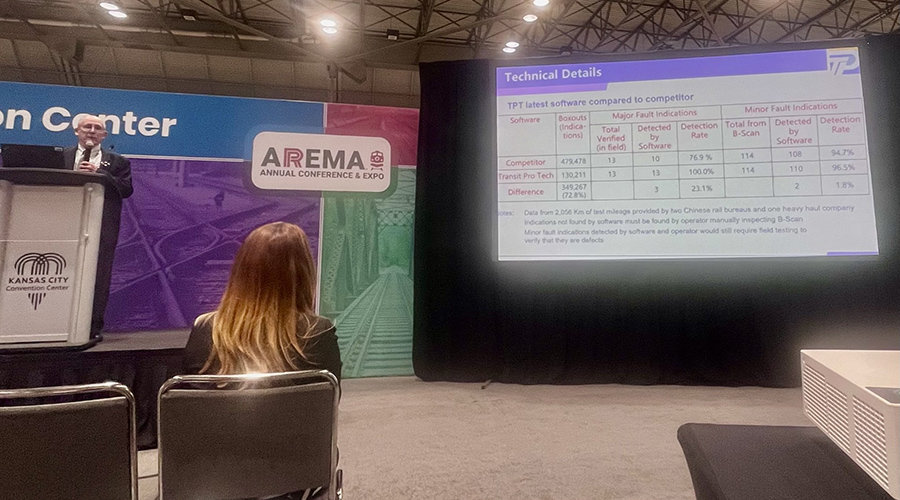 (At left at the lectern) David Staplin, TPT senior consultant, said his company is pushing for further improvements to its detection abilities.Bridget Dean
The platform is the basis for the Trimble Reality Capture Data service, a software designed to view, analyze and redistribute different types of data, including maps, 3D point clouds and other geospatial measurements often used in MOW and construction projects, Williamson said.
Trimble also offers hardware and applicable software for capturing rail-specific geospatial measurements, including cameras that roll on tracks and equipment that is attached to locomotives or other rolling stock.
Once data is collected at a work site, it is processed and available to view online. This enables teams across multiple locations to quickly capture field measurements, view project design updates, and share comments and concerns.
The service is especially useful for 3D railroad data, Williamson said. Because everything is stored in the cloud, crews can view large datasets like those used for 3D modeling on their mobile devices, as long as they have internet connection, he said.
Transit Pro Tech: Using AI to improve rail flaw detection in China
With a goal of making rail flaw detection more reliable and accurate, Transit Pro Tech Inc. (TPT) developed an ultrasonic rail inspection solution that has improved the accuracy of detection when tested against competitors in China.
The U.S.-based company was founded in Delaware in 2023; its research partner in China uses the technology to develop the Chinese market.
The ultrasonic flaw detection process involves equipment that sends sonic signals into the rail head to identify flaws in the steel. Return signals are interpreted by software to show inconsistencies in the steel.
Operators review the indications found by the software in a B-scan to flag major flaws and mark smaller indications for further examination via a field test, said TPT Senior Consultant David Staplin.
“This system has problems — missed flaws, false positives — and it takes a lot of time,” he said, adding that human inconsistency is another problem. “There’s operator fatigue, unequal skill levels, inconsistent standards and duplicate work”
TPT developed a software that encompasses data storage and a high-performance computing unit. The system’s built in AI algorithm model has advanced detection and context association capabilities to better identify defects from false positives, said Staplin.
Two Chinese rail bureaus and one heavy-haul company tested TPT’s latest software over 1,278 miles of track. Compared to a competitor, TPT software had about 73% fewer indications that needed verification, leading to a 75% reduction in staff hours needed to perform verification. TPT registered a 100% major flaw detection rate compared to the competitor’s 76.9%, and a 96.5% minor fault detection rate against its competitor’s 94.7%, said Staplin
And the company continues to enhance the software.
“[We want to] continue to reduce the false positive rate while not losing the accuracy,” Staplin said.
Continued use of TPT’s technology across China sets the stage for further software improvements and market growth in the United States. Heavy-haul, light-rail and high-speed rail systems in China, among others, have adopted TPT’s software, Staplin said.