Blast from the Past: When mega-merger tension led to a mega-merger moratorium
12/30/2025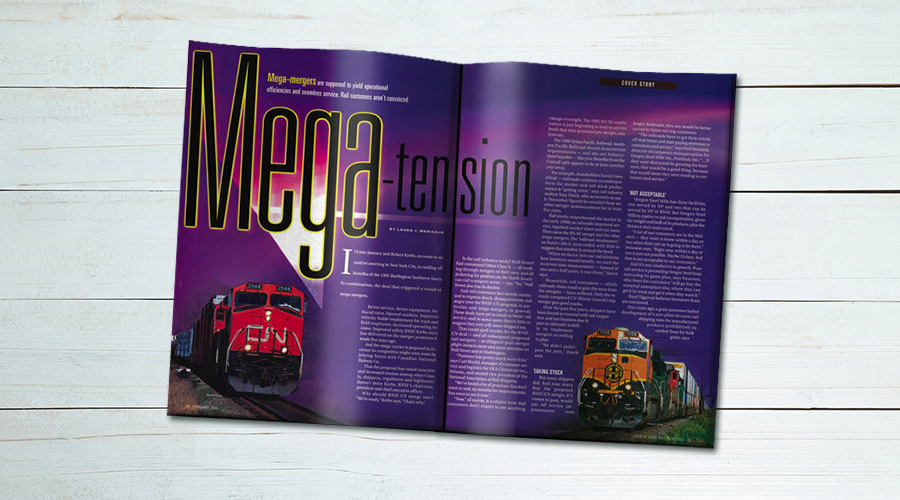
When Union Pacific Corp. and Norfolk Southern Corp. filed an application with the Surface Transportation Board (STB) on Dec. 19 requesting approval to combine the two railroads, it marked the first major railroad merger application filing since the STB issued new merger rules in June 2001.
The rules were unveiled following a 15-month merger moratorium the STB imposed on March 17, 2000. The moratorium gave the board time to develop new rules that would require merger partners to prove their union would enhance competition and prevent service problems.
The moratorium also prompted Burlington Northern Santa Fe and CN — which had announced their intent to merge on Dec. 20, 1999 — to drop their combination plans. If approved, BNSF-CN would have created North America’s largest railroad.
During the brief period that BNSF-CN was a possibility, rail stakeholders (especially rail shippers) weren’t shy about speaking out about the deal. Many had been impacted by rail mergers (including Burlington Northern-Santa Fe, UP-Southern Pacific and the NS-CSX carve-up of Conrail) the previous five years.
A couple weeks after BNSF and CN announced their merger plans, rail customers and shipper group representatives shared their concerns with Progressive Railroading writer Laura J. Merisalo for a story that appeared in our February 2000 issue titled “Mega-tension: Mega-mergers are supposed to yield operational efficiencies and seamless service. Rail customers aren’t convinced.”
In addition to rail shippers, Merisalo interviewed execs at the would be merging partners, notably BNSF Chairman, President and CEO Rob Krebs; execs from other railroads, including Jim McClellan, senior vice president of strategic planning for NS, which at the time was struggling to integrate its Conrail share; and rail analyst (and current Progressive Railroading columnist) Tony Hatch, who provided context and insight.
The story, which hasn’t been available online until now, follows.
— Pat Foran, editor-in-chief
It’s late January and Robert Krebs, en route to an analyst meeting in New York City, is rattling off benefits of the 1995 Burlington Northern-Santa Fe combination, the deal that triggered a round of mega-mergers.
Better service. Better equipment. Reduced rates. Opened markets. Improved velocity. Stable employment for track and field employees. Increased operating income. Improved safety. BNSF, Krebs says, has delivered on the merger promises it made five years ago. And the mega-carrier is prepared to increase its competitive might even more by joining forces with Canadian National Railway Co.
That the proposal has raised concerns and increased tension among other Class Is, shippers, regulators and legislators doesn’t deter Krebs, BNSF’s chairman, president and chief executive officer.
Why should BNSF-CN merge now? “We’re ready,” Krebs says. “That’s why.”
Is the rail industry ready? Wall Street? Rail customers? Other Class Is — all working through mergers of their own, and all jockeying for position on the North American rail transport scene — say, “No.” Wall Street also has its doubts.
And rail customers last month continued to express shock, disappointment and anger over the BNSF-CN proposal, in particular, and mega-mergers, in general. These deals have yet to result in better rail service, and in some cases there’s little to suggest they ever will, some shippers say.
That could spell trouble for the BNSF-CN deal — and all subsequent proposed rail mergers — as shippers’ post-merger plight attracts more and more attention on Wall Street and in Washington.
“Patience has pretty much worn thin,” says Curt Warfel, manager of customer ser-vice and logistics for EKA Chemicals Inc., Atlanta, and second vice president of the National Association of Rail Shippers. “We’ve heard a lot of promises. You don’t want to wait six months for improvements. You want to see it now.”
'We didn't anticipate the pain'
“Now,” of course, is a relative term. Rail customers don’t expect to see anything change overnight. The 1995 BN-SF combination is just beginning to lead to service levels that were promised pre-merger, analysts say.
The 1996 Union Pacific Railroad-Southern Pacific Railroad merger should demonstrate improvements — and eke out balance sheet benefits — this year. Benefits from the Conrail split appear to be at least another year away.
For example, shareholders haven’t benefited — railroads continue to underperform the market and rail stock performance is “getting worse,” says rail industry analyst Tony Hatch, who as recently as early December figured he wouldn’t hear another merger announcement for at least five years.
Rail stocks outperformed the market in the early 1990s as railroads improved service, regained market share and cut costs. Then came the BN-SF merger and the other mega-mergers. The “railroad renaissance,” as Hatch calls it, soon ended, with little to suggest that another is around the bend.
“When we factor into our calculations how investors would benefit, we used the incorrect time measurement — instead of one and a half years, it was three,” Hatch says.
Meanwhile, rail customers — which railroads claim stand to gain the most from the mergers — have suffered. Only the recently completed CN-Illinois Central Corp. merger gets good marks.
Over the past five years, shippers have been forced to contend with rail congestion and lost business due in part to railroads’ inability to implement mergers according to plan.
“We didn’t anticipate the pain,” Hatch says.
Taking stock
But many shippers did. And now, many fear the proposed BNSF/CN merger, if it comes to pass, would put off service improvements even longer. Railroads, they say, would be better served by better serving customers.
“The railroads have to get their minds off Wall Street and start paying attention to customers and service,” says Fred Swanson, director of corporate transportation for Oregon Steel Mills Inc., Portland, Ore. “... If they were distracted by growing the business, that would be a good thing, because that would mean they were tending to customers and service.”
Oregon Steel Mills has three facilities: one served by UP and two that can be served by UP or BNSF. But Oregon Steel Mills is captive to rail transportation, given the weight and bulk of its products, plus the distance they must travel.
“A lot of our customers are in the Midwest — they want to know within a day or two when their rail car is going to be there,” Swanson says. “Right now, within a day or two is just not possible. Maybe 10 days. And that is not acceptable to our customers.”
And it’s not conducive to growth. Poor rail service is preventing Oregon Steel from executing its game plan, says Swanson, who fears his customers “will go buy the material someplace else, where they can get it by truck and get it when they want it.”
Ward Uggerud believes Swanson’s fears are warranted. Four years ago, a grain processor halted development of a new plant because rail shipping rates for manufactured products prohibitively exceeded those for bulk grain, says Uggerud, vice president of operations at Otter Tail Power Co., Fergus Falls, Minn., and former chairman of the Alliance for Rail Competition.
“What I saw were captive shippers actually being shut out of the ability to expand their business,” says Uggerud. “I saw railroads actually controlling where economic development is taking place.”
Rails struggle, too
Mega-mergers also are taking a toll on non-Class I railroads.
Several short-line CEOs contacted in January 2000 — each of whose roads have been hammered by Class Is inability to implement mergers in recent years — said they weren’t sure their railroads could survive the rail network congestion another mega-merger could create. Regional railroads, too, have struggled.
“There is an opportunity in this country for the short lines and regionals to start working together, but that is possible only when you can get to a competing major carrier,” says Kevin Schieffer, president of Dakota, Minnesota & Eastern Railroad Corp., which is nursing a $1.4 billion plan to reach the coal-rich Powder River Basin. “As they keep gobbling each other up we lose options,” he says. “... Without competition, we are completely hostage.”
‘The jury is out’
So how many mega-mergers are too many? Is the rail industry better off now than it was five years ago? Can merged railroads deliver on their better-service promises?
“The jury is out,” says Jim McClellan, senior vice president of strategic planning at Norfolk Southern Corp., which has struggled mightily to integrate its share of Conrail. “Now, it’s a matter of performance.”
It’s also a matter of timing, say NS and other Class Is competing with BNSF and CN for North American rail supremacy. In an “open letter” issued last month, Canadian Pacific Railway, CSX Transportation, NS and UP expressed “serious concern with the potential impact of the BNSF-CN merger on the future structure of the rail industry,’’ adding that “another wave of mergers would be premature.”
The Surface Transportation Board wants to hear more — from Class Is, shippers, rail labor and other interested parties at a March 8, 2000, hearing designed to put the rail industry consolidation era into context.
BNSF officials say they welcome the opportunity to discuss mega-mergers — their own, in particular — at the hearing and in any other forum.
In Krebs’ view, the combination would increase competition and lead to better rail service and is “good for our shippers and good for our owners.” That the deal might trigger another round of mergers — no matter how unsettling — shouldn’t quash the BNSF and CN proposal.
“Companies in any industry are constantly jockeying for position,” Krebs says. “To say that can’t happen is the death knell of the industry.”
Besides, why should BNSF wait, asks Krebs, for other railroads to get their merger implementation acts together? CN officials concur.
“We’re ready — simply because other carriers are not doesn’t mean we should be penalized,” says CN spokesman Mark Hallman.
In the mega-merger era, “readiness” is in the eye of the beholder. The upcoming STB hearing could shed light on whether the BNSF-CN deal will move forward, or if other mergers soon will follow.
But it’ll be a while before the “mergers-lead-to-better-service” corollary is proved or disproved. It also may be a while before railroads get their service act together.
“It’s hard to improve a system if you’re moving around in crisis mode to fix [merger] problems,” says analyst Hatch. “That is what I am worried about. The state of crisis.”
Laura J. Merisalo is a Milwaukee-based freelance writer.