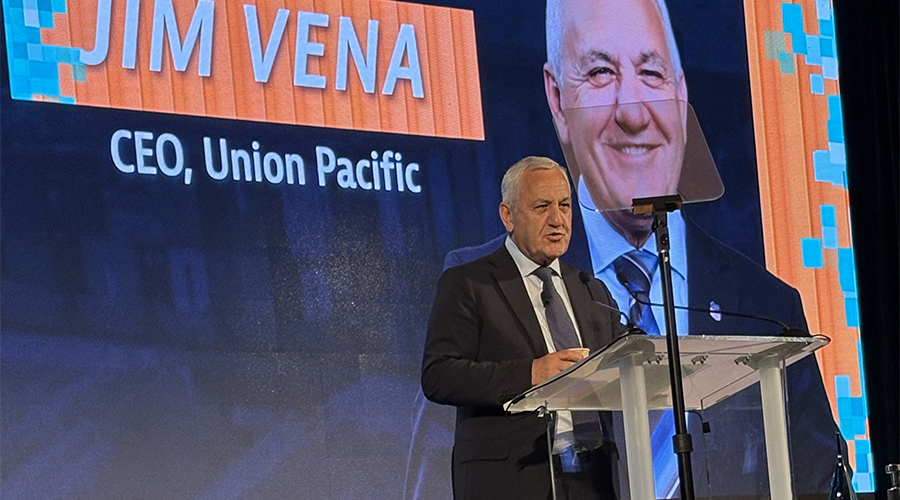
Webcast panel explores what's next for UP-NS merger
8/17/2026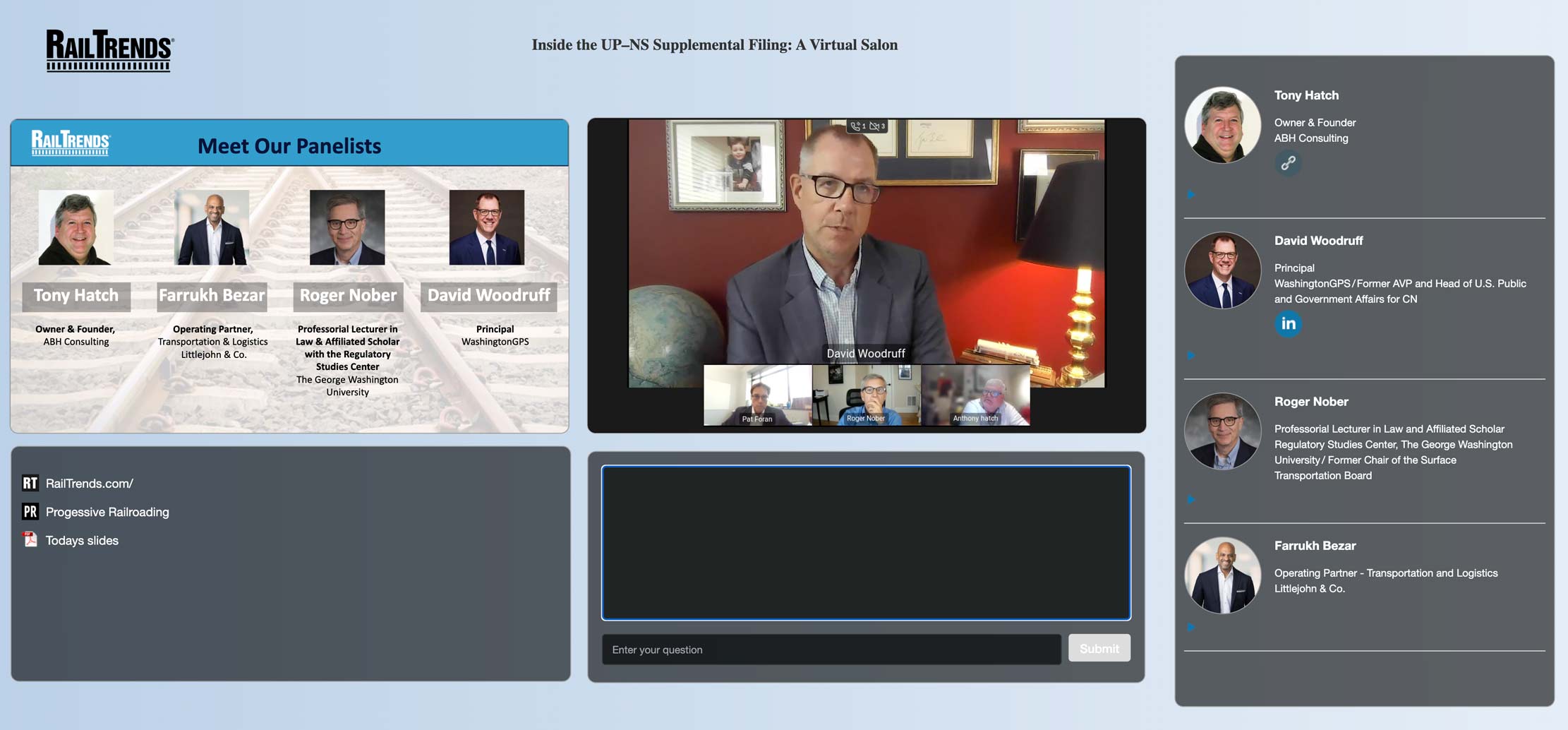
By Hazel Wheaton, Associate Editor
The Surface Transportation Board (STB) officially accepted the amended Union Pacific Railroad-Norfolk Southern Railway merger application on May 28 and requested that the applicants submit supplemental information by July 27. That information was submitted in time.
So where do things stand with the proposed merger now? And what significance does the deal UP recently struck with CN have? How will the upcoming midterms impact the state of rail? Are we any closer to defining enhanced competition? Speaking of definitions, what does prima facie mean?
These questions and others were addressed on Aug. 12 by a four-member panel during a RailTrends® webcast titled, "What's Next for the UP-NS Merger."
The panelists were:
Tony Hatch, an independent transportation analyst, Progressive Railroading columnist, and RailTrends co-founder and program consultant;
Farrukh Bezar, an operating partner-transportation and logistics in Littlejohn & Co.;
Roger Nober, a professional lecturer in law and affiliated scholar with the George Washington University's Regulatory Studies Center, and a former STB chairman and BNSF Railway chief legal officer; and
David Woodruff, a principal at WashingtonGPS and former assistant vice president of U.S. public and government affairs for CN.
This event marked the fourth time the panel had assembled to discuss the merger. Major developments since their last meeting have included the acceptance of the application; a flurry of strong public responses from competing railroads and a coalition of shippers; and a letter written by a coalition of nine states Attorneys General to the STB in opposition to the merger.
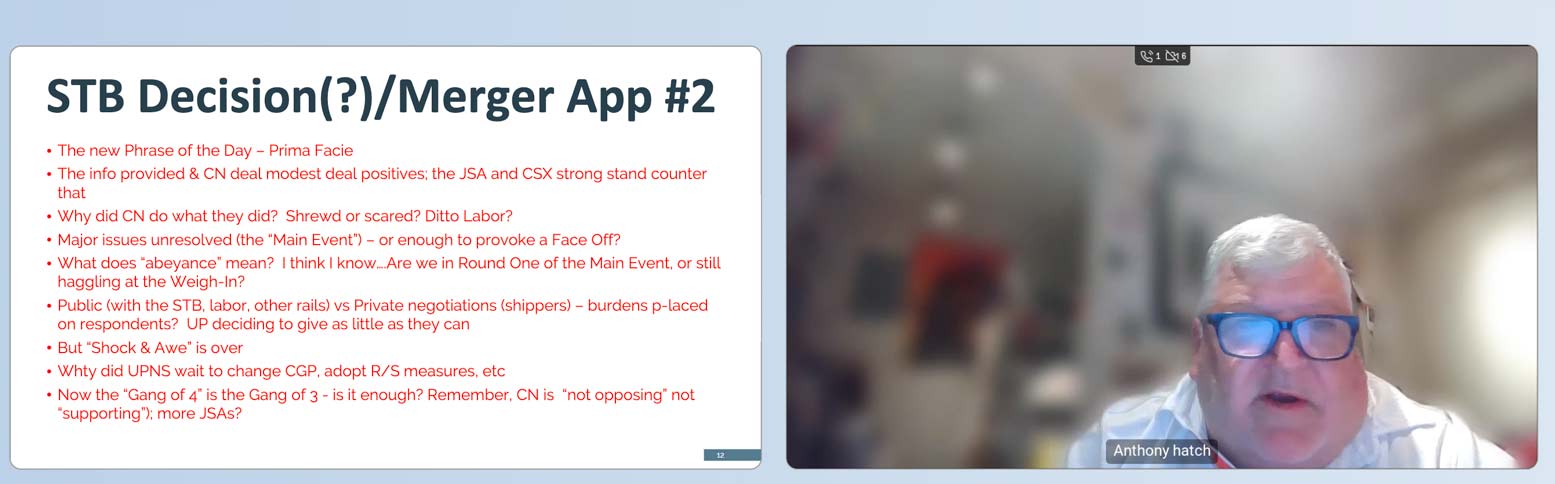
Where are we? And what is prima facie?
Hatch addressed these points first.
"We’re in abeyance now, and we don’t know when the STB will say anything,” he said.
Nober then explained that STB rules state that a merger applicant has to state a prima facie case, that if you took everything as true, it would be enough to satisfy the board's tests.
"So it's a technical legal distinction, but that's what the issue is about right now," Nober said.

Merger opponents have had plenty to say. CSX in a strongly worded legal brief and the nine attorneys general in their STB letter claim UP-NS has not met the prima facie standard.
"No merger has ever been thrown out for failing to state a prima facie case on the one hand. On the other hand, no merging parties have ever approached it as this is being approached," said Nober.
The panelists also made their predictions as to the merger application's odds of being approved. Both Woodruff and Bezar strongly believe it will be approved with concessions. Nober wasn't quite so sure.
"I think if they were just going to start the clock they would have done that already. If they were going to hold a full hearing on prima facie, they would have done that already. I think they're not sure what they're going to do and they're groping for a middle ground," Nober said.
The panelists did all agree that one of the most surprising things about the whole merger application process was its timeline.
"The fact that we're still here in August 2026 and the debate really has not yet begun still jumps off the page at me," Woodruff said.
UP's strategy
A large part of the regulatory process being bogged down was attributed to UP's approach to the application process, which various panelists described as "negotiating in public" with the STB while trying to give away as little as possible.
Said Nober: "I think they've been trying to hit, what's the minimum amount of affirmative concessions we have to make to get to the merits phase."
Once the application hits the merits phase, anyone who then wants additional conditions has to file separate requests, he explained.
"It puts parties that want concessions in the position of having to prove they need a condition, rather than the merging parties proving that they don't," Nober said.
The ultimate decision on the UP-NS merger will largely hinge on the definition of enhanced competition. Traditionally, competition is thought of as rail-to-rail; UP is betting on the STB accepting their definition of rail-to-truck. The STB has not made a decisive statement as to its interpretation of the term.
CN's bargain
The panelists also discussed the significance of two memoranda of understanding (MOUs) that CN recently signed with UP, and what it means that one of the main Class Is opposing the merger had effectively removed its objections.
Said Hatch: "CN was the only Class I railroad that could have done what they did. ... CN was able to walk away from the table to assure their position. They've taken themselves from a player to an observer, but they will watch out for their own interests."
Bezar believes the deal was a win for both parties. CN benefitted by gaining access to Kansas City and routes into Mexico. Apart from any particular details, UP got a chance to regain some sense of momentum.
"You can't fight with everybody," said Bezar. "At some point, you have to knock some pins down."
Nober speculated that the agreement might indicate a change in posture in the merging parties, a willingness to strike deals to pave the way for the merger to go forward.
"I took it a little bit as, maybe the laws of gravity apply to the merging parties here. But we'll see if that is the case going forward. I'm surprised there haven't been more agreements like the CN ones," Nober said.
Opposing parties
However, given the vigor of the opposition, another CN-like agreement seems unlikely soon, the panelists agreed.
Said Hatch: "The strongly worded position CSX took in their filing really shows they've come out of the dressing room ready to go. ... It's going to be very difficult for any of the three railroads that are opposing this to walk back anything they're saying. Not that they want to."
At the same time, Nober expressed surprise that individual shippers had remained largely silent, leaving the lobbying wholly to trade associations.
"[They] have kept their powder dry up until now. I think if you didn't want the merger to go forward, you would be trying to create as much momentum and opposition to it as you possibly could. That's not what's gone on," Nober said.
The shippers are a group to keep an eye on, Bezar stressed, because their concerns will carry weight with the STB.
"I believe from a board perspective that on a relative basis, they are going to get attention from the STB. Not only what the service is going to look like, what's going to be the implication on rates? There's clearly going to be value captured, with productivity improvement from this merger," Bezar said. "Are the railroads themselves going to capture that on their own or are they going to share it with their customers?"
The political picture
Another consideration the panelists addressed is the current political climate, with midterm elections coming up in November that may change control of the House, to be followed by the 2028 presidential election.
Hatch argued that the STB would remain independent.
"I do not believe that outside influences, all the way to 1600 Pennsylvania Avenue, will sway the decision of the board. I really think it's four people in a closed room, and we already know who they are," said Hatch.
Woodruff said Congress would likely not have a great impact in the next year, even if leadership changed hands, as they'd be occupied with more immediate matters, such as the Rail Safety Act and the surface transportation reauthorization bill.
"Broadly, I think Congress is about prioritzation, so this is an issue for tomorrow or next week and not necessarily today," said Woodruff.
However, Nober believes the merger has been politicized from the beginning.
"If you were opposing it, you would be focused on bringing pressure on the agency. One way to bring pressure on the agency is through political pressure. We can say what we want, but the nine attorneys general from Republican states writing to them ... the agency is not going to be ignoring that," said Nober.
How to enforce?
While addressing an audience question about providing oversight to a massive transcontinental railroad, the panelists agreed that policing would likely prove impossible, even with an extended oversight period.

Said Nober: "I think the members are going to be cognizant of, is this merged entity too big to regulate? Is it going to be something like, you can think of other companies, like Boeing or Lockheed, that are so big, you can't really regulate them in the traditional way because they're larger than that."
Hatch believes the STB will provide at least as long an oversight period as it did with the CPKC merger, and probably longer.
"But the real question is, can they actually do this? In a complicated world with thousands of different price points and contracts, can you actually police that?" Hatch said.
Woodruff pointed out that when CN acquired the Elgin, Joliet and Eastern Railway in 2013, there was an eight-year oversight period.
"Then that was extended another three, so ... that was 11 years for 140 miles of track," Woodruff said.