G&W a key partner in Incobrasa's Illinois expansion project
7/29/2026
By Hazel Wheaton, Associate Editor
On June 22, Incobrasa Industries Ltd. hosted a ribbon-cutting ceremony to mark the opening of its new 170,000-square-foot soybean crushing facility in Gilman, Illinois.
The $250 million project means Incobrasa now has the largest soybean extraction process in the country, company officials say. The crushing process converts soybeans into meal to be used for animal feed and oil, or to be refined for consumption or used to make biofuels.
The expansion had been years in the works. A privately owned and managed soybean processing company, Incobrasa first expanded into the United States from Brazil in 1995, opening the Gilman facility in 1996. The company added a refinery and packaging facility for food-grade vegetable oil in 2004 and launched a biodiesel production plant in 2007.
The new crushing facility more than doubles the site's annual capacity, to 98 million bushels of soybeans. With the added volume of extracted oil, biodiesel output now zooms from 37.5 million to 75 million gallons per year.
Moreover, the expansion also extends the plant's sourcing radius from 50 to 80 miles, offering greater access to local farmers. A new 50-acre solar array will power the facility and feed the grid.
That the expansion was coming might have been expected given Incobrasa's history, but that it became possible largely relied on access to sufficient transportation infrastructure. For that, Incobrasa depended on Genesee & Wyoming Inc.'s (G&W) willingness to expand right alongside them.
"G&W's Toledo, Peoria & Western Railway and Illinois & Midland Railroad are integral to [our] growth, providing the critical infrastructure to move more product efficiently and connect global markets," said Incobrasa CEO Aluizio Ribiero in a statement issued in January 2026. "This partnership exemplifies how strategic investments in rail unlocks economic opportunity and strengthens supply chains for decades to come."
G&W: Industrial development a must
G&W strives to be ambitious and proactive with industrial development (ID), a strategy that's been in place for decades. The company's ID team works years in advance to identify, improve and market rail-served sites to attract new customers or deepen relationships with existing ones.
G&W's January 2026 summary of its ID scorecard showed 44 separate projects in 16 states, accounting for more than $1 billion in customer investments.
Attracting new shippers is always a goal, says Jennifer Tanner-Bostian, G&W's director of industrial development for the Midwest.
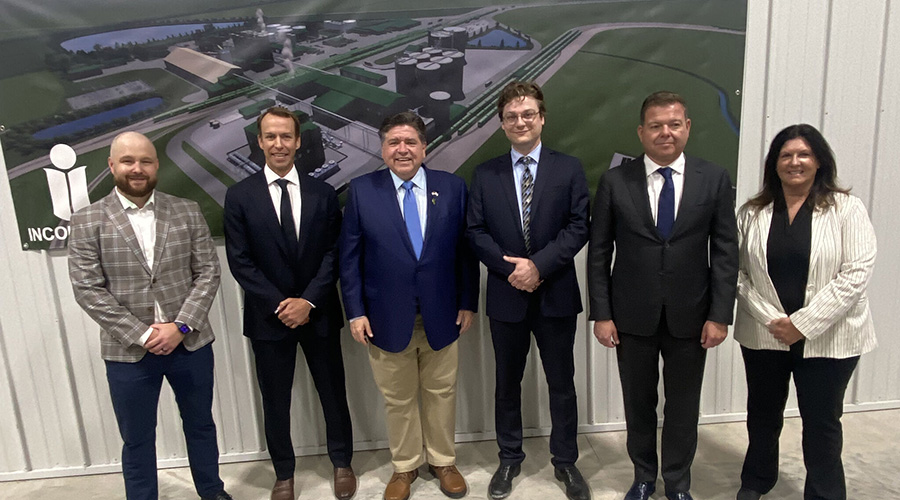 The late June ribbon-cutting ceremony for the expanded plant in Gilman was attended by company leaders, Genesee & Wyoming executives, Illinois Governor JB Pritzker and other dignitaries.Genesee & Wyoming Inc.
"But because G&W has such a large footprint across the United States, we also have 3,000 customers that we want to keep up on," she says. "Hopefully [we can] have them keep at the top of their mind when they're looking for sites and places to expand that G&W has a lot of bandwidth in that area."
Those customers include Incobrasa, whose Gilman facility was already served by G&W's Toledo, Peoria & Western Railway (TPW), which in turn connects to four Class Is: BNSF Railway, CSX, Norfolk Southern Railway and Union Pacific Railroad.
Incobrasa leaders approached G&W officials abut the planned Gilman expansion in July 2022. Still in the initial design stage, they needed to know they'd have access to transportation infrastructure that could support the expansion.
It made perfect sense to start with the railroad, says Tanner-Bostian.
"Honestly, if a customer has to have rail, they have to start with the railroad. You can't sort of need a railroad in a project," she says.
Incobrasa was open and transparent about the volumes that were going to be generated as a result of the expansion, says Heath Mondragon, general manager for G&W's railroads in Illinois and Indiana.
"They needed to know that we were willing to commit to growing with them," he says.
Through multiple meetings, the G&W team assured Incobrasa leaders that they were on board with what it would take to pull off the project.
"Our commitment to them was that we would be ready one way or another," says Mondragon.
Forging expansion plans times two
Incobrasa's openness with their expansion plans convinced G&W to expand, too, by boosting capacity not only at the Gilman site but also in Effner and Wolcott, Indiana. To handle more traffic, G&W would need additional infrastructure (track capacity), equipment and manpower.
The company then worked on funding the capacity expansion. G&W secured a $16 million Consolidated Rail Infrastructure and Safety Improvement (CRISI) program grant in 2023 from the federal government and contributed its own $8 million investment.
The partnership between Incobrasa officials and the G&W ID team was ongoing throughout the project, with unexpected obstacles handled jointly and necessary adjustments made.
Along the way, Incobrasa purchased a barge site from G&W to transport its soybeans to international markets, and G&W worked with Incobrasa's logistics team to arrange the delivery of massive equipment, including soybean dryers, that were originally intended to be moved by truck.
"We really try to be a problem solver with them," says Tanner-Bostian. "It really has become a very colorful and productive partnership with Incobrasa and we're very happy finding all the different opportunities that we're creating together."
But it isn't a happy ending just yet. Incobrasa's new biodiesel plant is due to be up and running by October, and an additional loop track and enhancements of their rail pit to increase unload speed still are in the works, says Jonathan Algeo, G&W's assistant VP of sales and marketing for the region.
And for G&W, the planned expansion at Wolcott hasn't yet been completed, although the project is on schedule and funds have been allocated.
A standard industrial development project can take between six and 18 months to complete, but a project of Incobrasa's size and complexity can take years to finish, says Tanner-Bostian
"It becomes a matter of getting the team all on board, understanding the customer's needs and making sure we keep solving the problems," she says. "That's how I look at industrial development — putting one foot in front of the next to get the next thing solved until we have a completed project."