CREATE partners prod key 75th Street Corridor projects along in Chicago
6/22/2026
By Jeff Stagl, Managing Editor
The Chicago Region Environmental and Transportation Efficiency (CREATE) program marked a milestone late last year with the 75th Street Corridor Improvement Project (CIP).
In November, the opening ribbon was cut for the CIP’s Forest Hill Flyover (CREATE project P3), a new bridge that eliminates or significantly reduces operational conflicts between CSX, Norfolk Southern Railway, the Belt Railway Co. of Chicago (BRC) and Metra. About 35 freight trains operate daily on CSX’s Western Avenue Corridor, and the flyover reduces freight train and Metra delays on the route and increases the railroads’ service fluidity.
The CIP is CREATE’s largest component. Launched in 2003, the $5.8 billion CREATE program involves a total of 70 projects designed to separate freight and passenger trains at six key junctions. The projects will eliminate about two dozen grade crossings and increase rail capacity, speed and reliability in the Chicago area.
CREATE is managed through a public-private partnership that includes Amtrak, the Association of American Railroads (AAR), BNSF Railway, BRC, Chicago and Illinois departments of transportation, Canadian Pacific Kansas City, CN, Cook County, CSX, Indiana Harbor Belt Railroad Co., Metra, NS and Union Pacific Railroad
The Forest Hill Flyover was the largest CREATE project undertaken so far and the 36th one to reach completion. It also was the first of four major CIP projects to reach the finish line.
 A map shows the major components of the 75th Street Corridor project: the Forest Hill Flyover (which was completed late last year), 71st Street grade separation, Belt/80th Street junction replacements and Rock Island connection. CREATE Program
 Now, two other CIP projects are marking significant progress in 2026. Located in the Chicago neighborhoods of Ashburn, Auburn Gresham, Englewood and West Chatham along two passenger and four freight-rail lines, the CIP is designed to improve operations and safety for CN, CPKC, CSX, NS, UP, BRC, Metra and Amtrak.
In addition to the Forest Hill Flyover, the CIP includes the 71st Street grade separation (GS19), Belt Junction/80th Street junction replacements (EW2) and Rock Island connection (P2).
GS19 calls for eliminating the most congested rail chokepoint in Chicago — Belt Junction — where 30 Metra and 90 freight trains cross paths each day. Work involves constructing a grade crossing separation at 71st Street to reduce neighborhood traffic delays and improve safety, building an additional mainline for Metra and establishing a flyover connection.
The work will reduce congestion and freight conflicts and connect Metra’s SouthWest Service with existing Rock Island District tracks. In addition, SouthWest Service trains will be able to access LaSalle Street Station instead of Chicago’s Union Station, freeing up capacity at Union Station for increased Amtrak service and proposed high-speed rail service.
A notice to proceed for GS19 has been issued and early construction work has started, said Ted Greener, the AAR’s senior vice president of communications, in an email.
“The first step of construction is applying for permits so that [71st Street] can be closed in the fall and work completed by the end of the year,” he said.
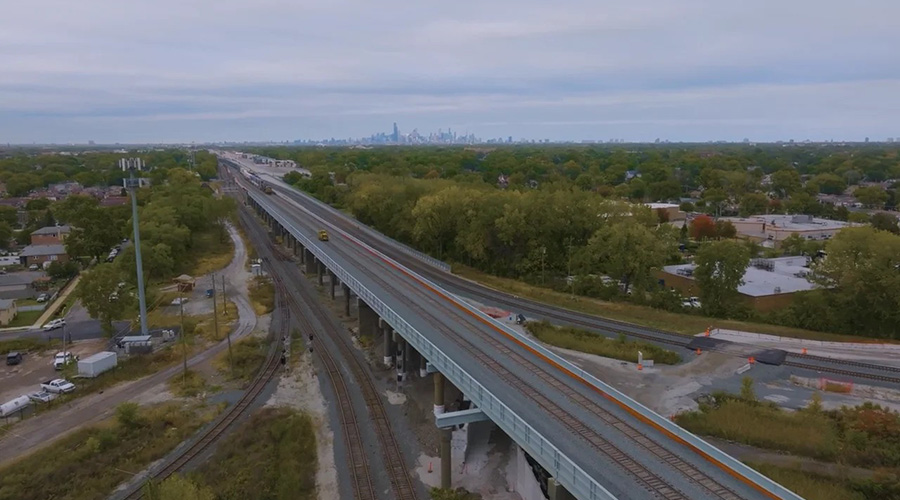 Opened in November 2025, the Forest Hill Flyover elevates CSX tracks above a critical intersection to enhance efficiency, safety and reliability for both freight- and passenger-rail operations in the area. CSX
CSX plans to soon hold a GS19 ribbon-cutting ceremony, but that hadn't been scheduled as of June 22. CREATE partners are targeting a contractor letting sometime in the third quarter, Greener said.
Following GS19 to the construction stage will be EW2, Segment A (EW2A). The project calls for reconfiguring track segments and signals at Belt Junction; adding a third track to NS’ line; and replacing and restoring 14 aging bridge and viaduct structures, some of which are more than a century old.
By reconfiguring a vital three-mile elevated rail corridor, the project aims to untangle traffic and eliminate bottlenecks for the BRC, CN, CSX, NS, UP, Amtrak and Metra.
EW2A will improve travel times, boost safety and bring track infrastructure to a state of good repair, which are prerequisites for implementing future enhancements at NS’ Landers Yard, CREATE partners say. The enhancements would include a future double track for Metra and an NS mainline.
Design work for EW2A is pegged for completion in first-quarter 2027 and construction is anticipated to start in third-quarter 2027, said Greener.
EW2A must be completed before the planned Rock Island connection (P2) flyover can be constructed. P2 calls for building a second main track for Metra’s SouthWest Service operations from near Wrightwood Station to east of Halsted Street and a flyover structure to connect the SouthWest Service to the Rock Island Line.