Short lines built some positive traffic momentum in Q1
5/12/2026
By Jeff Stagl, Managing Editor
After a roller-coaster 2025 that included a dizzying number of traffic ups and downs, many regionals and short lines got off to a promising carload-building start in 2026. Collectively, small roads registered a strong volume gain in the first quarter.
Through 2026’s first 12 weeks, a period ending March 28, 446 regionals and short lines handled 1,399,220 carloads, up 6% compared with the same 2025 period, according to the RailConnect Index of Short Line Traffic compiled by Wabtec Corp.’s GE Transportation arm.
Intermodal traffic led the way by a considerable margin, jumping 27.1% year over year to 292,305 units. The other double-digit percentage gainers among the index’s 14 commodity groups were waste and scrap materials (up 13.9% to 83,427), all other traffic (up 11.6% to 18,804), and stone, clay and aggregates (up 10.4% to 140,686).
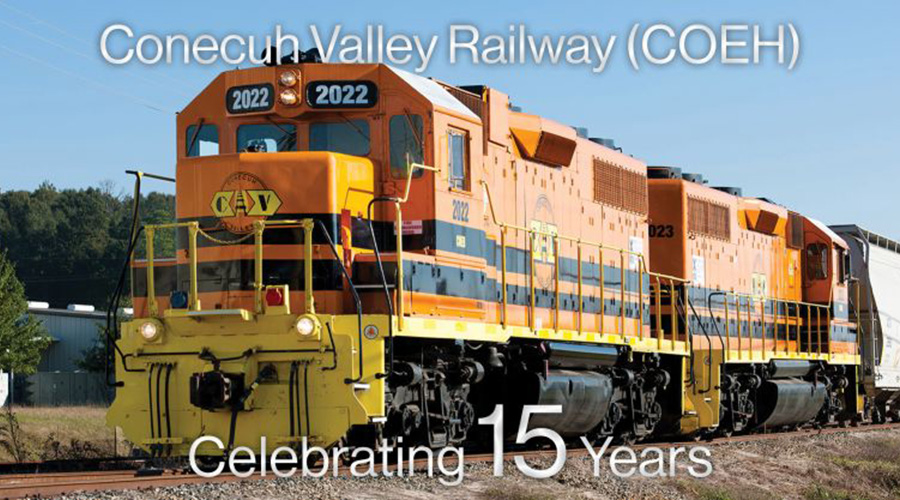 G&W’s 14-mile Conecuh Valley Railway recently marked its 15th anniversary. The holding company notched a traffic gain in each of 2026’s first three months.Genesee & Wyoming Inc.
In addition, grain volume climbed 6.6% to 172,355; motor vehicles/equipment units rose 4.4% to 44,439 and petroleum/coke traffic increased 3.3% to 43,932.
The other seven commodity groups logged the following year-over-year declines: ores, 9.5% to 32,954; paper products, 8.3% to 64,416; coal, 5.6% to 50,302; lumber and forest products, 4.6% to 61,197; metals and products, 2.8% to 96,676; chemicals, 1.5% to 232,155; and farm and food products excluding grain, 0.7% to 65,932.
To glean examples of short-line traffic gains or pains in the first quarter, RailPrime reached out to various holding companies, regionals and short lines via email. Following are responses from 11, which shared their traffic fortunes and what drove or hindered carloads.
Holding companies hold their own
For Genesee & Wyoming Inc. (G&W), Q1 was encouraging because carloads increased in each month during the quarter.
The overall quarterly gain primarily was driven by strong coal and coke and metals shipments, said Tom Ciuba, a spokesman for G&W, which owns more than 100 regionals and short lines in North America.
It was a solid quarter for Watco, too. The company — which owns and operates four dozen short lines — registered a 10.8% carload gain on a year-over-year basis. However, traffic dipped 0.5% compared with fourth-quarter 2025, when volume reached the highest quarterly level last year.
For example, carloads of coal, minerals and metals declined 24.8%, 16.2% and 3.2%, respectively, compared with Q4 2025 totals.
In the good news column, carloads of chemicals, crude oil and hazardous materials climbed 30.6%, 13.9% and 9.8%, respectively, in the quarter.
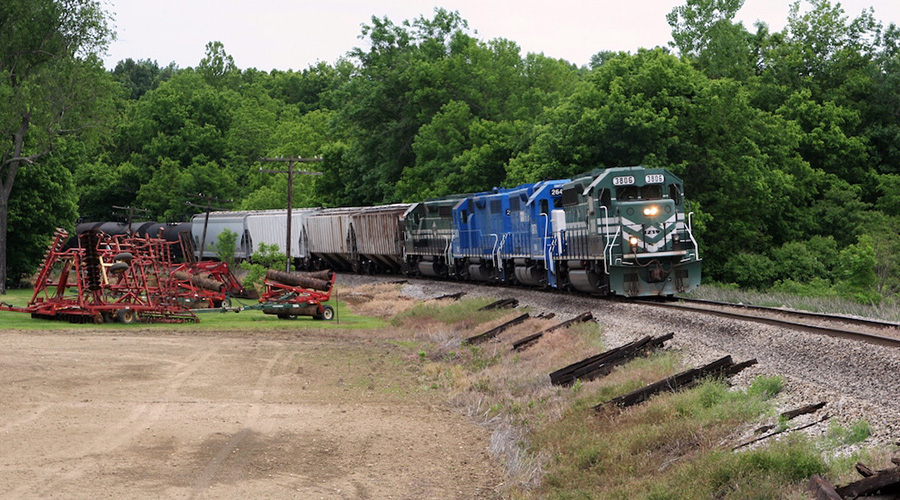 The 280-mile Paducah & Louisville Railway registered a 10% traffic gain in Q1. The short line interchanges with BNSF, CN, CSX and NS.Paducah & Louisville Railway Inc.
“In Q1 of this year, we were holding the line following Q4 of last year. There was good growth month over month in Q1, as well,” Watco officials said. “We finished March 11.3% better than February. And March ’26 was 8.4% better than March of ’25.”
At OmniTRAX Inc., the Q1 traffic news wasn’t quite as encouraging. The owner of 31 regionals and short lines registered flat carloads in the period.
Energy volume declined 6% primarily due to lower crushed stone, gravel and sand carloads, which dropped 9%, and lower petroleum and petroleum products traffic, which decreased 4%.
But some commodity groups finished in the black. Grain carloads shot up 31%, supported by corn volume growth at the Great Western Railway of Colorado LLC and Nebraska, Kansas & Colorado Railway, OmniTRAX officials said.
In addition, industrial and food volumes increased 3.6%, driven by strong chemical and fertilizer loads (up 25%).
“Various miscellaneous chemical segments across multiple railroads and fertilizers showed strong growth on the unit train side,” OmniTRAX officials said.
Q1 traffic was flat for Livonia, Avon and Lakeville Railroad Corp. (LAL), as well. But for the owner of four short lines, that actually was better than expected, LAL officials said.
“Traffic started to pick up in the second quarter. Frac sand and food products are trending up,” said LAL President and CEO Bob Babcock.
Regionals, short lines show growth
Things also are looking up for sister roads Red River Valley & Western Railroad (RRVW) and Twin Cities & Western Railroad (TCWR) after navigating Q1.
“Supporting the agriculture industry is in both railroads’ DNA, and our agriculture-based business (grain, ethanol, soybean meal, etc.) maintained positive momentum through the quarter,” said Victor Meyers, the president of both RRVW and TCWR.
The operator of more than 500 miles of track in Minnesota and North Dakota, RRVW logged flat carloads in the quarter as grain volume slipped slightly versus Q1 2025.
“Export corn demand from the RRVW service territory remained steady, supporting grain carloads, while export soybean demand has been very low,” said Meyers.
 The more than century-old Canton Railroad — which operates in Baltimore — had a tough Q1, when its inbound/outbound loads plunged 14.3%.Canton Railroad Co.
But TCWR had a banner quarter. The operator of 360 miles of track in Minnesota and South Dakota registered an 11% year-over-year traffic gain.
Grain carloads shot up 41%, driven by higher crop production from the 2025 harvest that increased the grain supply across TCWR’s network, Meyers said.
“TCWR also experienced a year-over-year increase in volumes at a railroad-owned transload facility in the Twin Cities area,” he added.
Grain was good for Battle River Railway, too. The commodity helped the more than 50-mile short line based in Forestburg, Alberta, log higher carloads in Q1.
“Traffic was up due to an increase in grain and fertilizer shipments. We had a big crop in the area,” said Battle River Railway General Manager Matthew Enright. “Industrial products were down, but they make up a very small amount of our total volume.”
In Kentucky, traffic was quite strong for Paducah & Louisville Railway Inc. (P&L). Q1 carloads for the 280-mile short line — which also includes traffic generated by sister roads Appalachian and Ohio Railroad (AO) and Evansville Western Railway Inc. (EVWR) — totaled 77,327, up 10% year over year.
“The major swing in business was on the AO, where we had two mines that were closed a big portion of 2025 due to mine fires. Both were back operational as of late 2025, so we are seeing those increases on the coal side of things,” said P&L Vice President of Marketing and Sales Kevin McEwan.
In addition, petroleum coke shipments rose 13% with more tons coming to P&L for export through its river terminal at Calvert City; cement shipments on P&L increased because of a new market for an online customer; and waste/scrap shipments skyrocketed 625% — from 48 to 348 units — because a new scrap metal customer came online for P&L in Q2 2025.
However, lumber shipments declined because a customer lost an existing lane and grain shipments on EVWR destined for SE chicken feed markets decreased.
Overall, it also was a good quarter for the Buckingham Branch Railroad (BBR). The 280-mile Virginia short line — which interchanges with CSX, NS and the Durbin & Greenbrier Valley Railroad — notched a traffic gain in Q1.
The increase was driven by higher loads of paper, liquified petroleum gas and aggregates, said BBR President Steve Powell.
Across the country in northern California, Sierra Northern Railway (SNR) had quite a dizzying quarter. The more than 100-mile short line experienced big traffic swings.
“Interesting enough, carload volumes are only up about 1% year over year, but the trends are all over the board,” said SNR President and CEO Kennan Beard. “California continues to be a challenging market.”
Lumber, agricultural feed and heating fuels/propane traffic climbed 32%, 15% and 14%, respectively, but cement carloads declined 9% and rail-car storage business for refinery customers fell significantly.
“This is attributed to two major refineries leaving California,” said Beard. “[However] transloading is up for nearly every commodity we handle, and this is expected to be a strong growth area as we continue into 2026.”
Business tumbled quite a bit in Q1 for the Canton Railroad Co. The more than century-old short line in Maryland registered a 14.3% drop in inbound/outbound loads.
“During this time, inbound loads of lumber, paper, roofing shingles and propane decreased. We did experience a significant increase (almost double) of outbound wood pulp loads, but they were not enough to offset the decrease in the other commodities,” said Canton Railroad President and CEO Tyler Horner.
Although the short line got off to a slow start in 2026, prospects already are much better in Q2. Carloads in April shot up significantly on a year-over-year basis — by 37.3%.
“Right now, though it’s early, May looks like it will be a good month for us, as well,” said Horner.