Short Line Training Center helps railroaders keep up with regs, certifications
9/15/2025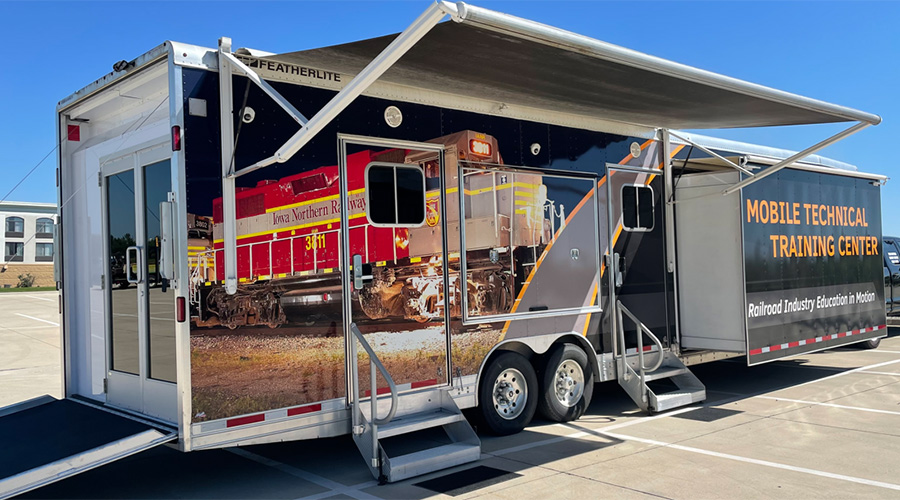
By Julie Sneider, Senior Editor
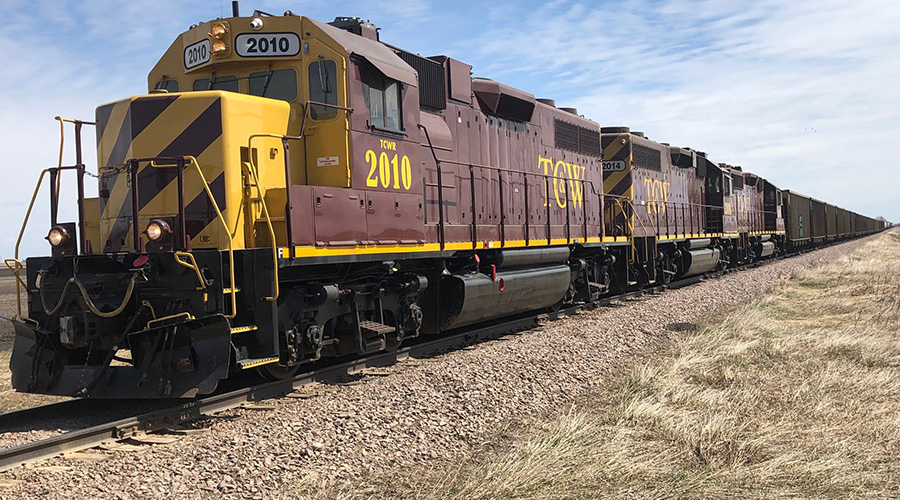
A $6.7 million federal grant awarded in 2021 to the Iowa Northern Railway Co. (IANR), in collaboration with the American Short Line and Regional Railroad Association (ASLRRA), has led to a plethora of comprehensive training and education courses designed to help smaller railroads keep up with essential regulatory, compliance and safety requirements.
Awarded through the Federal Railroad Administration’s Consolidated Rail Infrastructure and Safety Improvements (CRISI) program, the grant has funded the launch of the Short Line Training Center, a project between IANR and ASLRRA that combines an online learning management System (LMS) and locomotive simulators to deliver training courses and educational materials to short-line railroaders who may not have the time or funding to travel from their home base to an educational conference or out-of-the-area campus.
Through the LMS, short-line operators can tap into custom-built training courses and materials, available 24/7 for railroaders to complete. Programs include the ASLRRA’s model programs to help railroads meet federal regulations related to training, qualification and oversight for rail safety employees; FRA drug and alcohol testing programs; and more than 30 technical training courses for locomotive engineers. Courses on the transport of hazardous materials are under development.
IANR, which has long run its own training center for railroaders in Waterloo, Iowa, applied for the CRISI grant to develop a program that would fill in the educational gaps for small railroads’ employees who perform the same type of technical jobs that Class I railroaders perform but don’t have access to on-the-job training and educational resources that the larger railroads offer.
Filling in gaps, meeting needs
The impetus for developing a short-line training center was former IANR President and Chairman Dan Sabin’s interest in railroad safety, says Mark Vaughn, a senior manager at the short line. Vaughn now oversees safety training and regulatory compliance at the railroad company, which was acquired by CN earlier this year.
 “Short-line railroads do all of the same tasks and functions that Class Is do but have been disadvantaged in that they haven't had the funds ... available to have fully developed training programs.” — Mark Vaughn, senior manager, Iowa Northern Railway ASLRRA
Sabin was active in ASLRRA and wanted to do more to improve short-line safety through better training. The railroad’s Waterloo facilities today serve as a site for ASLRRA to offer in-person seminars and training experiences.
But Sabin also wanted to find ways to enable short lines that couldn’t afford to send locomotive engineers or other employees to Iowa for training. That interest led to the CRISI application during the 2020 fiscal-year grant cycle, says Vaughn.
“Short-line railroads do all of the same tasks and functions that Class Is do but have been disadvantaged in that they haven't had the funds and technical content available to have fully developed training programs,” he says. “So, we identified the gaps and the partnership with the association was a logical avenue to increase the bar for the industry.”
The Short Line Training Center rolled out its first online courses in 2022 and has continued to provide new offerings, including virtual reality courses. Online courses cover topics such as freight-car anatomy, locomotive daily inspection, Class I airbrake tests and inspection, and railroad workplace safety. Through the LMS, participating short lines can enroll users and assign training to employees through a dashboard.
To date, more than 1,200 railroad employees from 24 railroads are receiving online training through the LMS platform, according to ASLRRA’s website.
The CRISI funding from the FRA was the missing link to kicking off the online programming, says Sabrina Waiss, ASLRRA’s senior vice president who oversees education, training and business development services. Waiss and JR Gelnar, ASLRRA’s VP of safety and compliance, had talked for years about the need for online courses to supplement the association’s on-site seminars offered in locations across the country. But the question always was how to pay for it.
“Some of our smallest ASLRRA members might have three, maybe five people running the entire operation, so they can't always afford to send one or two people to a training seminar,” says Waiss.
 “It really has been a game-changer for some of our smaller railroaders.” — Sabrina Waiss, senior vice president, ASLRRAASLRRA
Given ASLRRA’s existing connection to IANR and its Waterloo facilities, it seemed natural to work with the company on a grant application that could result in funding an online training program’s startup. Since the grant was awarded, Vaughn and Gelnar, both experienced railroaders, have worked to identify the subject matter and guide course content for the online platform, she says.
“We can have a great impact by delivering this type of training to people anywhere in the country from a desktop,” says Waiss. “It really has been a game changer for some of our smallest railroads.”
Education on wheels
Vaughn also was the visionary behind the center’s locomotive simulator training program through the Mobile Technical Training Center, a motorized vehicle that travels to short-line locations anywhere in the continental United States. The vehicle has room for two locomotive simulators and classroom space for six students to participate in instructor-led seminars and training.
The CRISI funds helped the center buy four simulators, two for use at the Waterloo site and two for the mobile unit, Vaughn says.
To date, more than 180 people from 17 railroads in 13 states have used the mobile unit for training purposes, according to Vaughn, who personally drives the unit to short-line locations that request it.
“It's a proven training tool that gives us the ability to simulate scenarios that would be near impossible to simulate in traditional on-the-job training,” he says.
There is a fee for short lines to enroll in the online courses and access training via the mobile unit. But the fees are “minimal” and set to cover the cost of delivering the programming.
“We understand that grants are short term. So, anything we do at the center we want to perpetuate beyond the [CRISI] grant lifecycle,” explains Vaughn. “Our goal was that at the end of the grant this [education] would become self-sustaining, meaning the users of the program saw value in the content.”
Vaughn, Gelnar and Waiss will continue developing and rolling on new courses and seminars through the training center. A number are in the pipeline and will be opened for signups this year.
“Over the remainder of 2025, we'll probably see somewhere in the neighborhood of eight courses being added into the course catalog,” says Vaughn. Those courses will have a heavy mechanical component to them, as mechanical training is an area that ASLRRA member railroads indicated they wanted, he adds.
One of the best features of the LMS is that it enables short-line management to keep track of who on their staff is due for re-upping their FRA certification requirements, Vaughn and Waiss say. The system’s electronic technology can help short-line managers eliminate a lot of paper record-keeping.
“The report function of the LMS allows you to analyze your data, see whose certification is expiring and then plan for your training courses,” says Vaughn. “When everything was in a manilla folder in a file cabinet, there was a lot of mystery in that file cabinet unless you opened it up on a regular basis.”