Railroader Berish adds a second short line to his evolving company
1/23/2026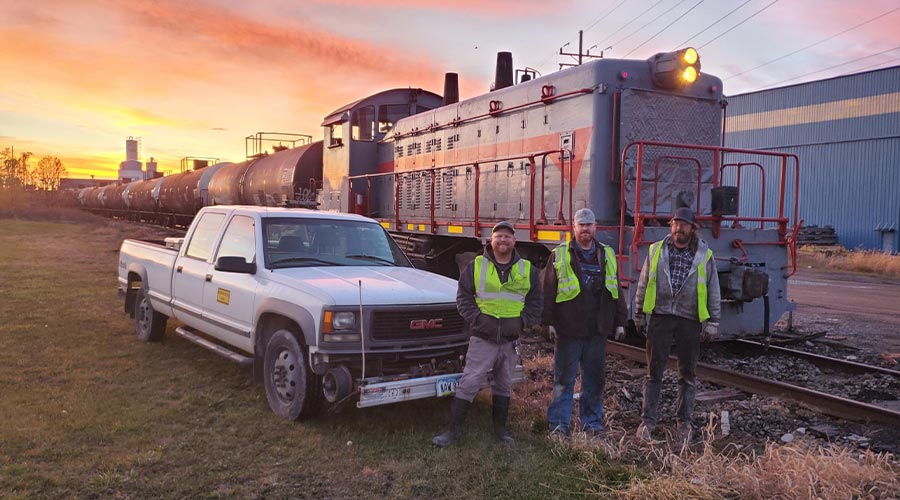
By Julie Sneider, Senior Editor
Short-line owner and operator Steve Berish is “living the dream” — his words — as an independent railroader.
Berish recently added a second line to Resourceful Rail, a railroad and transloading services company he founded in 2019. The company started with Davenport Industrial Railroad (DIR), which provides freight service on 3 miles of track in the Eastern Iowa Industrial Center on Davenport’s north side and connects with CPKC in Eldridge, Iowa. Berish co-owns DIR with John Howell.
Earlier this month, Berish announced Resourceful Rail bought and returned to service the West Erie Short Line Inc. (WESL), which was founded in 1995 by Erie Press Systems on the west side of Erie, Pennsylvania. WESL had been dormant for over a decade before it was acquired by NIWX Corp., a locomotive leasing company owned by Howell. In summer 2024, Howell offered to sell the WESL to Berish; Berish believed the nearly 2-mile line would be a good fit for Resourceful Rail.
 WESL's contractor installs crossties to return the railroad to service.Resourceful Rail
After the acquisition closed, Berish and a contractor friend spent months clearing overgrown brush, weeds and other vegetation from the line. They also replaced worn-out ties and made other track repairs.
The plan for WESL is to provide transloading and rail-car storage services to customers in Erie County and the surrounding region.
“Basically, the plan is to grow it anyway we can,” Berish says. “We have a couple of transload customers to start. Erie Press Systems wants rail service and there are other people in the area that want rail service.”
WESL interchanges with Norfolk Southern Railway in Erie and has leased additional track from NS to support future growth, he says.
At 31, Berish — last year, Progressive Railroading recognized him as a Rising Star in the rail industry — is among the few short-line owners and operators left in the railroad business, as holding companies and hedge-fund-backed businesses continue to buy up small and regional lines.
For Berish, a love of trains as a child stuck with him as he grew into adulthood. After studying civil engineering at the University of Toledo, the Ohio native went to work for a rail construction contractor’s South Carolina division. But Berish wanted to return home; after moving back, he went to work for himself. He began Resourceful Rail by buying and selling rail construction and transload equipment, hi-rail trucks and special locomotives from businesses undergoing liquidation.
But Berish’s main business goal has been to acquire and operate short lines. The opportunity to buy DIR arose in 2019 through a bidding process; Berish, Howell and another investor bid on and won a contract to take over the line. Berish began running the DIR, which interchanges with CPKC, on Jan. 6, 2020. The railroad provides freight-rail service, transloading and rail-car storage to customers in the Quad Cities area.
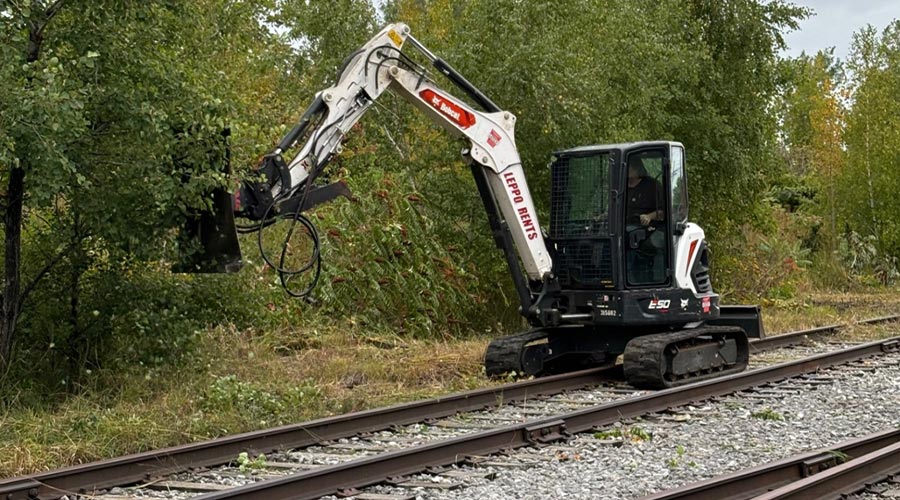 A brush-cutting excavator is used to clear the line of heavy overgrowth on the WESL.Resourceful Rail
For Resourceful Rail, Berish is aiming for slow, sustainable growth.
“We’re not trying to buy five railroads at once or anything crazy like that,” he says. “It’s really about [acquiring] one at a time, then putting in the effort to make sure that it grows properly before moving on to the next thing.”
The West Erie property was a good fit because Berish had contacts in the area to help him restore the line to service. The line’s history dates to the early 1900s, when it was a part of the Bessemer & Lake Erie Railroad that served steel mills in the region. Eventually, the line was spun off and more recently was operated by NS as an industrial spur.
“The last known service on the line we believe was in 2015,” Berish says. “Now, we’re starting with a couple of transload customers, the main one is for a cement. Come spring, we’ll be delivering cement and aggregates there. We're actively talking with other potential customers to bring in their business, as well. The goal is to grow West Erie until its sustainable and has a good, diverse mix of business.”
WESL currently employs a couple of part-time workers. As more customers sign up for service, Berish hopes he’ll be able to hire full-time help. For now, he’s splitting his time between the DIR, which employs three full-timers, and WESL.
For both railroads, Berish seeks to attract new customers who haven’t used rail before as well as those who’ve tried it but dropped it for various reasons. DIR currently serves both.
“We pursue all those customers slightly differently, but the goal is the same: to figure out how to get them shipping by rail,” he says. “Whether it’s a small customer that ships five cars a year or somebody that wants to ship unit trains, we want to talk to everybody and see if there’s a way we can help them with their goals.”
As Berish continues the hunt for new customers, he’s also on the lookout for more short lines to acquire. The proposed merger of Union Pacific Railroad and Norfolk Southern Railway, which would create the first U.S. transcontinental railroad, could present some opportunities for independent short-line railroaders like him, he believes.
“The Class Is are really good at the long hauls,” says Berish. “If the merger goes through, there are a lot of smaller industrial tracks and branches that wouldn’t necessarily make sense for a mega system like that. I would hope that a lot of those lines would get spun off and go to a short-line operator that can be a little bit more attuned to customers’ local marketing efforts.”