OmniTRAX's Wolfe keeps her finger on the pulse of the economic and industrial development marketplace
2/5/2026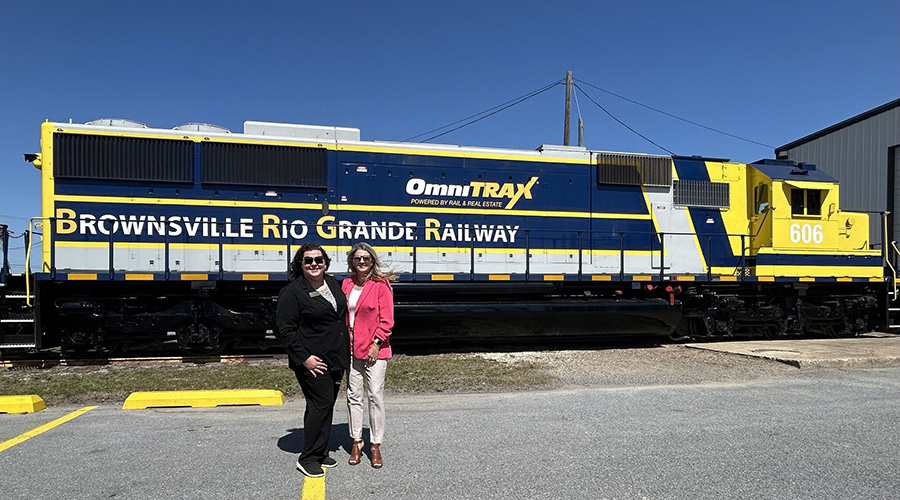
By Julie Sneider, Senior Editor
Ashley Wolfe already was experienced in rail economic development when she joined OmniTRAX Inc.’s three-person economic development team as a director in May 2023. She previously spent about 18 months in regional economic development at BNSF Railway, where she directed, planned and implemented rail facility expansions in north Texas and Oklahoma.
Before that, she managed the BNSF account for the rail practice group of Jones Lang LaSalle’s (JLL) commercial real estate arm.
Prior to entering the rail realm, Wolfe earned her economic development chops working for county and community agencies in Virginia.
In her OmniTRAX role, she focuses on properties in Arizona, Texas, Oklahoma, Nebraska, Washington and California. Wolfe nurtures relationships with government entities, elected officials, Class Is, lobbyists, economic development specialists, site selectors and brokers, utilities and potential customers looking to build, expand or acquire access to rail service.
Late last year, she was the third member of the OmniTRAX economic development team to earn certification from the International Economic Development Council (IEDC), a global nonprofit organization for economic development professionals. The certification is considered the gold standard in the economic development profession, according to OmniTRAX officials, and achieving it is rare in the rail industry. Wolfe says she started the coursework leading up to IEDC certification examination years ago, and all her employers along the way were supportive of her efforts to complete the process.
Currently, only OmniTRAX, Canadian Pacific Kansas City and Union Pacific Railroad employ IEDC certified economic developers; OmniTRAX is the only railroad company whose entire economic team has achieved certification, Wolfe says.
Wolfe is based in Arizona, where in 2024 OmniTRAX acquired Central Arizona Commerce Park’s (CAZCP) rail infrastructure and remaining park acreage. That acquisition made OmniTRAX the exclusive infrastructure partner of the 679-acre industrial park. CAZCP offers rail connections via UP.
Recently, Wolfe sat down with RailPrime Senior Editor Julie Sneider to discuss her OmniTRAX role and how she ended up in rail. Responses have been edited for clarity and length.
RailPrime: Explain your role on the economic development team at OmniTRAX.
Wolfe: I’m one of three on the team and we’re divided by geographic regions. I maintain relationships with our state, regional and local economic development partners in the areas where we have railroads. At the regional and local level, it's really a matter of working hand-in-hand with partners on business retention and expansion of existing industries, recruitment of target industries that the community wants and then working through project management to get those projects from conception to operational.
Our team is also tasked with maintaining relationships with the site selection community — there are companies that specialize in helping industries find a location for a new facility. We spend a lot of time and energy keeping those lines of communication open so that when those site selection firms have projects with a rail requirement, they know they can reach out to us directly.
And then lastly, we work directly with companies [that employ their own] site-location decision-makers that are rail-centric. So, there are three different prongs of how we work to make sure that our partners know who we are, where we have railroads and what our value proposition is to generate leads on the economic and industrial side for the company.
 “I maintain relationships with our state, regional and local economic development partners in the areas where we have railroads.” — Ashley Wolfe, OmniTRAX's director of economic and industrial development OmniTRAX Inc.
RailPrime: Why is earning the IEDC certification so important to your work for OmniTRAX?
Wolfe: The certification creates a level of trust with [development] partners by showing that we have the expertise to understand the metrics they’re looking for: the capital investment, job creation and rail infrastructure knowledge. We can help these economic development organizations and companies make sure they are making smart decisions about location and infrastructure before they make massive investments. We view the certification as a way to show our partners that we’re a trusted adviser.
RailPrime: Why do you think it’s important for a railroad company to have its own economic development team?
Wolfe: I think all railroads have a dedicated commercial team, the traditional business development roles, the sales teams responsible for managing the existing accounts on the railroad. But when it comes to recruiting new business to the railroad — ultimately, the goal is to increase carloads — you have to have the capacity and the people who understand the economic development marketplace. These are the projects that are so capital intensive they’re on long timelines and because of that, they’re not on what would be a normal sales cycle. It can take two years for a project to go through site selection, engineering and construction before it actually becomes operational.
As a railroad, if you want to have visibility into the new development projects that are coming to a state, then you must have relationships with the [state or community] economic development folks who review and respond to those project proposals. If you’re not developing those relationships, then you don’t have that visibility.
RailPrime: Describe one of the bigger projects that you’ve shepherded from beginning to end on behalf of OmniTRAX.
Wolfe: A recent one involved NebraskaLand Aviation in Holdrege, Nebraska, which is where OmniTRAX has its Nebraska, Kansas, Colorado Railway (NKCR).
The local economic development organization is Phelps County Development Corp. (PCDC). NebraskaLand Aviation is an existing business in Holdrege, but not on the railroad. They bring in fertilizer, put it in airplanes and spray crops with it. They were bringing it in by truck and decided they wanted to expand their operations and take advantage of the efficiency of bringing in the fertilizer by rail.
Just west of Holdrege is Iron Horse Industrial Park, which is owned by PCDC and is adjacent to NKCR, our main line. NebraskaLand Aviation decided they would purchase a site in that industrial park [to build a facility that will hold 6,665 tons of dry fertilizer].
From a rail perspective, I’m trying to understand issues like, what will be NebraskaLand’s rail volumes, where will they be coming from and going to? What does the rail concept look like? How does the switch come off of our main line and how does it lay out on their new site in the industrial park to make it operationally efficient?
The project is not yet operational, but the site has been selected and we’re in the middle of the project management phase. They broke ground in July 2025, that’s phase one; the building will be phase two; and then comes the rail. It will be another few years before the rail is constructed and operational.
RailPrime: I Iove asking rail industry professionals how they ended up in railroading. So, my final question for you is: What is your story?
Wolfe: Yeah, mine is a winding road. I went to college at Virginia Tech, where my undergrad studies were in animal and poultry science. My original ambition was to be a horse veterinarian — I have a personal passion for all things equestrian. I still own horses and have been riding since I was little. So, I studied animal science and in the middle of that, I decided I probably wasn’t going to go to vet school and ended up specializing in equine reproductive physiology and the breeding of horses.
After I graduated, I went to work for a horse-breeding facility, and then a couple years into that, I [switched to] the training, showing and selling of horses and I did that for a decade. It was a really cool job, but I was moving around a lot — to Pennsylvania, then Florida, then back — and I missed my family in Virginia. I decided to move back to Virginia, then wondered what I could do with 10 years of experience in horse breeding and training.
I ended up working at Virginia Tech, which is one of the two land-grant universities [in Virginia]; they have the Virginia Cooperative Extension, which has an agent that disseminates the research coming out of the university to people that can use it at the local level. So, I started as a county extension agent and that’s how I got into local economic development projects on the agricultural side.
I did that for a while, then took a leap of faith and moved to Arizona [to be with her now husband] and started looking for an economic development job. A friend told me about an opening at JLL in economic development for their BNSF account; I told him I don’t know anything about rail. And [the friend] said, “There's a company full of railroad professionals at BNSF. What they need is someone that knows about economic development. You can learn about railroading.”
And so, I said yes and took that job. Never had I thought that I would have ended up doing anything railroad-related.