Mt. Rainier tourist railroad, executive director forge ahead despite devastating fire
11/24/2025
By Julie Sneider, Senior Editor
When Bethan Maher went to work for a New York scenic railroad at the age of 21, she was looking for an office job to pay her bills while she pursued a Ph.D. in archeology. Before then, railroading had never been on the radar of the student who, as an undergrad, double majored in anthropology and piano performance.
But today, the 37-year-old executive director of the Mt. Rainier Scenic Railroad (MRSR) says she wouldn’t want to be doing any other kind of work. After giving up her Ph.D. studies to pursue railroading full time, she worked for the New York railroad for a number of years and then as a consultant before heading west. In September 2022, the MRSR’s new owner hired her as executive director of the Elbe, Washington-based railroad after its previous owner, American Heritage Railways, shuttered it in 2020.
In 2022, Western Forest Industries Museum, a nonprofit organization, acquired the MRSR with a plan to relaunch its excursion service. The nonprofit also exercised an option under a long-term lease agreement with Tacoma Rail, which owned the rail line on which the tourist railroad previously operated, to acquire the rail line. After Maher came on board and the MRSR’s track, bridges and equipment upgrades and repairs were completed, the railroad was ready to relaunch excursions on Sept. 1, 2023.
A scenic ride through logging history
The historic steam locomotive transports passengers on a 14-mile trip along the scenic foothills of southern Mount Rainier. The journey starts at the depot in Elbe and ends at the logging museum in Mission, Washington, where visitors can learn about the history of logging and related railroads that once operated in the Pacific Northwest. The museum’s mission, according to its website, also involves sharing with the public an appreciation for maintaining the area’s freight corridor.
Shortly after Maher joined MRSR, she came to appreciate what it had meant to the community before it closed: the traffic and revenue from tourists traveling from across the globe to visit Mount Rainier National Park and the broader Pacific Northwest.
“One of the most surprising things we found was how much community support we had for reopening the railroad,” Maher recalls. “Initially, we planned to have the railroad operational by 2025, but we were able to open for service by Sept. 1, 2023. We had a ton of volunteer labor to help us, including from other railroads and short lines in the area to do the work to upgrade the track, conduct the bridge work and repair the equipment we needed to open again.”
By the time Maher started selling tickets for train excursions, the community was ready for its business. “We were shocked that on opening day we sold out every single train that we offered,” she says. “And that trend continued throughout 2024. We ran 356 tourist trains in 2024, and on average we operated at 96.8% capacity.”
With the train rides running at or near capacity throughout 2024, Maher and the nonprofit’s leadership pondered how they could diversify the organization's revenue streams to fund the railroad’s expansion. One possibility that surfaced was adding a freight-rail service for local businesses. When two mill operators in nearby Morton, a town of about 1,100 in Lewis County, indicated interest in accessing rail, the MRSR team began exploring the potential.
With guidance from the American Short Line and Regional Railroad Association, Maher began writing a new business plan and preparing other documentation necessary to transition to a common rail carrier that would offer tourism as well as freight-rail service. Becoming a freight-rail carrier also would improve the railroad’s chances of successfully applying for government funding through the Federal Railroad Administration’s Consolidated Rail Infrastructure and Safety Improvements (CRISI) and other federal grant programs that help fund transportation infrastructure, Maher says.
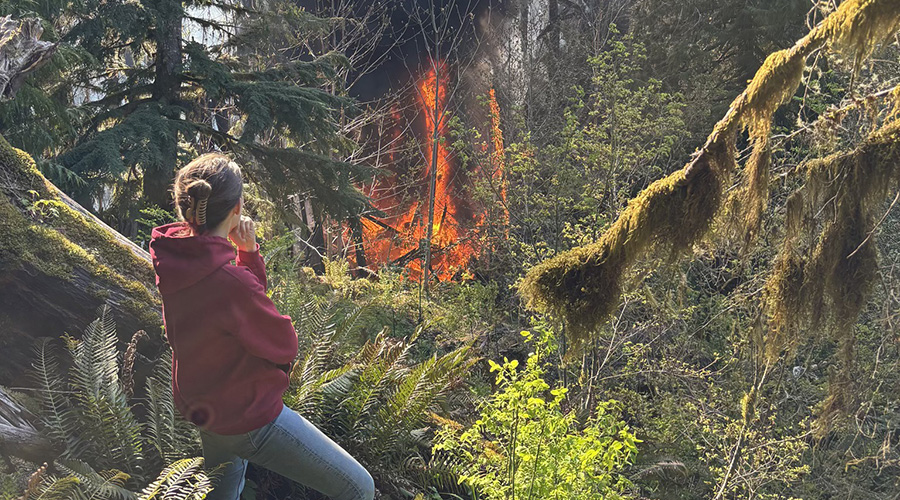 “There's been a common consensus among law enforcement agencies that this [was] arson.” — Bethan Maher, shown watching flames from the trestle fire. Mt. Rainier Scenic Railroad
 A suspicious fire puts plans on hold
But on April 30, all work on their expansion preparations came to a halt when the railroad’s largest and most important bridge — a 400-foot-long, 100-foot-high wood trestle structure — burned to the ground. It took firefighters from the local Department of Natural Resources hours to reach the remotely located structure and four days to put out the fire, Maher says. The 120-year-old bridge is a total loss, and investigators have determined the fire was “human-caused,” according to Maher.
“I think there's been a common consensus among law enforcement agencies that this [was] arson,” she says, adding that an arrest has yet to be made. Rebuilt only 20 years ago, the trestle was in excellent condition. Estimates to rebuild it run as high as $10 million, if it’s rebuilt with steel and concrete. Maher and the railroad’s staff of 15 to 20 employees were able to restart operations shortly after the fire. Local news media got the word out that despite the tragedy, the railroad remained open for business.
“Fortunately, we are able to maintain the core of our operation,” saysMaher. “But expanding it is a little more challenging because we’re losing valuable trackage over the most scenic part of the route.”
 “Tourist railroads are now a viable business where we’re carrying significant numbers of passengers, earning real revenue and providing a huge impact to the industry.” — Bethan Maher, shown with a railroad crew member discussing where to install decorations for the railroad’s upcoming holiday events. Mt. Rainier Scenic Railroad
 The bridge wasn’t yet part of the tours when the fire occurred, but it was part of the railroad’s plan to add route miles to the excursions starting next year.
“So yeah, that’s not an investment that we’re going to realize,” she says.
Despite the unfortunate turn of events, the railroad remains a year-round operation and this year is still offering its annual "Christmas with the Clauses" program, a “75-minute immersive theatrical experience where Christmas tradition meets enchantment,” as it's described on the railroad’s website. The holiday event typically attracts tens of thousands of visitors, Maher says. All year, the railroad’s excursions and events attract as many as 80,000 people.
Signs of hope and support
Maher’s spirits have been kept high by the community’s support of the railroad, especially since the fire. An online fundraiser to help pay for post-fire cleanup and legal costs has raised over $200,000 as of early November, and Maher has been posting updates on the teardown and demolition of what was left of the trestle, the recovery fundraiser and the suspected arson investigation. Offers of help have come from other railroads.
One fan of the MRSR is Kasie Howland, BNSF Railway’s general director of line maintenance in the Pacific Northwest area, who has offered her engineering and technical expertise — on her own time — as the railroad prepares to rebuild the bridge.
“I follow the railroad on social media, mainly because I’ve been wanting to make a trip on their rail bikes (a pedal-powered rail excursion),” Howland said in a “Rail Talk” feature on BNSF’s website. “I’m a bridge nerd, so I offered to provide technical assistance when I learned about the fire.”
 “I was never interested in trains as a child. Now that I have small children, they’re fascinated by trains.” — Bethan Maher Mt. Rainier Scenic Railroad
 Howland met with Maher and the railroad’s roadmaster on site after the fire. She talked them through the next steps of safely demolishing what remained of the structure and has offered to help prepare bid packages when the MRSR is ready to rebuild the bridge.
While the plan to begin freight service in 2026 is on hold, Maher continues working on the business plan and preparing an application seeking a federal CRISI grant that, if awarded, could help fund the bridge’s reconstruction. She’s also participating in efforts at the ASLRRA to raise the profile of tourist railroads and the contributions they make to local economies.
“Tourists railroads, many of which started as volunteer operations, have professionalized,” Maher says. “They are now a viable business where we’re carrying significant numbers of passengers, earning real revenue and providing a huge impact to the industry.”
Besides serving as tourist attractions, such railroads can be used to teach local residents about rail safety and expose younger generations to jobs and careers in rail, she says.
“When you’re carrying 80,000 people a year on your trains, those are 80,000 people in a captive audience, right?” she says.
As for her own life, Maher is hooked on the challenges and variety of tasks involved in managing a small railroad.
“It’s always fascinating,” she says of her work, which she balances with life at home with her husband, who works for the military, and their 4-year-old child and 2-year-old twins.
“I was never interested in trains as a child,” she adds. “Now that I have small children, they’re fascinated by trains. And I’m a very cool mom at preschool. I’ve got some really good street cred with 4-year-olds — which, at this point in my life, is a real bonus.”