Heard at RailTrends '25
12/2/2025
By Jeff Stagl, Managing Editor
Something was very apparent by looking around the meeting room during RailTrends® in New York City last month. The 21st annual event — which was held Nov. 20 and 21 at the New York Marriott Marquis — had again generated a record, standing-room-only crowd.
There also was something that was quite obvious while listening to all 21 presentations at the conference: The proposed Union Pacific Railroad-Norfolk Southern Railway merger was, by far, the No. 1 topic of discussion. Most of the 41 speakers at least touched on it.
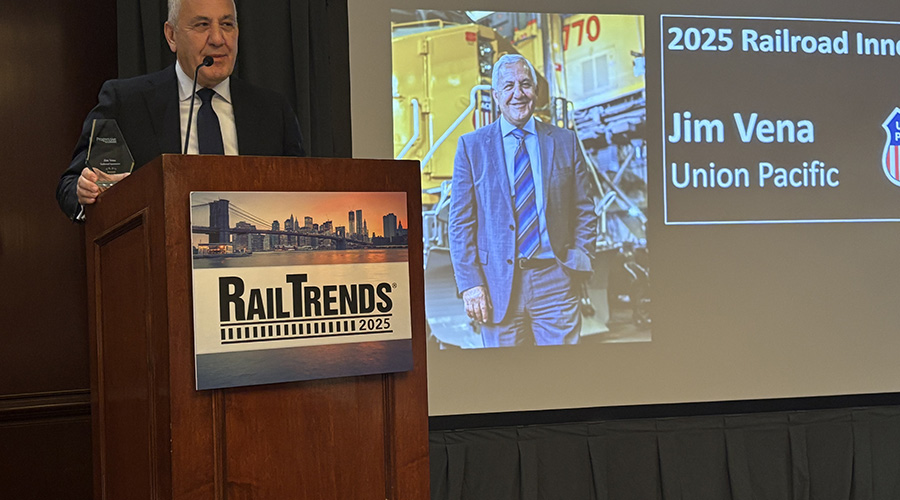 After accepting the Railroad Innovator of the Year award, Union Pacific Railroad CEO Jim Vena talked about how the UP-NS merger will divert traffic from trucks.Jeff Stagl
As per usual at RailTrends, the speakers ranged from CEOs and high-ranking officers at the Class Is to short-line executives to Surface Transportation Board members to major association presidents to industry observers and analysts to movers and shakers from the rail supply sector.
In addition to the planned UP-NS merger, they covered a broad range of topics, including the economy, regulations, legislation, labor, rail service, traffic growth, short line/Class I relationships, capital investments, trucking competition and technologies.
Following are paraphrased comments from a sampling of the presenters at RailTrends 2025.
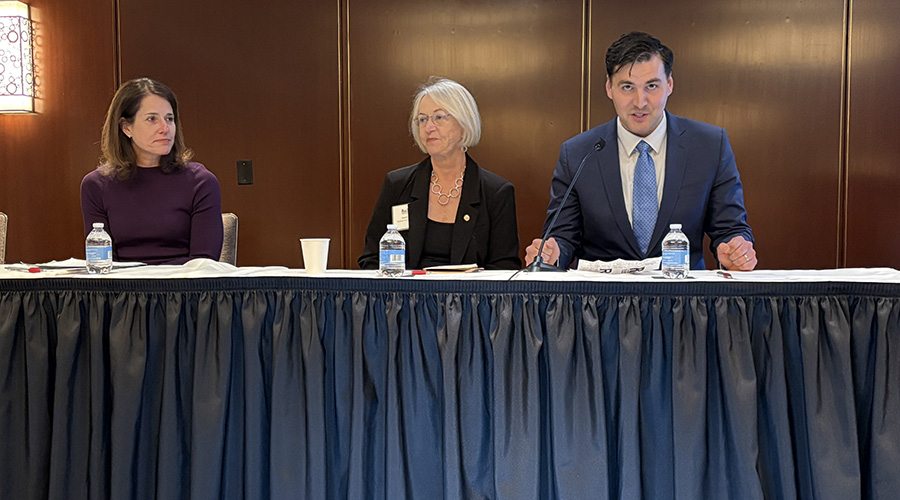 (From left) STB members Michelle Schultz and Karen Hedlund, and STB Chairman Patrick Fuchs. The board will “reach a thorough and fair decision” on the UP-NS merger application after it’s submitted, Fuchs said.Jeff Stagl
I’m not going to apologize for making your lives a bit harder soon. Don’t take the holidays off to get to a decision.
— Jim Vena, CEO of Union Pacific Railroad, addressing Surface Transportation Board Chairman Patrick Fuchs and members Karen Hedlund and Michelle Schultz (who seemed shocked by his presence in the second row) during a STB presentation. Vena was referring to the UP-NS merger application that the Class Is plan to submit to the board in the first half of December
The STB will consider all the evidence and arguments and reach a thorough and fair decision regarding the UP-NS merger application. The board members will rely on the facts when weighing the merger. We have been emphasizing a more collegial, nonpartisan approach when working together.
— STB chairman Fuchs responding to Vena’s comments
 (From left) Association of American Railroads leader Ian Jefferies, Railway Association of Canada leader Eric Harvey and American Short Line and Regional Railroad Association leader Chuck Baker.Jeff Stagl
Don’t judge this merger based on things that happened in the ’90s. I don’t care what happened after railroads merged back then. The question I’d ask is if this merger is better for customers. And the answer is: Yes. Customers will benefit from their shipments moving on a single line, that’s something you can’t get in the marketplace now. The day after we merge, trucks that are running today will come off the highway. The impact to railroads is we need to move ahead or we’re going to get left behind. There’s no way that the United States should be the one country in North America that does not have a railroad that goes from one end to the other seamlessly.
— Vena later commenting on the merger after accepting Progressive Railroading's 2025 Railroad Innovator Award
The railroad industry will be celebrating its 200th anniversary next year and when you look at regulations, many of them are 198 years old. We need to get on the ball. The industry’s regulatory process moves at a glacial pace. We are pleased that a railroader (David Fink) is back at the helm of the Federal Railroad Administration. Core issues are in play that affect the entire industry.
— Ian Jefferies, president and CEO of the Association of American Railroads
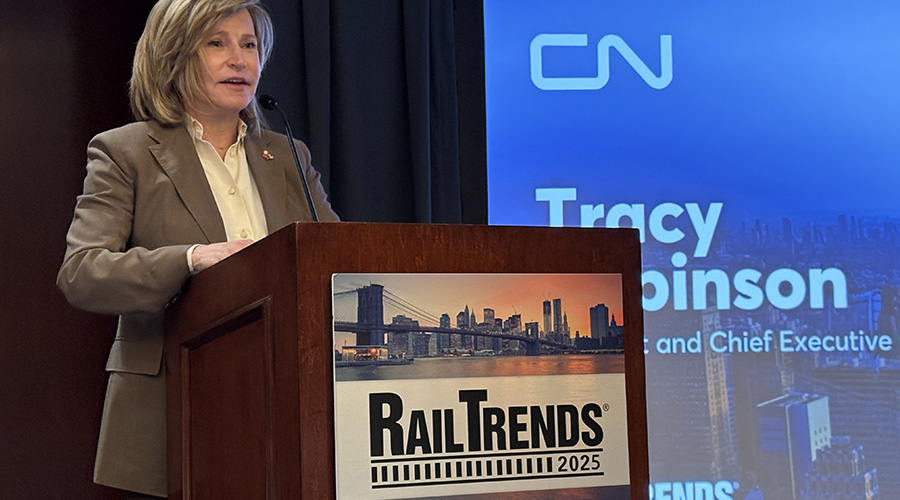 CN President and CEO Tracy Robinson said the Class I is trying to be efficient with spending. “There is no single magic lever here. We have to tighten our cost base and chase every single dollar,” she said.Jeff Stagl
I have the easiest job of any association. People love short lines. We need to tell the short-line rebirth story. We are trying to modernize the 45G short-line tax credit, which has been around for 20 years, to account for inflation. When it comes to technology, a lot of innovations are out of reach for short lines. There is only so much they can do on a short-line budget. We have notified the STB that we intend to participate in their review of the proposed merger between Union Pacific and Norfolk Southern. Short lines will be affected and we want to make sure there is a reasonable approach so Class Is and short lines continue to work together.
— Chuck Baker, president of the American Short Line and Regional Railroad Association
There have been four CEOs during my eight-year tenure at CSX. New CEO Steve Angel comes from the industrial gas industry. I’ve gotten to know him since late September. One night while talking to my wife, I told her he knows what “good” looks like. He knows how to work with customers, get a price, get more business and function as a team. He knows it from all perspectives. He is in it to win it, I say. He’s in my office every other hour and meets constantly with all the executives. He loves it, and he works long hours. One time I was in the office until 8:45 p.m. and I thought I had stayed longer than him, but he was still working.
— Kevin Boone, executive vice president and chief financial officer of CSX
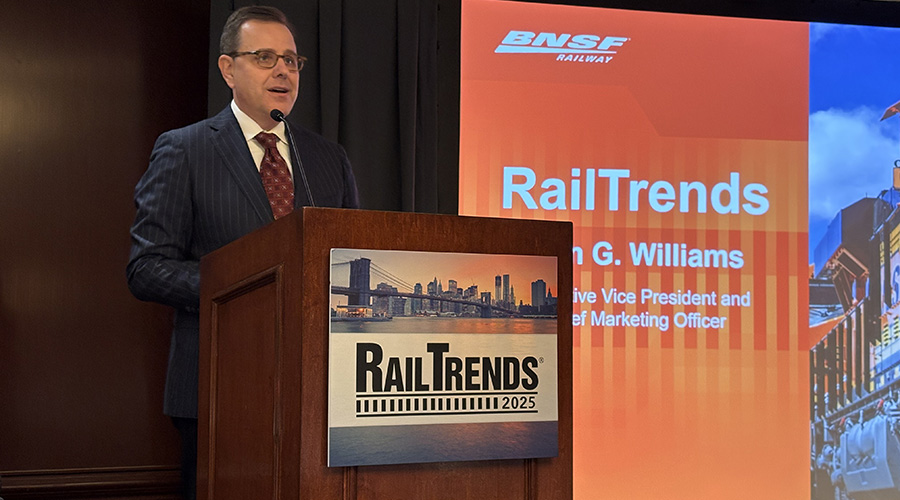 BNSF’s top marketing officer, Tom Williams stressed his railroad would argue that the absence of a merger is better than combining UP and NS.Jeff Stagl
I talked last year about how the rail industry needs to focus on becoming more of an eco-system and on enacting change. And this year, the eco-system effort has been off the charts. There have been so many deals and lots of collaboration that have created better service products for customers. But when it comes to enacting change, the industry hasn’t been as successful. We need to move at a faster pace with technology. Only 3.5% of the entire North American fleet is equipped with telematics. That’s not good. Trucks have had that for 10 years. Why isn’t every rail car equipped with GPS? Transaction friction has caused us to be complacent as an industry.
— Mike Miller, CEO of Genesee & Wyoming Inc.
The premium in times of uncertainty is to be flexible. We are positioned for the long term. For 2026, we are positioned to meet the moment. It will be another year of limited growth. So, we are ensuring our investments and resourcing reflects that. We are budgeting $600 million less on capital expenditures next year at $2.8 billion. We have the right capacity and focused productivity, and are trying to be efficient with every dollar spent. There is no single magic lever here. We have to tighten our cost base and chase every single dollar. We hope the economy rebounds, but we are not seeing any signs of that. If it does, we are ready.
— Tracy Robinson, president and CEO of CN
No merger has happened without some service disruptions. Rail integrations are super hard. There have been many interline service offerings unveiled in the last six months. Customers can see benefits from these without a merger (as in UP-NS). A merger is a tough sell that it’s good for the U.S. We would argue that the absence of a merger is better. The rail industry lost share to trucks after the 90s-era mergers. That was a tall hill to climb.
— Tom Williams, EVP and chief marketing officer for BNSF Railway
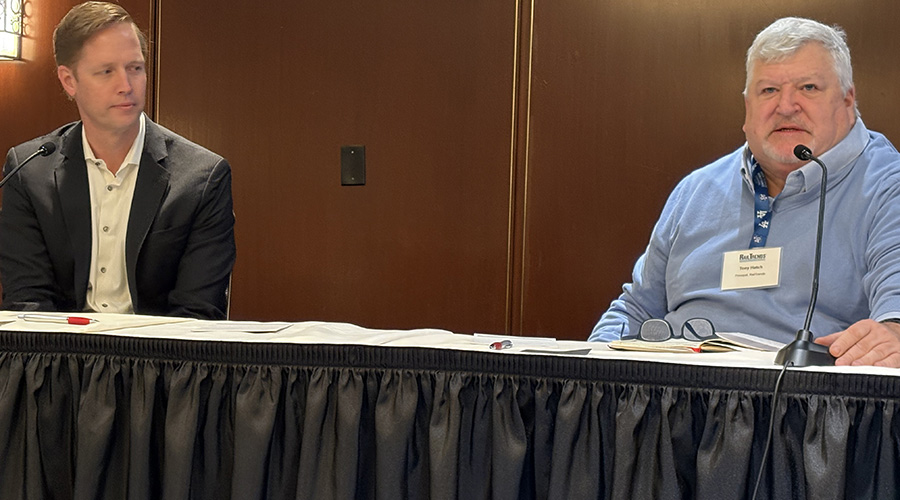 (From left) CSX’s top financial officer Kevin Boone and RailTrends program consultant Tony Hatch. New CSX leader Steve Angel — who became president and CEO in late September — is “in it to win it” when it comes to growth, Boone said.Jeff Stagl
We are an exception to the rail growth story. We have a consistent strategy as it relates to growth. For example, our "land bridge" targets freight moving between Canada and Mexico across the United States. We expect to total $430 million in land bridge business in 2025, which would be double from last year. Traffic has been heavy on autos going north and grain and plastics going south. In terms of a merger, the scale, scope and complexity is different in every one. We were the smallest Class Is when we merged and we are still the smallest Class I. UP-NS clearly would be different in scope and size. You have to incorporate all the interchanges in Chicago and New Orleans, and all the points in between. The concessions and conditions worked into a merger are only as good as what’s carried out.
— Coby Bullard, senior VP of sales and marketing for Canadian Pacific Kansas City
After there were 10,000 migrants on our system every day in 2023 and 2024 because of migration laws, we set out to rebuild ourselves. We created the La Maquinista project to digitize and optimize all intelligence in our yards. The system synchronizes every terminal and anticipates demand before it happens. Decision-making is not easy with humans in the middle. AI does the thinking about what is entering the network and how it can be handled. If there’s a hiccup, we can regroup quickly. We are scaling up our terminals and AI is in our front line. La Maquinista means machinist in the feminine form of the word. We think it’s universal.
— Fernando Lopez Guerra, CEO of Grupo Mexico Transportes
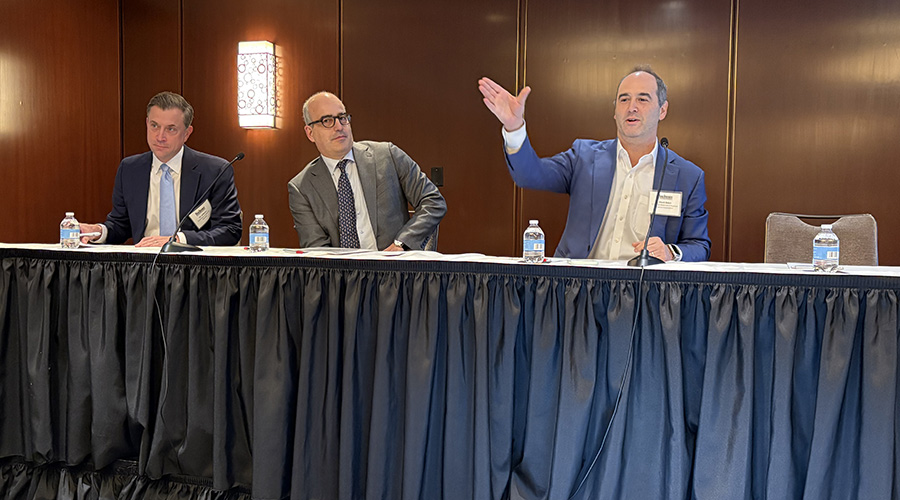
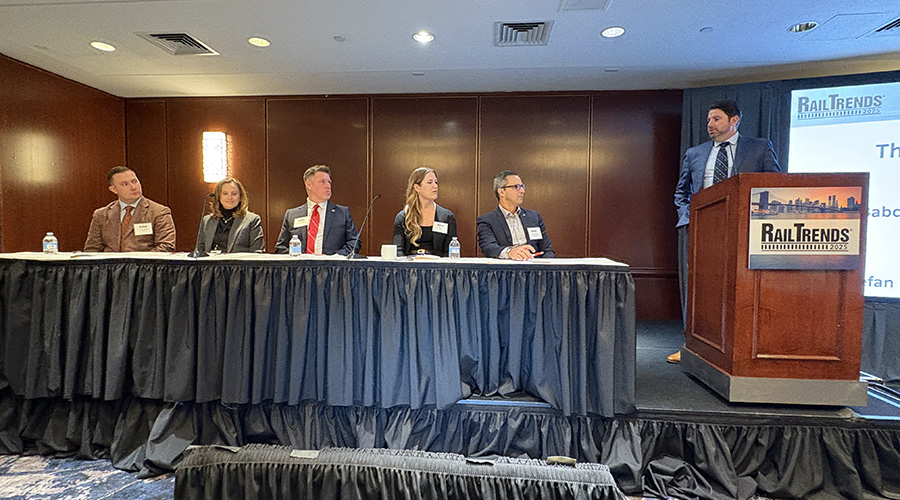 A short line panel included (from left) Watco SVP of Sales Zachary Boehme; Patriot Rail LLC CEO Brandy Christian; R. J. Corman Railroad Group President/CEO Justin Broyles; Railroad Development Corp. VP/Chief Operating Officer Ida Posner; and Livonia, Avon & Lakeville Railroad Corp. President/CEO Bob Babcock. NS VP of Business Development/First and Final Mile Markets Stefan Loeb (at far right) moderated the panel.Jeff Stagl
NS is still an independent company and will continue to operate that way as long as we are an independent company. We have the best service at the railroad that I’ve seen in 20 years. So why merge with UP? We are not keeping up with trucks. That’s the bottom line. The combined railroad can best compete with where trucks are going. The venture is more the sum of its parts. The merger will be a turning point for the industry. There was a lot of innovation and investments in the industry after the last round of mergers, and that will happen again. In the interim, we will run hard as an independent company.
— Mike McClellan, SVP and chief strategy officer for Norfolk Southern Railway
I met a farmer who had a young son that loved trains. I told the farmer to bring his son by us and we’d give him a train ride. They came one day and we gave the son a baseball hat with our logo on it and took him around. Years later, the farmer came back to our office. He said he was selling his farm that was 130 acres and asked if we’d be interested in buying it. We don’t get many opportunities like that, so we bought the land, which was near our line. Now there is a transloading operation and a new plant there. And all it really cost us was a hat.
— Bob Babcock, president and CEO of Livonia, Avon & Lakeville Railroad Corp.