Evertrak recycles plastic to make rail ties — and opportunities for unskilled workers
8/27/2025
By Julie Sneider, Senior Editor
When Tim Noonan founded St. Louis-based Evertrak in 2017, he did it with two missions in mind. The first was to help build a more sustainable railroad infrastructure by replacing wood rail ties with composite ties made from recycled plastic.
The second mission was to employ unskilled workers who wouldn’t stand much of a chance of being hired at many other businesses.
Noonan, 60, a Marine veteran launched Evertrak after retiring from Boeing Co., where he was vice president of training systems and government services. While still at Boeing, he had invested in a business venture that shipped recycled plastic to other businesses, including companies that made composite ties for the rail industry.
Eventually, Noonan came to believe that he could come up with a better composite tie made of recycled plastic that was just as strong as wood. He was familiar with other innovators that tried but for various reasons failed to produce such a product.
He acknowledges that convincing MOW-budget-conscious railroads to invest in rail ties that are more expensive than wood isn’t easy. But he believes the time is right for Evertrak’s composite tie, as availability of mature hardwood trees that are suitable for manufacturing wood ties is diminishing.
Business as a force for good
While he’s focused on producing a product that’s good for the environment, Noonan also wants Evertrak’s company culture to be centered on his belief that “business can be a force for good in the world,” he says.
So, after Evertrak’s production cycle ramped up to a point where it needed a larger workforce to perform the manual labor required on the factory floor, Noonan turned to Saint Louis University for help. The university offers a Transformative Workforce Academy that assists formerly incarcerated individuals develop the skills necessary to find work upon reentering the community after completing their prison term.
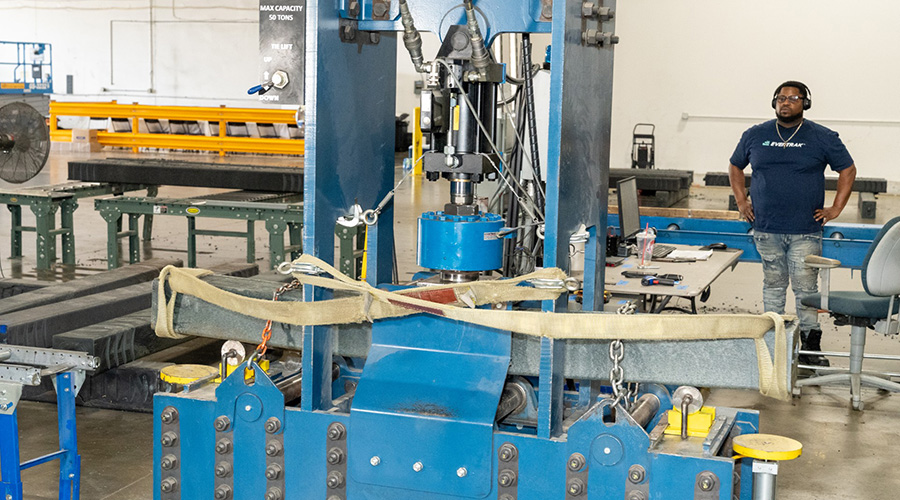 A worker watches production on Evertrak’s factory floor. The company uses recycled plastic to manufacture composite rail ties that have a 50-year lifespan. Evertrak
The academy helps people find jobs with “second- or fair-chance employers” that are willing to hire people who have a criminal record. Evertrak also has recruited workers through Missouri Veterans Endeavor, a nonprofit that helps homeless veterans find jobs.
The company does run a background check on all potential hires and declines to hire people convicted of violent crimes or sexual assault.
Today, more than half of Evertrak’s workforce of about 50 people is made up of formerly incarcerated citizens “who paid their debt to society and are willing to join our team,” Noonan says, adding: “It’s really been a joyful experience working with these guys.”
Because many of those workers left prison after serving terms that began when they were teens, they didn’t have the education necessary for work in today’s job market. As a result, they transitioned from prison into communities where jobs available for the unskilled primarily pay minimum wage without benefits.
Evertrak is trying to reverse that trend. It pays its unskilled workers a living wage and provides benefits that include paid time off and employer contributions to health insurance and 401(k) plans, according to Noonan.
“Economic liberty is liberty in our country,” he says. “It’s the freedom to put a roof over your head, buy a car, not worry about groceries — all those things that many people in America take for granted.”
Once hired, a worker goes through a few hours of training and, depending on their skills or prior work experience, may shadow a more experienced employee to learn what’s expected in a particular job. If they have some specific experience — such as a license to operate a forklift — they’ll be assigned to that duty. But most are assigned to work as table operators as part of the tie-manufacturing process.
Whatever they’re assigned to do, Noonan makes sure to let the workers know they’re valued members of the team.
“I say, ‘You get love and respect because you walk through the door, you do your job, you show up on time and you get a paycheck for doing that.’ And for a lot of these guys, they don’t hear that enough,” he says.
High turnover and stories of success
He acknowledges that retaining a workforce of people who’ve served time, been homeless or experienced other forms of trauma isn’t easy. Turnover is around 75%.
“With this group of people, they have unbuilt habits and an inconsistent work history,” says Noonan. “We’ll have guys come in here and work three to four days and then say, ‘This is too hard. I don’t want to do this.’”
Workers who make it through six months are likely to stay on the job for at least a year or more, Noonan finds. And, he has some success stories to tell.
One involved a man who served a 20-year prison term, had never worked for a paycheck and never had health insurance. He got hired at Evertrak, worked for six months, used the employee health plan to get a foot deformity fixed, saved enough money to buy a car and then left the company to become an Uber and DoorDash driver.
“I consider that to be a great win,” Noonan says. “The guy came in, had autonomy and moved on.”
When Noonan started Evertrak he and his wife were its sole owners. But in January 2025, Tokyo-based Sumitomo Corp., through its subsidiary Sumitomo Corp. of Americas, made a strategic investment in the company.
Sumitomo’s investment in Evertrak stemmed from “a shared vision to build sustainable railroad infrastructure and the opportunity to create synergies with Sumitomo Corp. Group’s existing businesses,” Sumitomo officials said in a press release issued at the time of the announcement.
“The investment by Sumitomo is a signal to the market that sustainable infrastructure is here to stay,” says Noonan. “It’s a sign that a globally elite, at-scale company sees a different future for this industry. We consider it to be a massive differentiator when you've got Sumitomo as a partner and an investor.”
Sumitomo also was a good fit because its social values align with Evertrak’s, says Noonan, who retains 51% ownership of the company and remains chairman and CEO.
“Their purpose statement is rooted in enriching people’s lives,” he explains. “And I don’t think there’s any other way to run a business.”
Eye on the future
Next, Evertrak is working on a new composite tie that’s price competitive with wood. Noonan hopes the company will be able to launch the new product in a couple of years.
To help get there, Noonan also is investing in Evertrak by spreading the word via social media. Despite being a baby boomer who admits he hasn’t been that active on sites like Instagram, he’s been featured in a few TikTok videos promoting Evertrak and the environmental benefits of composite rail ties.
He’s hopeful the messaging will reach future rail-industry professionals — especially young millennials and Gen-Zers who, polls show, place a high importance on environmental sustainability.
“Four million to 6 million rail ties are replaced every year in North America and they’re less than 12 years old,” says Noonan. “We’re running out of 100-year-old trees [for making wood ties], but there’s a forest of plastic outside the door of every community in America. What we’re doing sends a huge demand signal for recycled plastic. And we’re getting creosote out of the environment. This is all goodness.”