BNSF continues to make significant strides with safety
7/7/2026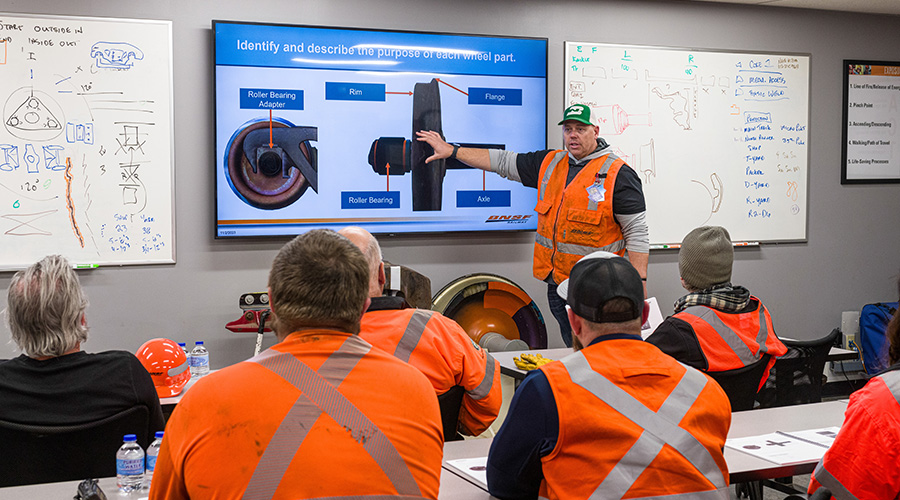
By Jeff Stagl, Managing Editor
BNSF Railway is on a roll when it comes to boosting safety. After registering its safest-ever year in 2025 as measured by certain metrics, the Class I has kept that momentum going in 2026.
Last year, the injury frequency ratio declined 7% and rail equipment incidents dropped 13% on a year-over-year basis. This year, progress made as of mid-June shows the railroad's injury frequency ratio fell 28%, rail equipment incidents decreased 12% and total injuries (reportable and non-reportable) plummeted 31% compared with metrics from the same 2025 period.
"BNSF remains at historic lows for year-to-date injury frequency ratios," said Kendall Kirkham Sloan, BNSF’s director of external communications, in an email. "Last year, we had the lowest injury frequency ratio in our company’s history, and we’ve led the industry for the last decade in fewest train incidents."
Safety always begins with employees and making sure they make it home at the end of each day, she stressed.
"We’ve maintained our status as a safety leader because it’s nonnegotiable for us, embedded into our culture and a main ingredient to maintaining our unmatched service," said Sloan.
BNSF strives to promote a strategy that stresses every accident and injury is preventable. The strategy focuses on fostering a culture that makes safety the highest priority and continuously examines the effectiveness of safety processes and performance; providing resources and tools that create an environment where all known hazards are eliminated or safeguarded; promoting essential work practices and training for all employees; and empowering workers to take responsibility for personal safety as well as the safety of fellow employees and community members.
"We maintain this [high] level of safety through our safety programs, training and technology, [through which] we will continue to work toward our vision of operating an accident- and injury-free railroad," said Sloan.
For example, BNSF employs a combination of classroom, field and on-the-job training and distance learning opportunities to ensure employees understand safe work habits.
Technical training is centralized at the Technical Training Center (TTC) at Johnson County Community College in Overland Park, Kansas. The TTC features simulation and lab equipment, including locomotive and grade crossing simulators, power-operated switches, radio and transmission networks, and freight-car and locomotive air brakes.
Field training programs include mobile field trainers and maintenance-of-way field instructors who provide training through on-site/new-hire classes, rule reviews and re-certification training. Simulators in the field provide distance-learning opportunities and can be customized to reflect various train types, weather, terrain and times of day.
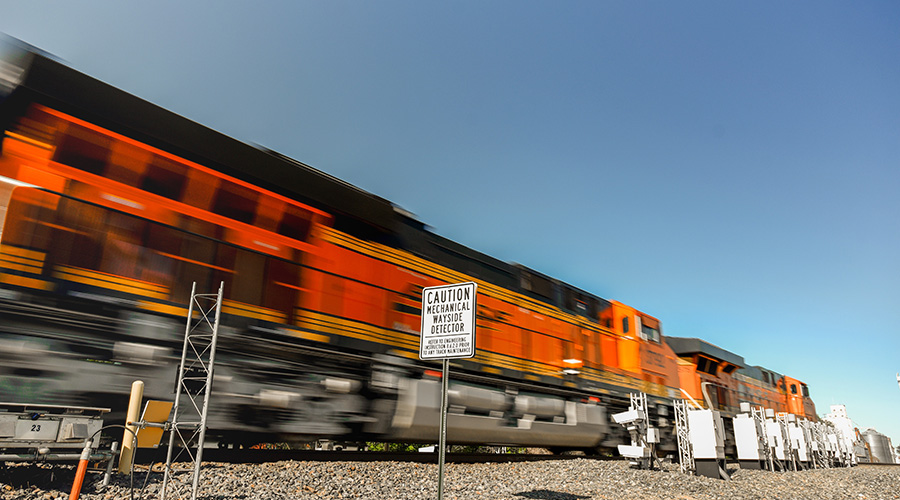 The railroad uses more than 4,000 wayside detectors to monitor passing trains for various potential safety-impacting issues, such as wheel defects, overheated bearings and dragging equipment.BNSF Railway
"Our extensive training programs enable us to ship 99.9% of hazardous materials to their destinations without a release caused by a train incident," said Sloan.
In addition, maintaining track is a critical element to improving safety, as is adopting technologies, she said. The railroad deploys machine vision systems, ultrasound and ground-penetrating radar to identify potential issues.
BNSF also uses recently developed Onboard Defect Identification & Notification (ODIN) and Track Health Optical Recognition (THOR) systems to help inspect and maintain track.
ODIN features a combination of sensors that analyze and survey track as a locomotive passes over a rail. Angled lasers measure the gauge (or distances between two rails), cross level, alignment and track surface.
Mounted under track geometry cars, THOR uses high-speed optical cameras to capture thousands of detailed images of rails at various angles at speeds up to 70 mph.
"THOR and ODIN complement each other to monitor different aspects of track health," said Sloan.
Last year, THOR units produced images over 165,000 miles of track and found about 2,000 defects that were addressed before developing into serious problems. The wayside ODIN systems measured 150,000 miles of track in 2025.
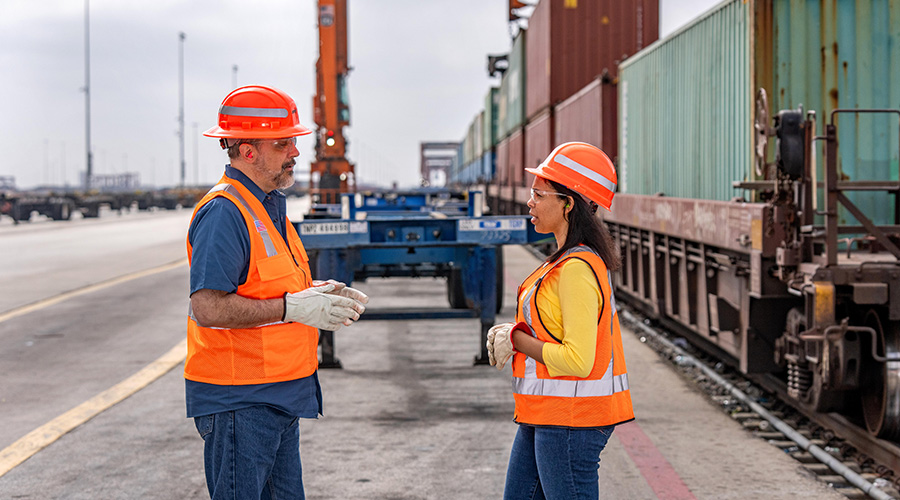 Field trainers help instill the company’s message to employees that every accident and injury is preventable and promote essential work practices.BNSF Railway
"Starting this year, ODIN will inspect more than 1 million miles of track each year, processing real-time data where immediate action is taken to protect track and prevent derailments," said Sloan.
Each day, artificial intelligence algorithms process more than 35 million readings from wayside detectors, enabling BNSF to predict maintenance needs and enhance safety.
Another safety contributor: The railroad has installed positive train control (PTC) on 17,000 miles of track across its network, which is beyond Federal Railroad Administration requirements to further enhance safety protection, said Sloan.
PTC helps prevent train-to-train collisions, derailments caused by excessive speed, unauthorized train access on sections of track undergoing maintenance activities and train movements through a switch left in the wrong position. PTC now covers 95% of the Class I's freight volume, said Sloan.
Moreover, TWC Plus covering track warrant control (TWC) has been implemented in 24 subdivisions and on more than 2,000 miles of track. TWC Plus is similar to PTC but is installed in non-signaled, track warrant-controlled territory.
"It provides most of the same types of protection, like exceeding train authority and speed limits through certain track conditions," said Sloan.
A transportation crew member came up with the idea for TWC Plus to add a layer of PTC benefits for TWC, or dark territory, operations, she said.
A Network Control System team then created a solution for TWC subdivisions, where most of the benefits of full PTC are enabled.
"This idea carried into an operable solution to enhance legacy dark territory operations, complementing PTC," said Sloan.