Q3 traffic: Short lines' tallies still mostly in the black
11/3/2026
By Jeff Stagl, Managing Editor
Short-line traffic remained on an upward trajectory through the third quarter. According to the RailConnect Index of Shortline Traffic through 39 weeks ending on Oct. 3, 444 small railroads handled 4,599,582 carloads, up 3.3% year over year.
Compiled by Wabtec Corp.'s GE transportation subsidiary, the index shows an even split of seven gainers and seven decliners among the 14 commodity groups listed. The two groups with double-digit percentage increases were intermodal at 12.7% (to 938,944 units) and "all other" traffic — unclassified or low-volume shipments that don't fit into primary categories — at 15.1% (to 70,751 units).
In addition, waste and scrap materials traffic jumped 9.9% to 287,292 units; stone/clay/aggregates loads climbed 9.4% to 547,927 units; grain carloads grew 4.9% to 536,706 units; farm and food products traffic (excluding grain) rose 3.1% to 213,915 units; and petroleum and coke shipments increased 1.6% to 140,461 units.
Meanwhile, the biggest decliner — by far — was coal traffic, which plunged 21% to 145,037 units compared with the same 2025 period. The other year-over-year drops were recorded for carloads of paper products (by 5% to 208,988); ores (3.1% to 102,499); chemicals (2% to 724,313); motor vehicles and equipment (1.4% to 151,281); lumber and forest products (0.9% to 212,392); and metals and products (0.4% to 319,076).
 Strong chemical carloads were one of three main traffic drivers for Watco in Q3. The company’s 217-mile Decatur & Eastern Illinois Railroad (shown) primarily moves chemicals, plastics, soybeans and corn.Watco
To find out how short-line constituents fared with traffic in Q3, RailPrime reached out to more than a dozen short-line holding companies, regionals and short lines. Following is information provided from 11 of them via email.
Holding companies: Gains across the board
Watco data shows Q3 carloads rose 11.8% on a year-over-year basis and 2.3% compared with Q2's level. Through 2026's first three quarters, traffic for the company — which owns and operates four dozen short lines — was up 10% compared with the same 2025 period.
The top three traffic drivers in Q3 were crude oil (up 34.3%), chemicals (up 28.2%) and agricultural products (up 24.5%). The bottom three performers were metals (down 6.4%), other traffic (down 6%) and pulp/paper (down 0.8%).
One reason traffic rose in the quarter is the additional carloads generated by the Great Lakes Central Railroad, which Watco acquired in August 2025, company officials said. Plus, there are other promising factors.
"Fuel prices are up, which is driving truck-to-rail conversions," Watco officials said. "[And our] sales team is just really doing a good job at landing new customers or finding lanes for existing customers to move more traffic."
For Genesee & Wyoming Inc. (G&W) — which owns and operates more than 100 small railroads in North America — Q3 traffic was up on a year-over-year basis.
"We saw lower agricultural product shipments and higher metals shipments than anticipated each month of the quarter," said G&W spokesman Tom Ciuba.
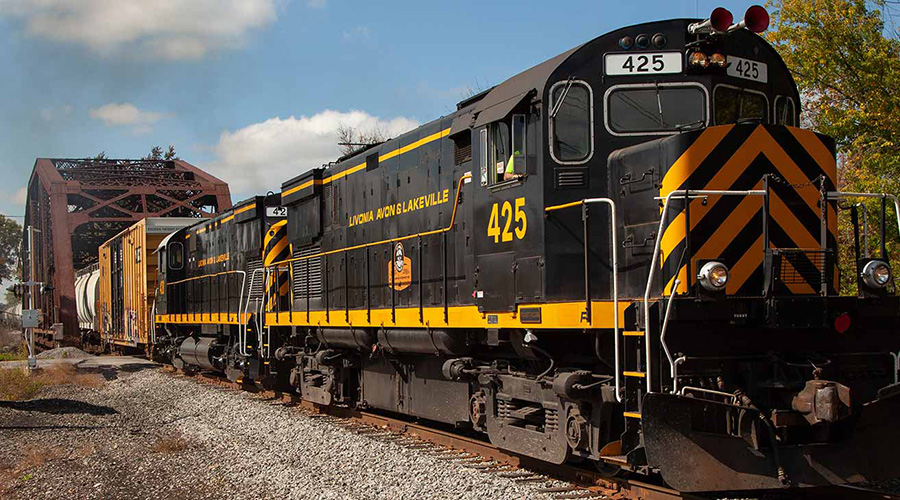 All four of Livonia, Avon and Lakeville Railroad Corp.’s short lines registered traffic gains in the quarter, led by higher movements of food products and feed grains.Livonia, Avon and Lakeville Railroad Corp.
It was an equally good quarter for Livonia, Avon and Lakeville Railroad Corp. (LAL), which owns four short lines: B&H Rail Corp., Livonia, Avon and Lakeville Railroad, Ontario Midland Railroad and Western New York & Pennsylvania Railroad.
"Volume was up on all four of our railroads in the third quarter. Food products and feed grains drove the increase," said LAL President and CEO Bob Babcock.
Regionals rate mixed success
Carloads registered by the Red River Valley & Western Railroad Co. (RRVW) climbed 26% in Q3. Strong grain volume, primarily supported by consistent domestic and export demand for corn, helped propel traffic, said RRVW President Victor Meyers.
"Grain carloads are up 17% year over year, driven by strong export demand for corn through the first three quarters of 2026," he said.
In addition, fertilizer carloads grew 12%, driven by driven by increased customer investments on the railroad, which stretches more than 500 miles in Minnesota and North Dakota. Through 2026's first three quarters, RRVW's traffic rose 7% compared with the same 2025 period.
The traffic outcome wasn't nearly as encouraging for the Alaska Railroad Corp. (ARRC). Rail-car freight volume decreased by 6.7% in Q3.
The drop primarily was caused by reduced gravel shipments and lower demand for commodities transported from Seward to Fairbanks, said AARC Corporate Communications Officer Catherine Clarke.
"Petroleum demand also declined on the Fairbanks-Anchorage corridor," she said.
For Conrail, Q3 traffic results were discouraging after a more promising Q2. The railroad logged 119,626 cars, down 1.5% from the second quarter's level.
"Results varied by district, with growth in North Jersey offset by lower activity in Detroit and a modest decline in South Jersey," said Conrail General Manager of Field Operations Joe Soto. "Overall, Q3 customer activity was slightly below Q2, with automotive-related reductions weighing on Detroit and selected terminal and liquid-bulk gains supporting North Jersey."
Car totals show 57,372 logged in North Jersey (up 4% versus Q2), 38,151 registered in South Jersey (down 1.1%) and 24,103 handled in Detroit (down 13.1%).
In terms of a broader context, total shared assets volume — including rail cars and intermodal — reached 844,145 units through September, up 1.2% compared with the same 2025 period.
"Rail-car handling increased 3.2%, while intermodal declined 8.6%, making intermodal the principal offset to year-to-date rail-car growth," said Soto.
In Q3, automotive-related traffic contributed significantly to the sequential decline, he said. Several major Detroit assembly and truck facilities handled fewer cars in the quarter than in Q2, as did a Doremus auto terminal in North Jersey.
"Performance varied by facility, however increased activity at GM’s Hamtramck location partially offset those reductions," said Soto.
Meanwhile, petroleum and liquid-bulk customer activity was mixed. Port Reading’s Shell operation and several New Jersey liquid-terminal locations increased volume from Q2, Soto said.
Short lines note positive signs
The Twin Cities & Western Railroad (TCWR) — which is a sister railroad to RRVW — had a banner quarter. Its carloads shot up 28% year over year in Q3. And through three quarters, carloads climbed 22% year over year for the short line, which operates more than 360 miles of track in Minnesota and South Dakota.
"Grain carloads were up 49% year over year, primarily driven by higher crop production from the 2025 harvest and steady export and domestic demand for corn, said Meyers, who also serves as TCWR's president. "TCWR has also set a record for the total number of soybean shuttles originated on the railroad in a calendar year."
In addition, Q3 volume increased significantly at a railroad-owned transload facility in the Twin Cities and lime rock traffic shot up 48% as a result of increased demand from agriculture product processing facilities located on TCWR, said Meyers.
 In September, the Canton Railroad marked its highest monthly carload volume in the past five years. Credit: Canton Railroad Co.Alameda Corridor Transportation Authority
For the Sierra Northern Railway, traffic bounced back in Q3 from a slow Q2. The 100-mile short line operating in central and northern California registered volume growth in nearly every sector.
Grain/cattle feed shipments picked up significantly at the end of Q3, said Sierra Northern Railway President and CEO Kennan Beard.
"Some of these increased shipments were due to more canola flowing back into the states versus to Asia," he said. "We anticipate this trend to continue through the end of 2026."
Carloads also increased in the quarter for the Canton Railroad Co. In September alone, the Baltimore short line marked its highest monthly carload volume over the past five years, said Canton Railroad President and CEO Tyler Horner.
"Chemical carloads dropped 10% from 3Q 2025 compared to 3Q 2026, while petroleum-based products increased a whopping 308.5%," he said. "Lumber increased 24.73%, metals increased 31.25%, food-related carloads dropped 14.14%, but stone, clay and aggregates traffic increased 58.8%."
For the New Orleans Public Belt Railroad, volume remained consistent in the quarter. Overall, the short line received 30,100 rail cars in Q3.
Meanwhile, Farmrail System Inc. noted that some things remained the same in Q3 while others recently increased traffic-wise. Volume in the quarter reached 1,897 carloads versus the 1,490 carloads registered in the same 2025 period.
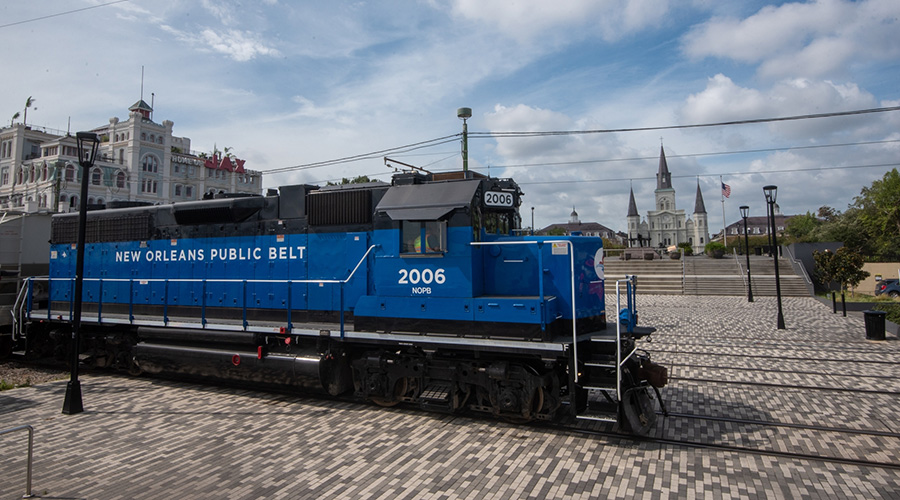 For the New Orleans Public Belt Railroad, volume remained consistent in Q3, clocking in at 30,100 rail cars.New Orleans Public Belt Railroad
Year to date through Q3, Farmrail's traffic clocked in at 5,311 carloads compared with 4,999 carloads in the same 2025 period. The company operates short lines Farmrail Corp., Grainbelt Corp. and Land Rush Rail.
On a year-over-year basis, grain traffic fell from 564 carloads to 76 carloads, primarily because of a poor wheat harvest. But aggregate traffic climbed from 288 carloads to 353 carloads and farm and food products volume rose from 139 carloads to 219 carloads.
"Chemical traffic rose a bit from 309 to 345 carloads, due to an increase in oilfield activity. Petroleum went from 13 to zero carloads," said Farmrail Assistant Commercial Manager Laci Bryant. "Frac sand went from 165 carloads up to 896 — that is the biggest jump when comparing the quarters."