With completion of channel dredging, Virginia Port Authority nears end of $1.4B capital investment program
3/4/2026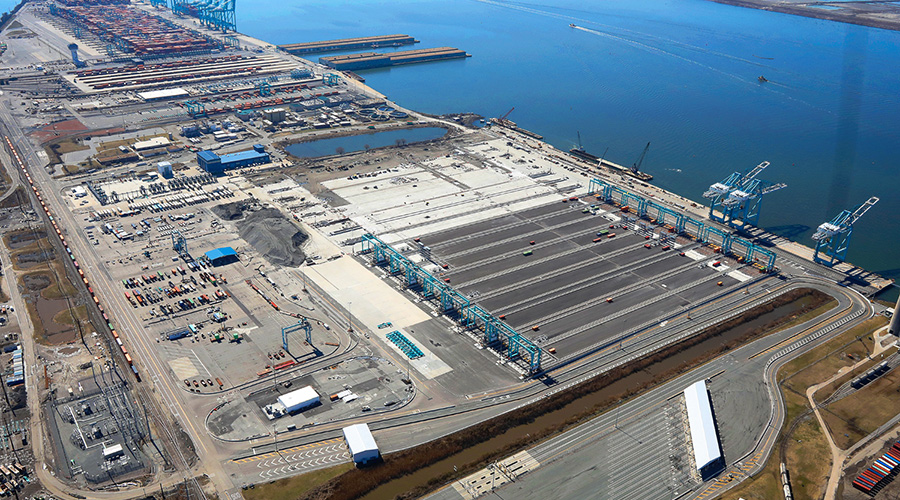
By Bridget Dean, Associate Editor
The Virginia Port Authority’s (VPA) late February completion of dredging work in Norfolk Harbor was more than just routine depth maintenance: It cleared the way for two-way traffic of fully loaded Ultra Large Container Vessels (ULCVs) and puts the authority on track to complete its $1.4 billion Gateway Investment Program (GIP) by the end of 2027.
Once final depth soundings are completed in the coming weeks to ensure accuracy, the VPA’s two container terminals — Norfolk International Terminals and the Virginia International Gateway — will be able to accommodate ULCVs weighed down to their limits with cargo, says VPA Senior Director of Media Relations Joe Harris. Virginia is now home to the deepest port on the U.S. East Coast, with the harbor reaching a depth of 55 feet, he adds.
The depth clearance will build on channel widening work completed in spring 2024 that for the first time allowed for two-way traffic of ULCVs at both container terminals. Prior to opening the “passing lane,” the U.S. Coast Guard would need to close the commercial channel for three to four hours whenever a ULCV was in transit, says Harris. The widening and deepening makes for more efficient goods movement and quicker ship turnaround.
The $450 million channel projects were a key aspect of the GIP, a multiyear capital program designed to boost the port’s capacity. With more cargo able to be moved on each ULCV, and the vessels themselves moving through the port quicker thanks to the two-way traffic, VPA had to prepare its infrastructure for the increase in container traffic ahead of the dredging, says Harris.
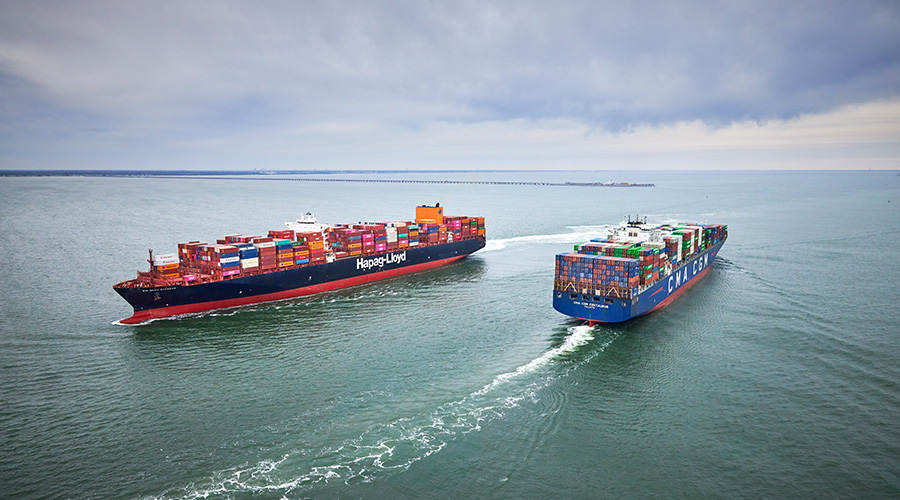 The channel dredging builds on widening work completed in 2024, which enables two-way traffic of ultra large container vessels at the port.Virginia Port Authority
“You need to have the crane capacity [and] terminal capacity to handle that faster movement of boxes on and off ships, because the ships are coming quicker,” he adds. “It’s kind of a domino effect.”
The VPA formally named the GIP in 2023; the capacity expansion work has been underway for years, says Harris. When completed in 2027, the projects will bring the port’s annual capacity to 5.8 million 20-foot-equivalent units (TEUs) and berth capacity for five ULCVs at once.
VPA has completed most of the work, including the $83 million Central Rail Yard expansion at Norfolk International Terminals that resulted in a more than 30% increase in total rail lift capacity. Work on the yard, which is served by Norfolk Southern Railway and CSX, was completed in 2024 and enables the port to process 2 million TEUs annually by rail. The VPA also spent $220 million converting the Portsmouth Marine Terminal from a container terminal into an offshore wind energy hub, among other projects designed to boost sustainability and efficiency, says Harris.
The largest undertaking, which is slated for completion by the end of 2027, calls for $650 million in improvements to Norfolk International Terminals’ north side. The work includes installing new ship-to-shore cranes and reconfiguring the container stack yard.
“Once we finish this latest round of capital projects, there will probably be a two or three-year pause, and then we’ll start up another round,” says Harris. “[We’re] always striving to be more modern, to be better, to be more efficient.”
A few years ago, the VPA branded the Port of Virginia as “America’s Most Modern Gateway” to reflect the capacity expansion efforts as well as the port’s use of technology and a common operating system between terminals.
“Our goal in building ‘America’s Most Modern Gateway’ is to always be prepared for the future,” Harris says. “That preparation is a message to the ocean carriers and the cargo owners that [they] are not going to outgrow our capabilities.”