Vena off script at IANA: Entertaining, engaging and revealing
9/18/2026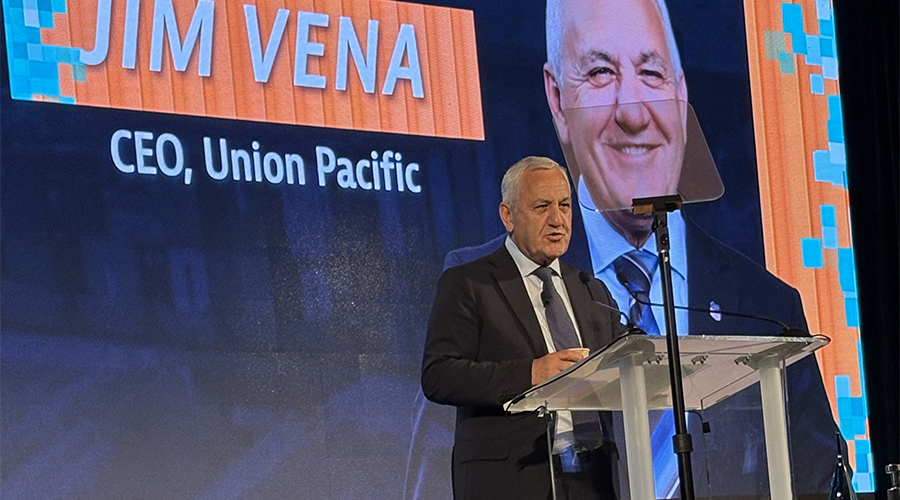
By Jeff Stagl, Managing Editor
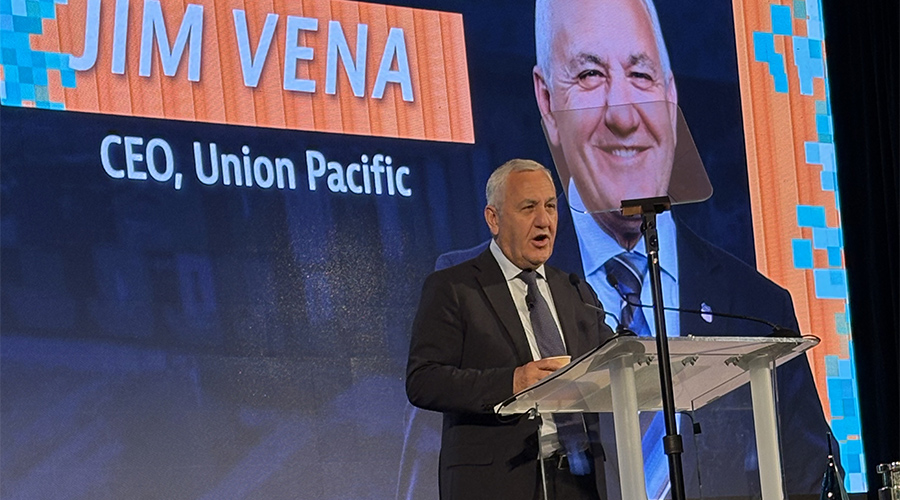
On Sept. 15, the convention center ballroom in Long Beach, California, was packed with more than 500 attendees of the Intermodal Association of North America’s Intermodal Expo who were eager to hear a keynote address from Union Pacific CEO Jim Vena.
They expected to hear him talk about the latest developments surrounding UP’s planned merger with Norfolk Southern Railway.
He didn’t disappoint — although he didn’t quite address it in the way many attendees might have anticipated. One thing that’s become apparent with Vena’s presentations of late: Expect the unexpected.
To say Vena is unscripted is a vast understatement. Here are some of the off-the-cuff things he shared during his keynote:
-
he hates lukewarm coffee like the one he was holding, to the point he said he was getting a hotter cup while a video played for the audience;
-
he was surprised to see a couple walking a pig in downtown Long Beach the night before and to watch the animal show digestive distress while relieving itself;
-
he can’t stand before an audience and talk while advancing slides as many CEOs do (it’s just not in his nature and he finds it very boring, he said);
-
he strongly (very strongly) dislikes the dissemination of misinformation; and
-
he doesn’t understand some of the comments about the UP-NS merger that pertain to future operations in certain areas because “we won’t operate everywhere,” such as some points in Florida. “That’s CSX territory,” he stressed.
Among his more predictable comments on UP-NS, Vena said that continuing to win business is getting more difficult in North America if you just “stay where you are.” Hence, the merger is critical to generating growth as a transcontinental railroad, he said, using rail operations in the continent's two other nations to underscore his point.
“In Mexico, there are two major railroads, and they are good. They can move across the country and not have to hand off [traffic],” Vena said. “In Canada, CN and CPKC can move from one end of the country to the other and not hand off. What we need in the U.S. is a change in paradigm.”
The merged railroad will simply serve as a new option for shippers. There will be no strong-arming or rate magic to coerce any shippers to use the transcontinental railroad, Vena said.
 The merger obviously would result in some job cuts, mostly at the non-unionized management level, said Vena. Every union job would be protected and guaranteed.Jeff Stagl
“You don’t have to use it. Stay with what you want,” he stressed. “We’re not offering something more expensive. A single line is always less expensive than two railroads handling something. And especially if you have two railroads and a short line, it gets expensive compared to a single line.”
But perhaps shippers should have all the facts before making a modal decision. Vena said he’s tired of hearing how UP-NS will control 50% of the rail market share in North America if the merger is approved, alluding to BNSF Railway President and CEO Katie Farmer making that exact comment while speaking before him.
Vena then displayed a slide showing UP-NS would control 40% of North American rail market share (per gross ton-miles) compared with BNSF at 38%, CSX at 13%, CPKC at 5% and CN at 4%.
“BNSF is bigger than us now. They move more volume than we do,” Vena said. “I’m not that good with math. But I know when some figures don’t make sense. Where did these people go to college? They must not have been good ones.”
During the question-and-answer portion of his keynote, Vena said the merger obviously would result in some job cuts, mostly at the non-unionized management level. Every union job would be protected and guaranteed, he said.
“You only need one CEO. One of us is not going to get the job. Mark [George] knows it. There’s only going to be one CFO,” Vena said. “Now, we are looking for the best talent within the two companies. And I’ve met with a lot of people because there’s a lot of really smart people at Norfolk Southern.”
In an effort to give the proposed merger more of a local angle, Vena said the ports in Long Beach and Los Angeles would benefit from UP-NS, saving about a day of transit time for cargo moving from southern California to eastern destinations. A lane from southern California to the Northeast would be 232 miles shorter, he said.
“That 232 miles is huge. That would give us a day advantage to anybody else,” Vena said.
He also addressed UP’s intermodal business during his keynote. That traffic segment is a huge growth driver for UP, Vena said.
“It accounts for 50% of our total business, so intermodal is very important to us,” he said.
Since 2021, UP has boosted annual intermodal lifts at all its terminals by 1.2 million lifts. And since 2022, intermodal train size has increased by 8%, intermodal car velocity has risen by 19% and the intermodal service performance index has improved by 20 points.
Stronger operational performance, recently created strategic buffers of workers, equipment and other resources that can respond as market demand dictates, and robust intermodal investments have helped drive improvements in those metrics, Vena said.
Since 2021, the Class I has allocated $1.2 billion for intermodal investments, with an additional $100 million pegged for 2026 alone.
“This is who we are at Union Pacific — we have the highest customer service levels of anybody in the industry, and we are the safest railroad,” Vena said.