CN's new Zanardi Rapids bridge will buttress growth at Prince Rupert port
8/20/2025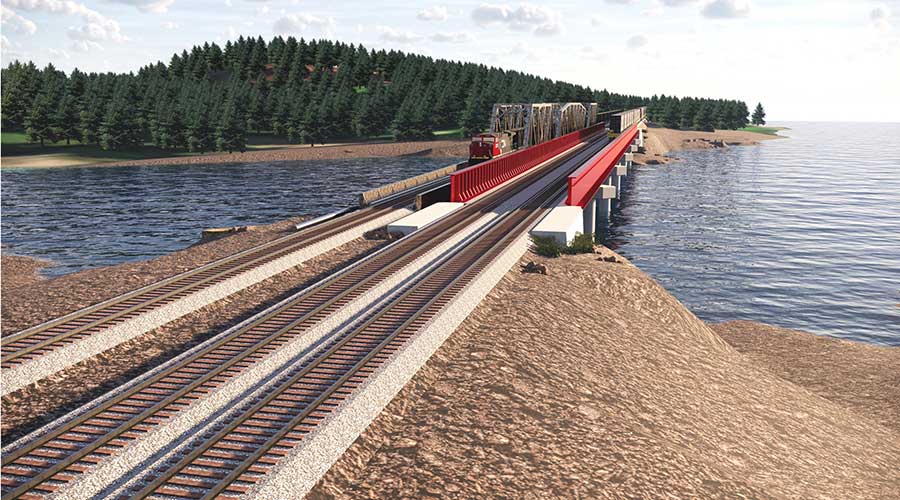
By Jeff Stagl, Managing Editor
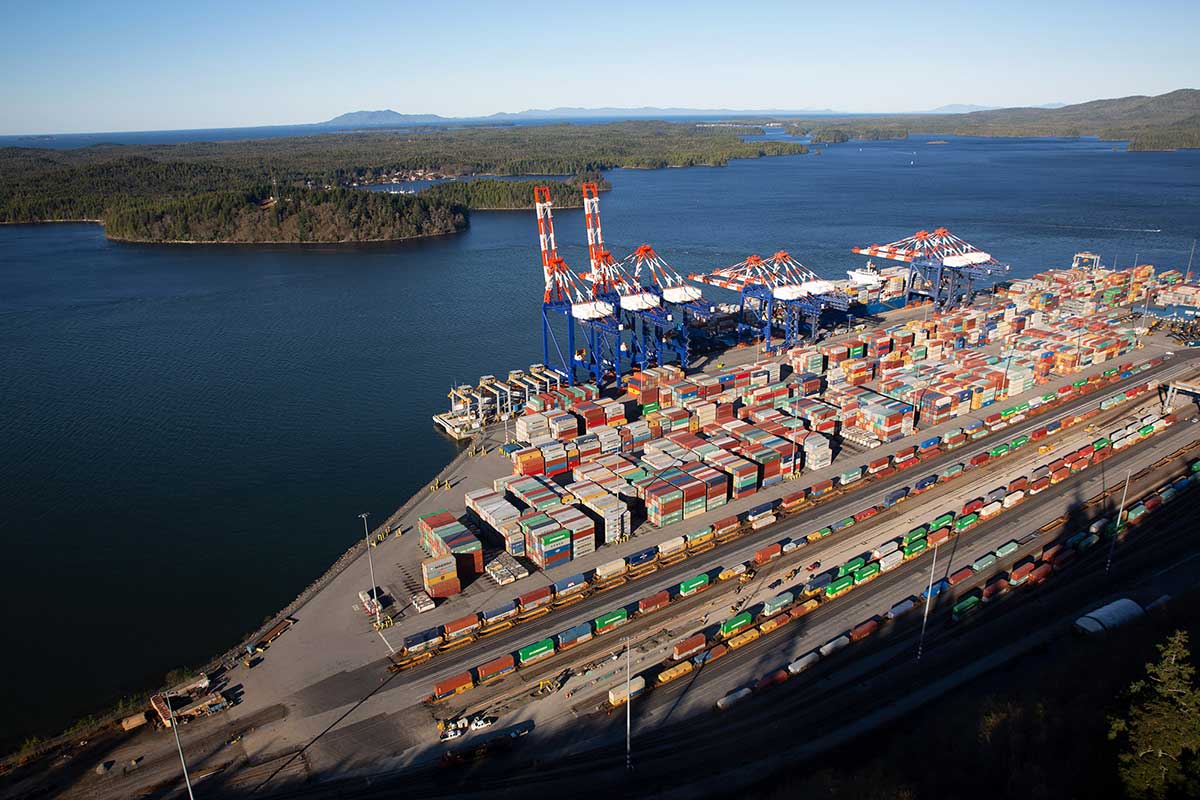
The Port of Prince Rupert in British Columbia, Canada, is one of North America’s fastest growing and most efficient cargo gateways.
The port is 500 nautical miles closer to Asia than any other West Coast port and is Canada’s third-busiest port as measured by container volume, trailing only those in Montreal and Vancouver. Governed by the Prince Rupert Port Authority, it covers more than 1.6 million acres and controls 12 miles of waterfront.
The port also is a key gateway and traffic generator for CN, which provides the rail connection between Prince Rupert and a number of major North American consumer and manufacturing markets. Since global trade volumes continue to rise, the Class I is carrying out several major infrastructure projects to strengthen supply-chain resiliency and boost rail capacity for the port.
One of those projects is a new Zanardi Rapids Bridge. The structure — built in 1910 between the Ridley and Watson islands — serves as the entrance to the port and city of Prince Rupert. Lately, bottlenecks that form regularly at the old bridge are impacting rail capacity, CN officials say.
Earlier in the second quarter, the railroad began constructing a new 1,600-foot, double-track bridge. The current single-track bridge will be fully restored and remain fully operational once the new bridge enters service in the first part of 2027, said CN spokesperson Ashley Michnowski in an email.
“There will be two tracks on the new bridge and the bridge itself will be made up of six double-track, steel thru-plate girder spans,” she said.
The bridge is located at the last mile to the entrance of Ridley Island, essentially serving as the lead to terminals on the island. Operations are at yard speeds, with frequent stops to build trains, said Michnowski.
“The new bridge will also add new long leads to Prince Rupert Grain and Trigon Terminals at the entrance to Ridley Island, and [accommodate] future terminal growth on Ridley Island,” she said.
Since bridge construction will be ongoing for more than a year, one of the challenges that needs to be overcome is the significant tidal flow at the Zanardi Rapids. Flows reaching 26 feet occur twice a day, requiring the construction of a temporary work bridge since barge access isn’t a viable construction alternative, said Michnowski.
“There is also a shallow sloping bedrock present, which requires the foundations to consist of steel caissons that need to be socketed into the bedrock by upwards of 20 feet,” she said.

The existing bridge can accommodate up to 24 trains per day, which is problematic since cargo demand is expected to grow within the next decade. The new bridge is designed to handle more than 50 trains per day.
“But further capacity improvements in the port and track leading up to the bridge would be required to meet this capacity,” said Michnowski.
That’s why CN is playing a role in the development of CANXPORT, a bulk transload and breakbulk facility on Ridley Island that will feature an off-dock container yard; the Ridley Island Energy Export Facility, a bulk liquids and liquified petroleum gas terminal; a new import container transload facility at the port; and a Trigon Terminal berth expansion.
The projects will help support and enhance the Fairview Container Terminal to ensure the port is aligned for growth, efficiency and global competitiveness, CN officials say. The Fairview terminal is a dedicated intermodal facility at the port that’s operated by DP World.
Fortifying the port for growth is a key objective of the new Zanardi Rapids Bridge, a project that’s expected to reach full completion and operation before the end of 2027. The new structure will not only expand capacity but also “future-proof” the entire port corridor for decades to come, CN officials say.
“The Zanardi Rapids Bridge is more than a piece of infrastructure — it’s a strategic enabler of long-term growth, directly supporting CN’s commitment to creating the most efficient, resilient and sustainable supply chain in North America,” they said in an online post.