BNSF's Farmer talks up short lines, talks down merger at ASLRRA event
4/17/2026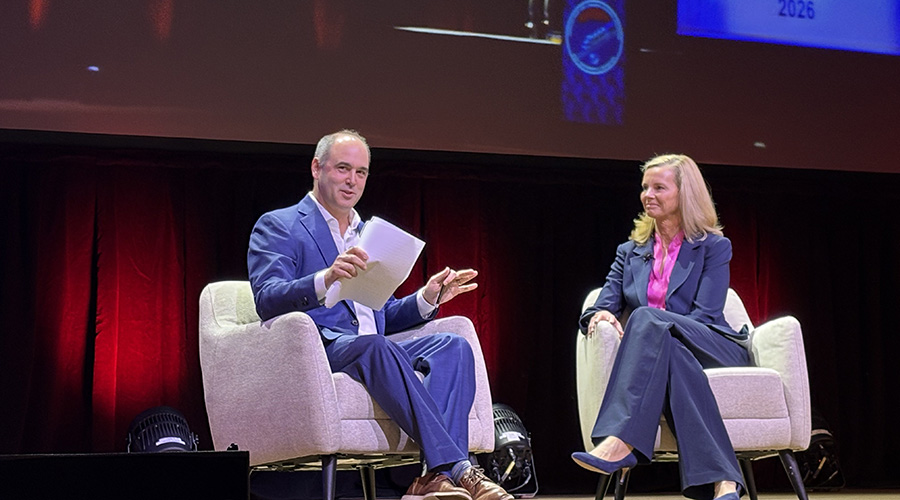
By Jeff Stagl, Managing Editor
Katie Farmer had a lot of things to share during her keynote address April 13 at the American Short Line and Regional Railroad Association’s (ASLRRA) annual conference in Minneapolis. BNSF Railway’s president and CEO was able to touch on quite a variety of topics because it wasn’t a really a keynote at all — she was part of a “fireside chat” type question-and-answer presentation moderated by ASLRRA President Chuck Baker.
While introducing Farmer, Baker expressed his excitement about her appearance because she typically is very insightful and articulate even though she doesn’t use a script, notes or teleprompter, he said.
Farmer began by addressing Baker’s question about how short lines figure into BNSF’s business and growth. One-third of the Class I’s annual carloads are moved with short lines, which help extend BNSF’s network reach, she said.
“Short lines allow us to do more in a collaborative way. We get to say ‘yes’ to customers we might not otherwise have said that to,” said Farmer.
Short lines could help the Class I seize business opportunities in emerging or growing markets, such as data centers and renewable fuels.
“It’s about customizing solutions,” she said.
BNSF employs a first mile/last mile team that collaborates with short lines to tailor services for shippers. The Class I also created a Shortline Select program in fall 2024 to combine the benefits of short lines’ customized service with BNSF’s vast network reach. But currently only about 5% of the 200 or so short lines that the Class I connects with are in the program.
“We want to keep adding more,” Farmer said.
Adding more — as in capacity, infrastructure and customers — is also a goal for the Class I when it comes to capital investments. BNSF has budgeted $3.6 billion for capital expenditures in 2026, down slightly from the $3.8 billion budgeted in 2025 but still a robust spending plan, said Farmer.
BNSF has led the industry in capital investments for as long as she can remember, she stressed.
“We aren't scaling back. We are still investing in the property," Farmer said. "We have investments that facilitate a better customer experience.”
This year’s capex includes funds for major track expansions at yards in Galesburg, Illinois, and Winslow, Arizona, and to continue efforts to double, triple and quadruple track along the Transcon route between Los Angeles and Chicago.
BNSF also aims to continue developing the planned Barstow International Gateway project, a planned 4,500-acre integrated rail facility in southern California.
“We have begun the permitting process for it,” Farmer said.
 A merger concern for short lines: There will be fewer interchange points since UP-NS would be a single-line transcontinental railroad making less stops, Farmer said.Jeff Stagl
Given the unprecedented difficult times around the globe, from the war in the Middle East to mounting tariffs to rising inflation, now is the time to be as flexible and agile as possible to roll with the punches, she believes.
“We try to control what we can control,” Farmer said.
One thing that falls into that category is safety. Through efforts to stress safety throughout the organization, the Class I has reduced accidents from 6,000 in pre-BNSF 1980 (involving the Burlington Northern Railroad and Atchison, Topeka and Santa Fe Railway) to 250 in 2025.
“We are on pace for 200 this year. That is still too many, but we are making progress,” Farmer said.
Merger still top of mind
What BNSF doesn’t have control over was a major discussion point during the fireside chat: the planned Union Pacific Railroad-Norfolk Southern Railway merger. It’s been made clear of late that BNSF is opposed to that combination, but short lines should form their opinion on it, Farmer said.
One thing she believes they should consider is that there will be fewer interchange points since UP-NS would be a single-line transcontinental railroad making fewer stops.
“There will be a significant reduction in flexibility and optionality. They want to optimize their large network but optimizing it won’t be good for customers or short lines,” Farmer said. “Short lines have felt the effects of mergers in the past, and disproportionately so.”
UP and NS expect to grow traffic 12% in the first three years as a combined entity, but Farmer is skeptical about that goal. Local service could get lost in the mix, she believes.
While the Surface Transportation Board eventually will scrutinize the merger according to the new merger rules developed in 2001 — which are 25 years old and not “new” in any sense — the combination really should be judged on a higher standard as to whether it meets the public interest and enhances competition, Farmer said.
For example, when Canadian Pacific and Kansas City Southern combined as CPKC a few years ago, BNSF lost 10,000 carloads per month in the Laredo gateway near the U.S./Mexico border.
“It went from 10,000 a month to zero. Customers lost another option,” Farmer said. “So, when it comes to this merger, judge for yourself.”